
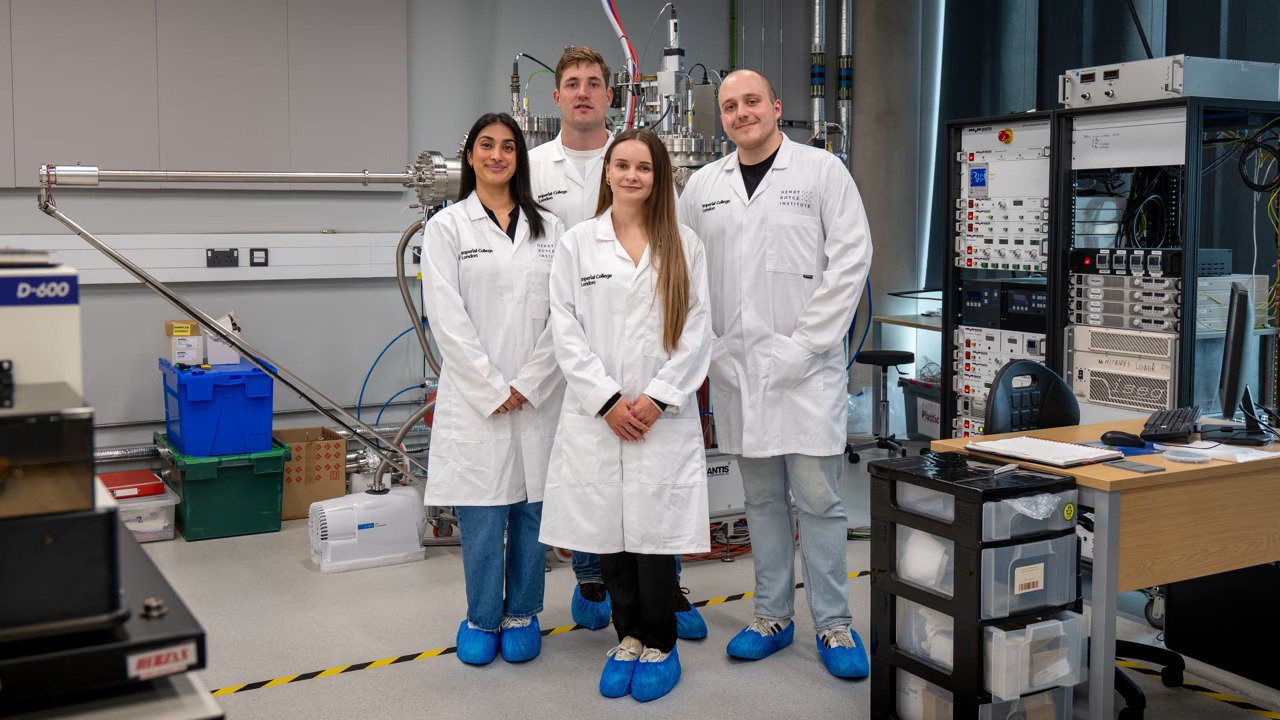
UK-based materials innovation startup Mater-AI has raised £1.5 million.
Over 70 per cent of global energy, worth over $152 billion annually, is lost as waste heat, from data centres to heavy industry.
Yet the last major breakthrough in thermoelectric materials happened in the 1950s with bismuth telluride, the semiconductor used in everyday technologies like heated car seats and portable coolers.
Mater-AI has developed a new platform for the discovery of more efficient thermoelectric materials that can turn heat into electricity or provide cooling without refrigerants. It combines AI and physics-based modelling to accelerate design from decades to weeks – up to 438× faster than traditional R&D – optimising for properties like thermal and electrical conductivity to achieve higher efficiency, lower cost and scalability.
Founded by Dr Nickel Blankevoort (CEO), Gatleen Bhambra (COO) and Chelsea Williams (CTO), Mater-AI builds on research conducted by Dr Blankevoort at the University of Warwick in theoretical modelling of quantum nanoelectronics and thermoelectrics.
During his PhD, he discovered three new material structures in a year through traditional methods. Mater-AI's platform now generates and evaluates 100 structures every hour.
I spoke to Bhambra and discovered the genesis of Mater-AI, how the startup was able to carve out a niche, and significantly achieved repeat funding at an extraordinarily rapid pace in their startup journey.
From Gen AI to material science
Bhambra was previously working as a product designer at Jacquard, a GenAI LLM based martech company. It was just after ChatGPT came out, and she knew AI would fundamentally reshape everything.
“I’d always wanted to build a company, but I didn’t come from a background where entrepreneurship felt obvious. You don’t know where to start — it just feels like an abyss,” she admits. Bhambra turned to the Y Combinator matching platform — which she describes as “basically like dating for founders.” After a year of conversations, she met Chelsea, now Mater-AI’s CTO, who holds a PhD in machine learning and quantum computing.
Their skills aligned: Bhambra brought product, commercial, and operational experience, while Chelsea had deep technical expertise. The pair went through Conception X’s Deep Tech Accelerator and the Barclays Product Builder Accelerator, exploring what kind of meaningful, commercially viable, defensible problem they could tackle. Bhambra admits that materials science wasn’t initially on their radar.
“One of our Conception X mentors asked if we’d thought about material science — essentially applying the principles of AI-driven drug discovery to materials discovery.
But we immediately saw the need.”
Recognising their own limits, they again turned to YC’s platform in search of a domain expert. That’s where Chelsea met Nickel — now Mater-AI’s CEO and third co-founder — who holds a PhD in computational materials science with a focus on quantum electronics and thermoelectrics.
“After one call, Chelsea told me, ‘You have to meet him — this is our idea.’” And with that, Bhambra says, the founding team clicked into place. “And that was it. We’d found the founding team.”
What thermoelectric materials actually do
I asked Bhambra to explain the functionality of thermoelectrics for readers unfamiliar with the field.
She shared:
“Thermoelectrics convert heat into electricity. They’re plug-and-play devices with no moving parts — extremely durable and maintenance-free.
For example, A 40mm x 40mm thermoelectric module under a heated car seat can either cool the seat or generate electricity from heat.”
But the real opportunity lies in industrial and energy systems where enormous amounts of heat are currently wasted. Thermoelectric devices can be deployed to recover that energy, extend component lifetimes, or provide precise thermal control — all without moving parts or complex maintenance. Today, applications span a wide range of sectors:
- Data centres: cooling GPUs, CPUs, and servers; reducing heat-related throttling.
- IoT and remote sensors: replacing batteries when only ~1 watt of output is needed.
- Automotive and defence: powering remote sensors, managing heated seats, extending battery life.
- Energy and heavy industry: improving efficiency across grids, transformers, EV batteries, and industrial machinery.
- Turning wasted heat into usable energy is no longer optional — it’s increasingly essential.
“Make heat useful again”
Because thermoelectric modules scale easily — from tiny chips to surface-level arrays — they offer a flexible pathway to energy recovery and thermal management across both consumer electronics and large-scale infrastructure.
The company is initially targeting thermoelectric generators for defence, automotive and industrial IoT applications, where improved performance could unlock £3.4 to 4.6 billion in new market value.
The technology could enable silent, solid-state power sources for next-generation defence systems, extend battery lifetimes, and enable self-powered industrial sensors for continuous monitoring of machinery and remote infrastructure.
Bhambra shared:
“Our mission is simple: make heat useful again. We want to build a world where every car, data centre, battery, and industrial system reuses its own heat — turning waste energy into recovered energy.
Imagine data centres generating their own power from waste heat, electric vehicles that travel further by recapturing their thermal energy, and infrastructure that never needs batteries.
Our platform finds new materials in weeks instead of years, bringing us closer to a world with a fundamentally different energy architecture – where everything powers itself.”
This provides a significant competitive opportunity for the startup.
Mater-AI’s modular discovery engine gives it an edge
A lot is happening in AI-materials discovery, but according to Bhambra, very few companies focus on novel thermoelectric materials specifically. Instead, big players are tackling huge categories — silicon, carbon capture — which requires hundreds of millions and massive teams.
Conversely, smaller companies are focused narrowly on things like magnets.
“Our advantage is that our engine is modular: we focus on thermoelectrics today, but the architecture can be adapted for future material classes."
Secondly, Bhambra asserts that because today’s thermoelectric materials are so inefficient, “if we can double efficiency, we essentially halve the price of energy recovery. Incumbents won’t be able to compete unless they come to us.”
Why investors backed Mater-AI before the tech existed
Mater-AI is unique in that it raised £1.5 million very early. Bhambra attributes its success to Conception X, a UK-based not-for-profit that runs the largest cross-university deeptech venture programme for PhD students across Europe.
Check out our earlier interview with Conception X’s CEO, Riam Kanso.
Bhambra asserts that Conception X helped the team realise that this could genuinely be a company:
“We shaped the pitch, understood the opportunity, and raised our first £100k from Conception X’s venture partner on the programme. They also joined our main round.”
The team pitched very early with an idea and a deck, not traction, but the Venture firm understood the problem.
“They operate one of Europe’s largest GPU clusters,” explained Bhambra.
"Data centres lose around 97 per cent of their energy as waste heat. The economic impact is enormous. The data centres told us, 'If you can save even 1 per cent of wasted energy, that’s huge.'
That early conviction allowed us to build the tech the team has today."
That said, Bhambra admits that, for its Pre-Seed round, validation mattered far more than it did in our first £100k.
“Investors wanted evidence. We built faster than anyone expected. We thought it would take two years to build the discovery engine. We did it in six months with a team of four, after hiring our founding AI scientist, Dr Jack Broad.
During due diligence, one of the toughest reviewers was Dr. Edward Grant (co-founded Rahko, acquired by Odyssey Therapeutics). He tried every way to rigorously stress-test the models: hallucination tests, edge cases, and ways to force errors. Mater-AI exceeded expectations, and he later joined as its AI advisor.
“We also spoke directly to global leaders in energy, power electronics, and data centres — and they told us what they’d pay for and what pilot numbers would look like. That industry pull made a big difference,” shared Bhambra.
The underrated power of non/less-technical founders in deeptech
My experience as a journalist is that the best teams are a combination of highly technical folks and communicators. A lot of startups assume that the media prioritises the technical CEO, but plenty of people have a lot to say, from those close to the customers to communicators. After all, you can have the best PhD-level innovation in the world, but if you can’t articulate why it matters, it won’t get funded.
Bhambra has a product, commercial and operational background, so she’s used to working with engineers but admits, "I’m not technical — I can’t code. Honestly, that’s been an asset." Instead, she asserts that every deep tech company needs a translator — someone who can turn complex science into clarity for customers, journalists, partners, and investors.
“I manage all stakeholder relationships, pitch decks, commercial strategy, and communication. A lot of technical founders underestimate how crucial that bridge role is,” Bhambra shared.
She has a message for prospective non-technical founders:
“Don’t count yourself out of deep tech. You might be the missing piece.”
Twin Path Ventures led the funding with participation from Mishcon de Reya, One Planet Capital, XTX Ventures, the Conception X Angel Syndicate, Koro Capital and Tailored Solutions.
"Mater-AI is addressing a fundamental bottleneck in the energy transition: the discovery of next-generation thermoelectric materials. Their AI discovery engine has the potential to unlock entirely new applications, such as harvesting 'waste' heat in extreme environments, like powering sensors, vehicles, and defence infrastructure. We believe this is a truly foundational technology that will accelerate the path to a sustainable and efficient energy future." Nick Slater, Partner at Twin Path Ventures.
"Mater-AI has turned decades-old limitations in materials discovery into an opportunity for systems-level change. We're entering an era where the materials we build with are no longer determined by what we stumbled upon in the last century, but by what we can computationally design for the world we need. That future is closer than most people realise, and this team is building it." Riam Kanso, Conception X Angel Syndicate Lead.
Mater-AI’s 18-month path to commercial thermoelectric breakthrough
Over the next six to eight weeks, the team will begin laboratory testing of its first AI-discovered thermoelectric materials in collaboration with the University of Cambridge, Imperial College London, and the Henry Royce Institute. “That takes us from TRL (tech readiness level) 4 to TRL 5 for the first time,” Bhambra says.
From there, Mater-AI will embark on a fast cycle between experimentation and computation. Lab results will feed directly back into the company’s physics-based AI models, sharpening predictions and accelerating the search for a commercially viable material.
Then over the next 12 to 18 months, the company will iterate quickly between lab results and our AI model to refine predictions.
“The goal is a commercially viable material with higher efficiency and lower toxicity,” explained Bhambra.
Ultimately, the aim is to achieve a new class of thermoelectric material that not only outperforms today’s 5 to 7 per cent efficient gold standard but is also less toxic, cost-effective, and scalable to manufacture. Once a leading candidate is validated, Mater-AI will move toward device-level prototyping, embedding its materials into thermoelectric modules for the first time. Because industrial timelines are long — often 15 to 24 months — the company is already nurturing relationships with major players worldwide.
Together, these milestones set Mater-AI on a clear trajectory to real-world deployments.
Lead image: Photo: Ruffled Media.


Would you like to write the first comment?
Login to post comments