

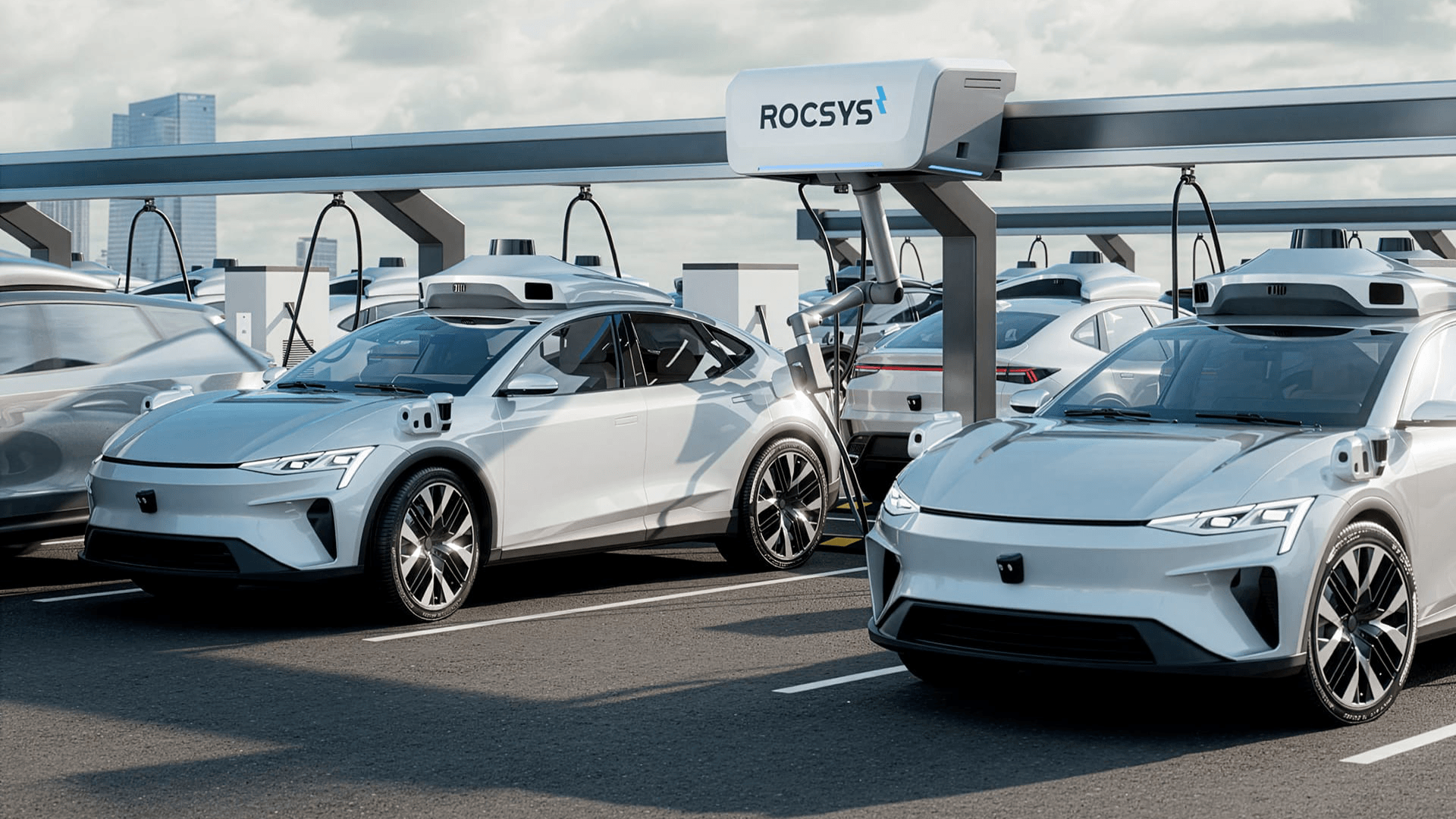
Hands-free EV charging company Rocsys has introduced the Rocsys M1, a hands-free charging solution designed specifically for robotaxi depot operations. The system is positioned as the first system capable of serving multiple bays simultaneously in robotaxi environments. As part of a broader autonomous depot platform, the M1 is currently in pilot deployment, with large-scale rollout planned for 2027.
To support its growth strategy, Rocsys also secured a $13 million Series A extension led by Capricorn Partners, with participation from Scania Invest, Forward.One, SEB Greentech Venture Capital and Graduate Ventures. This brings the company’s total funding to $56 million to date.
The launch comes amid accelerating demand for autonomous mobility. The global robotaxi market is projected to reach $45.7 billion by 2030, increasing fleet utilisation and placing growing pressure on depot infrastructure. Manual charging, repeated thousands of times daily, has emerged as a key operational bottleneck, introducing cost, inefficiencies and safety risks that limit scalability.
Rocsys aims to address this challenge by automating charging processes, improving fleet uptime and overall productivity.
Technically, the Rocsys M1 features a modular, multi-bay architecture capable of serving up to 10 charging bays with a single system. Flexible mounting options, including overhead, ground and roof configurations, allow integration into a wide range of depot layouts while preserving space for parallel operations. In a 50-bay depot, Rocsys estimates the system can boost operational efficiency by up to 75 per cent and deliver up to $1.7 million in annual savings.
Built on more than six years of real-world operational data, the system is designed to perform reliably across varying lighting, weather and vehicle positioning. Combining AI-driven computer vision with motion intelligence, the M1 achieves a plug-in success rate of over 99.9 per cent and is fully interoperable across EVs, chargers and connector types, enabling deployment without costly retrofitting or vendor lock-in.
As part of the broader Rocsys platform, the M1 integrates hardware, software and services into a connected ecosystem. This includes operational monitoring through the Rocsys Portal, API integrations with customer systems and remote support services, ensuring vehicles remain charged and ready without manual intervention.
Crijn Bouman, CEO and co-founder of Rocsys, said the system addresses a critical gap in autonomous mobility infrastructure:
Autonomous vehicles are growing rapidly, and infrastructure must keep pace. Without hands-free operations, autonomy stops at the depot. Based on a platform designed to extend beyond charging to automated interior cleaning and inspection, the Rocsys M1 introduces smart charging infrastructure for continuous, real-world use at scale, validated by signing a major robotaxi deal. It enables operators to run mixed fleets autonomously, reliably and without interruption. This is the missing link for robotaxi operators to move from pilots to global deployment.
The newly raised capital will support the company’s next phase of growth, focusing on scaling both its technology platform and market presence. Rocsys plans to accelerate development and deployment of the M1, expand pilot programs into full commercial rollouts, and strengthen operations across North America and Europe.
Investment will also go toward advancing its AI-driven software, expanding its service ecosystem, and supporting integrations with fleet operators and infrastructure partners.


Would you like to write the first comment?
Login to post comments