


Startup founder Egor Dubrovsky told me that he won't trim his beard until Filmustage's monthly recurring revenue triples. Today it's more than 15 centimetres long.
Ironically, beards have also become a useful way of explaining what his company actually does.
During development, Filmustage analysed a screenplay and flagged a character's beard as an important production element. Someone questioned why facial hair mattered. For Dubrovsky, the answer captured the difference between generative AI and production AI: if an actor shaves between shooting days, makeup, continuity and scheduling all need to know.
A simple beard can be critical to getting a film made.
When AI became Hollywood's biggest controversy
From May to September 2023, the Writers Guild of America (WGA), representing 11,500 screenwriters, held a 148-day strike against the Alliance of Motion Picture and Television Producers. One of the key issues was the use of AI in scriptwriting and rewrites. The resulting agreement introduced landmark protections. AI cannot receive writing credit, and AI-generated material cannot be treated as source material in ways that diminish a writer's authorship, credit or compensation.
Writers may use AI tools voluntarily, but studios cannot require them to do so. They must disclose when material provided to writers has been generated or incorporates AI-generated content. The agreement also preserves the WGA's right to challenge the use of writers' work to train AI models under existing contracts or copyright law.
As Hollywood debated where AI belonged in the creative process, another group of startups was taking a different approach. Rather than trying to replace writers, Belarusian-founded Filmustage applies AI to one of filmmaking's least glamorous tasks: pre-production.
Its origins, however, were anything but planned.
A stolen passport sparked a startup
Filmustage was co-founded by Egor Dubrovsky, Ruslan Khamidullin, and Andrei Karalkou, who are originally from Belarus. Dubrovsky’s background combines both the film and tech industries. Before Filmustage, he built websites, online shops and other digital products, while also working in film production for companies including Uber, the United Nations and TikTok.
The idea for Filmustage came after he visited Los Angeles several years ago to help a friend on a film production. During this time, the worst happened — someone stole his backpack containing his passport and documents.
“I ended up staying in the US for about six months while I waited for replacement documents and worked on productions for companies including Netflix and Amazon,” he explained.
That experience exposed him to a major problem across the industry. At the time, people in film production relied on spreadsheets, paper, pens and manual processes for almost everything. He realised this was a problem worth solving.
Taking the pain out of pre-production
Filmustage is intentionally focused on pre-production, where filmmakers spend an enormous amount of time on repetitive manual work.
“They have separate spreadsheets for budgeting, scheduling and script analysis, and then another spreadsheet that combines all of those together,” shared Dubrovsky.
He often compares it to building a house.
“Before you build anything, you have to create the plans, hire the team, organise the equipment and prepare everything. Film production works the same way.”
Before filming begins, production teams have to coordinate actors' schedules, locations, props, permits and hundreds of other details. They also need to identify potential risks. For example, a scene may require animals, children or special safety conditions. All of this traditionally takes weeks.
“This is exactly the kind of work where AI is most valuable because it's about analysing information rather than replacing creativity,” contends Dubrovsky.
Reimagining film pre-production
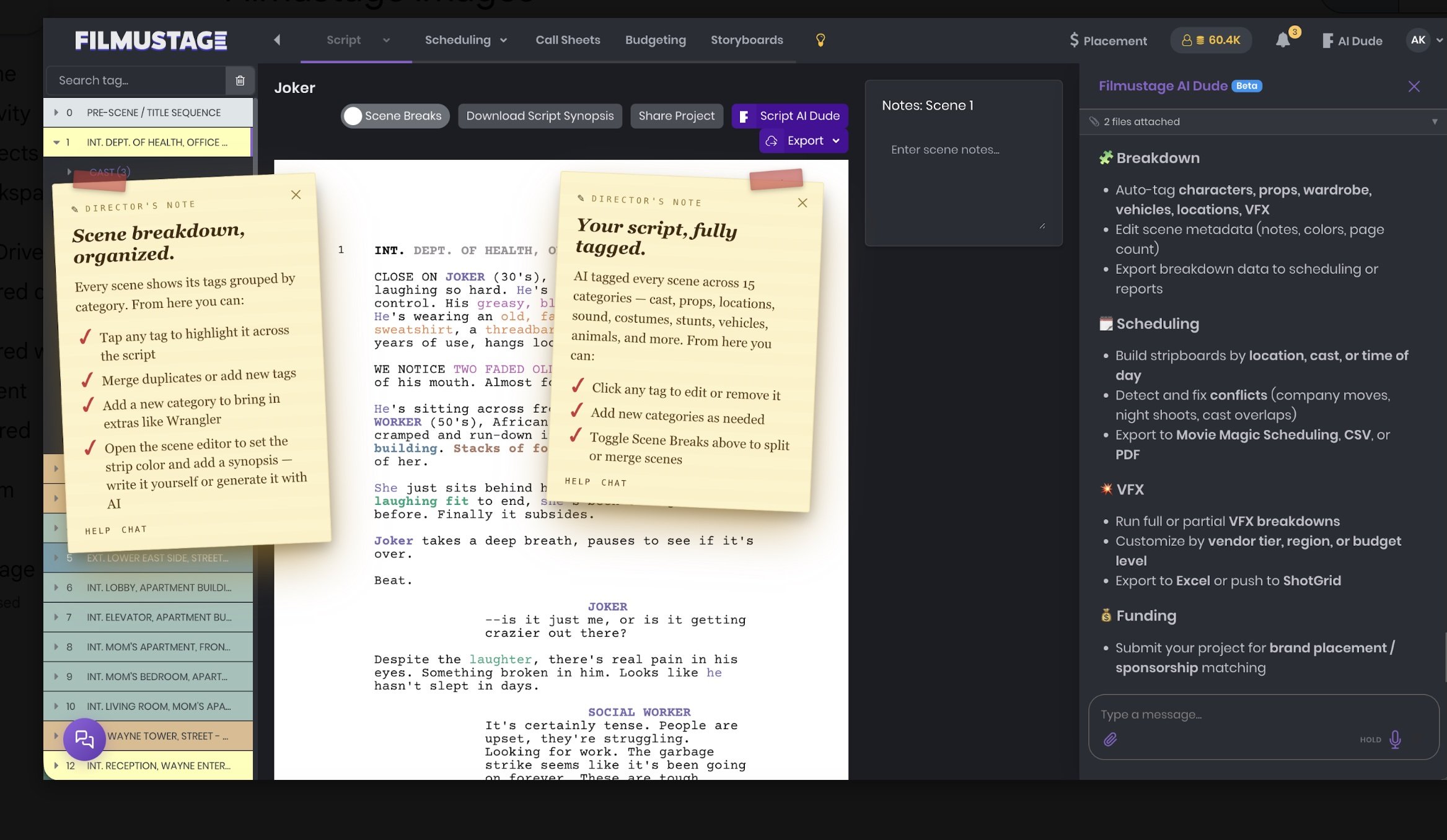
Filmustage automates many of the time-consuming tasks involved in taking a screenplay from script to shoot.
After a script is uploaded, Filmustage automatically generates a detailed script breakdown, identifying characters, locations, props, costumes, vehicles, VFX requirements and other production elements.
It then creates shooting schedules with stripboards, Day Out of Days (DOOD) reports and conflict detection, while AI-assisted budgeting tools generate draft production budgets with cost estimates. Additional features include call sheet generation, storyboard creation, VFX breakdowns, project collaboration and exports to industry-standard software including Final Draft, Movie Magic Scheduling and Movie Magic Budgeting.
It also creates optimised shooting schedules with stripboards, Day Out of Days (DOOD) reports and conflict detection, while AI-assisted budgeting tools generate draft production budgets with cost estimates.
Helping crews, not replacing them
Given Hollywood's concerns over AI replacing creative workers, I asked whether Filmustage had eliminated pre-production jobs.
Dubrovsky asserts that this has not been the case:
“Every technological advance has changed how people work rather than removing the need for skilled professionals. Editing software didn't replace film editors.
Digital cameras didn't replace cinematographers. CGI didn't eliminate visual effects artists. Our platform helps people complete repetitive work much faster, but humans still make the final decisions. AI supports professionals—it doesn't replace them.”
Protecting scripts in the AI era
Intellectual property is a major concern in film production. To protect customers' scripts and other sensitive material, Filmustage does not use customer scripts to train its AI models and has agreements with AI providers including OpenAI and Google that prevent customer data from being used for model training.
Dubrovsky explained:
“We understand how sensitive scripts are. If a script leaks before release, it can jeopardise an entire production. Some television series even produce multiple fake versions of scripts so that only the real version is revealed on set. Security is therefore a major priority for us.
We comply with industry security standards, including the Entertainment Partners Network requirements and SOC 2 certification. Our infrastructure is protected at both the cloud and device level, allowing us to meet the security requirements of major studios.”
From Star Wars to AI-powered pre-production
Filmustage’s tools are already used by over 34,000 students and independent filmmakers, as well as established producers like Steve Clark-Hall.
Roger Christian, the Academy Award-winning set decorator behind the original Star Wars films, is one of Filmustage's users. Best known for creating many of the franchise's most iconic props, including the lightsabers and droids, he is now using the platform to help prepare his documentary about Star Wars.
He uses generative AI to visualise ideas, create pitch decks and develop concepts that would otherwise take much longer to communicate.
French cinematographer and director Franck Onouviet, who works across fiction, documentary and television productions in Gabon and France, uses the platform to automatically break down scripts before reviewing them manually, calling it a "second brain" that helps identify production elements he might otherwise overlook.
According to Onouviet, script breakdown and production planning account for more than 80 per cent of his use of the platform, enabling him to prepare shoots with a small crew, generate schedules and call sheets more efficiently, and hire additional team members only when needed.
Giving smaller productions studio-grade tools
Filmustage is also designed to make professional pre-production tools accessible to smaller teams. According to Dubrovsky, “pre-production can account for around 20 per cent of a film's overall budget. Smaller productions often don't have the resources to hire large production teams or experienced specialists."
AI helps level the playing field. Smaller teams can generate professional production documents, follow industry-standard workflows and learn best practices without needing large budgets.
Filmustage also works with film schools across the US, offering educational discounts for students and free access for professors. Independent filmmakers receive free collaboration tools, reflecting the company's goal of making professional production workflows more widely accessible.
Dubrovsky predicts that the film industry will change significantly in the next few years as AI lowers the barriers to filmmaking, allowing more creators to bring their ideas to life.
“Many talented filmmakers have great stories but lack the resources to develop them. Generative AI can help them visualise projects before production begins. It can create concept art, characters, environments and presentation materials that make it much easier to pitch films to investors or studios.
Personally, I don't believe generative AI replaces filmmaking itself," he said.
"I believe it helps filmmakers communicate their vision much more effectively."
Investors appear to share that view. Filmustage closed its seed round in 2023 at the height of the WGA strike and went on to raise a total of $2.5 million over the following year.
From pre-production to product placement
Filmustage has also expanded beyond production software with the launch of Filmustage Placement, an AI-powered marketplace that connects brands with film and television productions during the script stage, before creative decisions are locked in.
Filmmakers can upload their screenplays for AI analysis, which identifies potential product placement opportunities while generating audience insights and scene-level brand safety scores.
The platform then matches productions with brands based on audience demographics, budgets and campaign goals, allowing advertisers to integrate products organically into a story rather than retrofitting placements during post-production.
By replacing the traditional agency-led model with an AI-driven marketplace, Filmustage aims to make product placement faster, more transparent and more accessible for both filmmakers seeking financing and brands looking for authentic on-screen exposure.


Would you like to write the first comment?
Login to post comments