


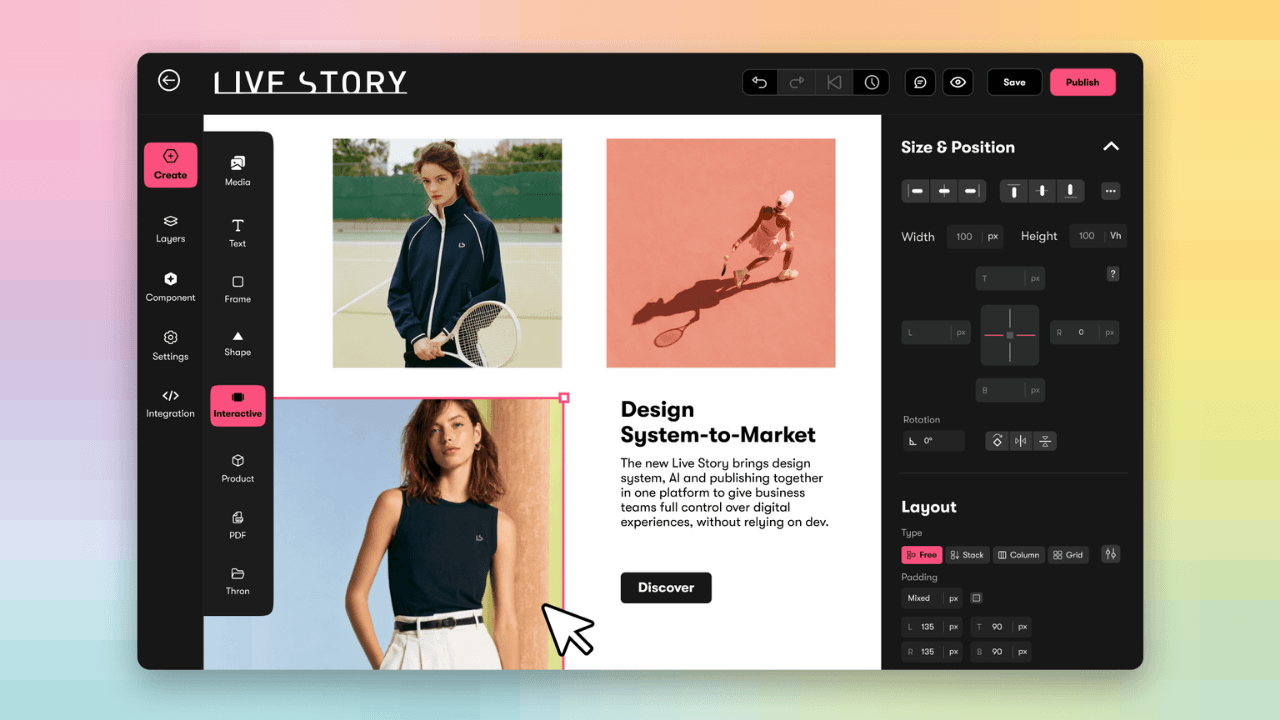
Over the past 20 years, the technologies used to create digital experiences have evolved dramatically. Yet the process of bringing an idea online has remained largely unchanged.
Marketing and design teams create concepts, define layouts and prepare content that development teams must translate into code before publication. Every new campaign or adaptation can introduce another technical step, affecting delivery times and limiting the autonomy of the teams responsible for the experience.
Artificial intelligence has accelerated code generation, but it has not necessarily removed this dependency. It can make an existing workflow faster without changing its underlying structure.
This raises a broader question for businesses: rather than accelerating the existing process, could the industry rethink why digital experiences still need to be translated into code in the first place?
Design System-to-Market: Rethinking the frontend workflow.
Frontend creation remains fragmented, slow and costly. Disconnected tools, teams and workflows add complexity and limit efficiency, while the frontend remains heavily dependent on hard-coded development.
Although IT teams play an essential role in ensuring performance, security, scalability and governance, not every creative change should require technical intervention. The challenge is to give business teams greater autonomy without compromising the technology behind the experience.
A different approach begins with the design system. Rather than treating it as a reference that developers must interpret and rebuild, the design system can become the foundation from which digital experiences are created, adapted and published.
This is the principle behind Design System-to-Market, the approach introduced by Live Story, the no-code platform developed to help businesses design and publish digital experiences.
The evolution of Live Story builds on the experience gained from working alongside more than 150 enterprise brands across different sectors, from finance to fashion and luxury, including Max Mara Fashion Group, Dolce & Gabbana and Guess.
The model enables marketing, creative and e-commerce teams to work directly with their brand's components, content and visual rules, without requiring a separate development process for every new experience.
AI and human creativity: Moving beyond code generation.
The growing adoption of AI makes this distinction increasingly relevant. AI agents can generate digital interfaces from natural-language prompts, but producing an initial result is only part of the creative process.
Digital experiences must also reflect brand guidelines, adapt to different markets and devices, and accommodate ongoing changes. When every adjustment requires another prompt or round of code generation, creative teams remain dependent on technical processes, adding time and costs.
Live Story approaches this differently. AI agents can generate experiences from prompts, while users can refine individual elements directly through a visual editor, modifying layouts, content and creative details without additional prompts, AI tokens or code.
This allows AI to contribute to the creative process without replacing human judgement. For businesses, it also means AI-generated experiences can remain editable, reusable and consistent with established brand standards.
Design system, components and AI within one platform.
Introduced today, 11 November, the new Live Story brings together the tools needed to turn a creative project into a published digital experience, from campaign and experiential pages to product pages.
At its centre is Live Story Studio, a no-code visual editor that enables teams to start directly from design to create pixel-perfect, responsive digital experiences, manage content independently and adapt pages across different markets, languages and digital touchpoints. Live Story Components allows teams to create reusable components aligned with their design system, providing a shared foundation for creative execution.
Through the Live Story MCP, the platform connects with design tools and AI agents, such as Figma, ChatGPT, Claude and Cursor. Teams can start from existing designs or generate new experiences through natural-language prompts, using their own components and brand rules to guide the creation process. The resulting experiences can then be refined directly in the visual editor, giving teams full control over every change without consuming additional AI tokens or writing code.
Live Story Delivery completes the workflow by publishing these experiences to existing websites, without requiring businesses to replace their technology stack.
“With the new Live Story, we have brought design, AI collaboration and publishing together into a single workflow. Our goal is to overcome the fragmentation that has long slowed down the creation of digital experiences, reducing time-to-market and giving businesses greater agility and control over their frontend,” says Stefano Mocellini, CEO and Founder of Live Story.
The evolution reflects a shift in responsibility: giving the people who understand the brand greater control over its frontend, while IT teams continue to manage the underlying technology. More about this approach and the new platform can be found on the Live Story launch page.
Growth engines: Towards a new generation of digital experiences.
The launch also marks the beginning of a new development phase for Live Story. Among the areas of innovation are growth engines, already being tested in pilot projects with customer brands, opening up new possibilities for interaction, conversation and personalisation.
The vision extends beyond individual web pages towards an ecosystem where design systems, data, content and components provide the foundation for dynamic, brand-consistent digital experiences tailored to each user, with the aim of driving measurable business results through higher conversion rates and revenue growth.
The broader implication is a change in how businesses approach the frontend: not simply as the final technical output of a design process, but as an environment that can be continuously shaped by the teams responsible for the customer experience.
Rather than focusing exclusively on faster code generation, the next phase of frontend innovation may depend on eliminating the need to write code for every new digital experience.
Live Story will explore this approach in a dedicated webinar on 18 November, titled “From brief to live: create digital experiences without the dev queue with Live Story”, examining how design systems, reusable components and AI can support the journey from campaign brief to publication.


Would you like to write the first comment?
Login to post comments