
For years, Europe’s energy debate has focused on increased supply — more renewables, more grid capacity, more infrastructure. But as electrification accelerates, from heat pumps to EVs, the real challenge is shifting from how we generate power to how we use it.
Peaks and troughs in demand still force the system to overbuild, waste clean energy, and rely on fossil backup, even when renewable generation is abundant. At the same time, the technologies meant to make homes “smart” remain fragmented with lower adoption than in other parts of the world. This leaves millions of connected devices in our homes, yet very little real, automated control over when and how energy is actually consumed.
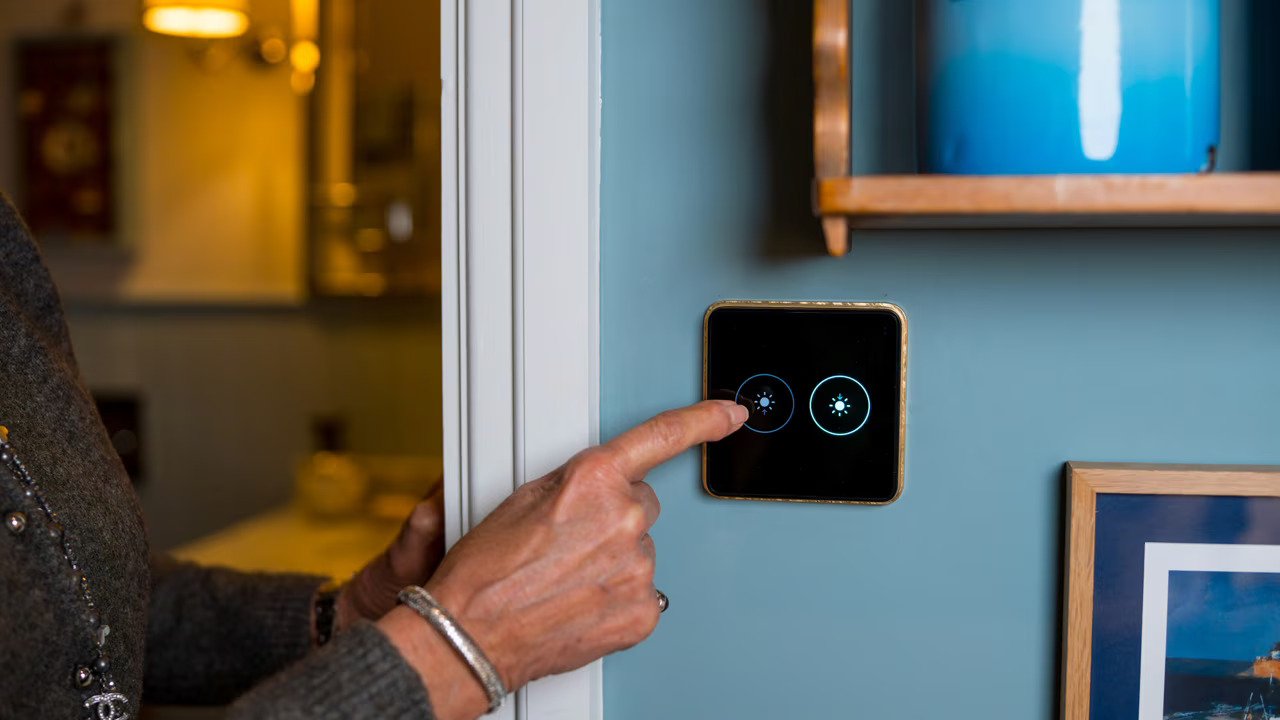
Tewke is a London-based climate-tech and smart-home company whose flagship product, Tap, replaces the traditional light switch with an AI-enhanced interface for lighting control, energy management, and environmental sensing. Through the Tewke app, you can control lighting and connected devices remotely and set up automation based on routines or sensor triggers.
Built-in sensors and software analyse energy usage and offer recommendations to reduce waste and save on costs. Tap can also track home environmental factors like air quality, humidity and CO₂, helping you understand and improve your home health.
Tewke is led by serial entrepreneurs Piers Daniell and Rowan Dixon.
Piers Daniell founded Fluidata (now FluidOne) in his bedroom in 2006, growing it to over 150 employees before exiting in 2019. Sir James Wates is Chairman of Tewke and former Chairman of the Wates Group, one of the largest family-owned construction, development, and property services companies in the UK.
As his company grew, Daniell shared, “We operated out of 18 data centres, and at certain times of day, the national grid would actually pay those data centres to go offline. That’s when the idea of demand-side control really landed for me: if you could change demand in millions of homes, you could have a massive impact on energy consumption.”
When he eventually exited that business, he realised that no one had truly solved demand-side control at a granular, home level. “
You had companies like Octopus playing around the edges, but not really controlling demand in detail.”
The nuclear-scale prize of shifting household demand
The potential impact for demand control is enormous, according to Daniell:
“If everyone ran their washing machines or dishwashers at three in the morning, we could use all that excess energy and flatten peak demand,”
Daniell said. “I once read an estimate that Europe could save the equivalent output of around 200 nuclear power stations just through better demand management.”
At the same time, Daniell‘s personal experience with home automation exposed a different but related problem: usability.
“I was living in a home with a high-end automation system, Control4. It was powerful but incredibly hard to use,” he said.
“My in-laws once babysat and sat in the dark all night because they turned the system off and couldn’t work out how to turn it back on. Everyone has similar stories — people unplug smart plugs, forget passwords, get logged out of apps.”
— This is also my experience. Whenever we get a cat sitter, we come home to find every smart device unplugged from the wall, despite how simple we make Google Home instructions.
Daniell realised that if home technology was going to scale, it had to be “usable by absolutely everyone, not just tech enthusiasts,” he said.
“So those two worlds came together: intelligent energy control and genuinely usable home technology. But I needed serious technical firepower to build it — that’s where Rowan came in.”
Dixon was studying Design Engineering at Imperial Collegeand working in Microsoft R&D when Piers approached him.
He shared:
“At that stage, it was basically a napkin sketch, but the ambition was very clear. The goal wasn’t just to build a ‘smart home’ — it was to remove human error from energy use.”
Why the light switch is the most powerful interface in the home
The team opted for the light switch because, according to Daniell, it's the most universal interface in the home.
“A three-year-old can use it. A grandparent can use it. Babysitters, builders, visitors — everyone understands it,” Daniell said.
Dixon added:
“We realised that if you control the light switch and the socket, you essentially control all the energy in the home.”
They also insisted on physical buttons. This means that if the internet goes down or software fails, the lights still have to work.
Re-engineering the wall: power, sensors, and a modular brain
The Tewke product has three layers:
- The frame for aesthetic customisation,
- The wired core that replaces the switch, and,
- A magnetically attached display module that contains the sensors and compute.
Each device contains nine sensors: Doppler radar for presence detection, a microphone, temperature, humidity, air pressure, ambient light, volatile organic compounds, CO₂, and voltage and current sensing. Together, they give a real-time picture of environmental conditions and occupancy.
Historically, IoT has been fragmented: one device for air quality, another for temperature, another for motion, each with its own apps and ecosystems. Tewke provides a single, integrated platform that could actually reason about what’s happening in a space. If you ever need to upgrade the intelligence, you don’t need to rewire the wall — you just replace the module.
One of the hardest technical challenges is that a light switch is in series with the load: when the light is off, the power is off. Yet you want sensors, processors, radios and a screen to remain powered.
“We developed and patented a way to do this with and without a neutral wire, explained Dixon.
This is critical in Europe, where many homes don’t have neutrals at the switch.
Turning lighting control into energy intelligence
More than just a great smart lighting solution, Tap provides real-time energy cost tracking to empower users to make efficient energy use choices, helping them to shift the use of energy-heavy appliances, like the dishwasher, washing machine, tumble dryer or EV charger, to much lower cost times of the day. Paired with a variable energy Tariff, Tap helps users to make informed decisions that could save them considerable money on their energy bills.
The sensors feed into on-device AI that learns behavioural patterns rather than relying on fixed schedules. It understands when rooms are used, how air quality changes, and how people move through the space, and it automatically adapts lighting, heating, and ventilation.
Adding a natural language layer to the wall
While the physical light switch remains the most universal interface in the home, Tewke includes TewkeAI, a built-in voice interface that allows residents to control lighting, energy use and home settings through natural language, without relying on external assistants or cloud-only processing.
Unlike traditional smart speakers that act as a separate layer in the room, TewkeAI is embedded directly into the wall switch itself, combining microphones, on-device AI and contextual awareness from Tap’s sensor stack.
For Daniell, this is about removing yet another source of friction.
“If a three-year-old, a grandparent and a visitor can all use a light switch, voice should work the same way,” he said. “You shouldn’t have to remember commands or wake words. You should just be able to say what you want to happen in the room.”
Because Tap already understands occupancy, light levels, air quality and routines, voice becomes contextual rather than generic. A request like “make it cosy in here” can translate into a specific lighting scene, temperature adjustment and ventilation change, while “I’m going to sleep” can trigger an energy-optimised night mode across the home.
Privacy first from the get-go
According to Daniell, “being invited into someone’s home is a privilege."
"We keep as much processing on-device as possible. When data leaves the device, it’s anonymised. We don’t know whose home it is or where it is — only that “a room like this” has certain characteristics.
That still allows us to train models and improve performance, without compromising personal privacy. We’re European, and we take European privacy values seriously.”
In turn, TewkeAI processes voice locally wherever possible, keeping raw audio in the home and using anonymised data only to improve models.
Future features will allow users to manage activities such as home security, media and thermostat control, all of which will be activated in the background, without the need for further hardware or configuration.
From electricians to landlords, social housing, and hotels
Tewke’s initial customers are homeowners via electricians and installers. After appearing on Grand Designs, (a UK architecture TV show) the team saw a big spike in consumer interest, which helped build its partner network.
Dixon explained:
“Our model is that you buy through an electrician — they source it, install it, and become an extended sales and education channel.”
Tewke is also seeing strong interest from landlords, social housing providers, student accommodation operators, and hotels. The same hardware works across residential and commercial use cases, which is important for scale. Presence detection alone is hugely valuable: turning heating and lighting off automatically when rooms are empty, pre-heating before check-in, monitoring air quality, and even detecting vaping or unusual activity in hotel rooms.
“Like building six companies at once”
In explaining why the company chose to manufacture in the UK despite the added complexity, Daniell points to the strategic value of control.
“We’re full-stack: electronics, mechanical engineering, industrial design, software, AI — all in-house,” he said.
“It’s like building six companies at once, but it gives us total control over quality and roadmap.”
The company employs around 16 full-time people and has grown largely through bootstrapping, supplemented by a small group of angel investors. According to Daniell, that constraint has shaped not just the pace of growth but also the company’s culture.
“It forces discipline,” he said. “If we’d raised €10 million on day one, we’d have spent it — and probably built something worse.
Tewke’s long-term vision is to position the home within the smart grid.
Think white goods, heating systems, EV chargers — coordinated automatically so demand shifts to the cheapest and greenest times. Your washing machine runs when renewable generation is high. Your heating pre-warms your home when energy is abundant.
Piers Daniell contends that in this case, “Instead of everyone having to invest in huge capex like batteries and solar, we optimise what already exists. Shift demand, don’t just add supply. If we can flatten peak load, we reduce the need for massive new power stations.”
In the long run, while we start with hardware, we expect to be seen as a software and energy-intelligence company. The light switch is just the gateway — but it’s the most familiar gateway in the world.”


Would you like to write the first comment?
Login to post comments