

Spatial AI company SE3 Labs today emerges from stealth. SE3 builds foundational spatial intelligence technology for the next generation of autonomous systems. As autonomous systems operate in increasingly complex and contested environments, the ability to perceive, reason, and act in three dimensions becomes the defining capability.
SE3 provides the spatial intelligence layer that sits between raw sensor data and meaningful action. The company is backed by Lakestar and Seedcamp, alongside EWOR, the Sequoia Scout Fund, UnternehmerTUM Funding for Innovators, SDAC, Magnetic, TwinTrack Ventures, Plug and Play, the founders of Flixbus and Ascending Technologies, and strategic angel investors.
Teaching autonomous systems to understand the physical world
Today's unmanned aerial vehicles can fly a pre-programmed route or follow a beacon, but they cannot reason about the world around them. SE3 closes that gap.
Its stack operates as a single platform and domain-agnostic system across aerial, ground, and mixed swarms, and is already under contract with the German Bundeswehr.
The stack is hardware-agnostic, modular, and runs on-edge. Customers can integrate SE3 as a standalone capability into an existing platform or have SE3 cover the full software stack for UAVs
"Advances in AI have enabled machines to understand language. The next step is enabling them to understand the physical world," said Lukas Köstler, CEO and co-founder of SE3.
"We’re building the category leader in Spatial AI. Our technology unlocks a new generation of autonomous systems that can operate reliably in real-world conditions across defence, public safety, and industrial applications."
According to Dr Klaus Hommels, Founder and Chairman of Lakestar, Europe’s sovereignty depends on its ability to build and scale the critical capabilities that will define the next era of defence.
“SE3 is developing one of those capabilities, and we believe it will be essential to Europe’s security, resilience and technological independence.”
Spatial autonomy turns raw sensor data into shared understanding
SE3's navigation system delivers precise, continuous autonomous navigation in GPS-denied terrain and under active electronic warfare.
Onboard visual-inertial odometry and real-time map matching replace the satellite link: each platform builds and updates its own spatial picture as it moves, and paths adjust dynamically as the environment evolves, without operator intervention.
On top of the resilient navigation foundation, the perception stack turns raw visual data into a continuously evolving 3D understanding of the operating environment. Terrain, elevation, and points of interest are reasoned across in real time, and objects are localised in three-dimensional space to sub-metre accuracy. That spatial picture is shared across the swarm, so every platform converges on the same target.
For the operator, it forms a live 3D common operating picture of the environment. The operator interacts with that picture in natural language: spoken intent reaches directly into the 3D space and is translated into action across the swarm. AI agents run continuously on top of the same picture, analysing the real world in real time and conducting advanced reasoning over what they see.
From that shared 3D picture, one operator commands the swarm. This turns a single operator into a force multiplier: mixed aerial and ground platforms are directed in natural language, and operator intent is interpreted spatially and distributed as behaviour across the swarm, so the size of the force scales with the mission rather than with the headcount available to fly it.
“Perception alone doesn't make a system autonomous. The harder problem is discernment: knowing what matters, separating the urgent from the merely important, and ranking intentions against the mission and the environment. Without that layer, more sensors just produce more noise. SE3 is building the discernment layer for physical AI.” said Carlos Eduardo Espinal, Managing Partner at Seedcamp.
Built on world-class research from the leading institutions in computer vision and AI
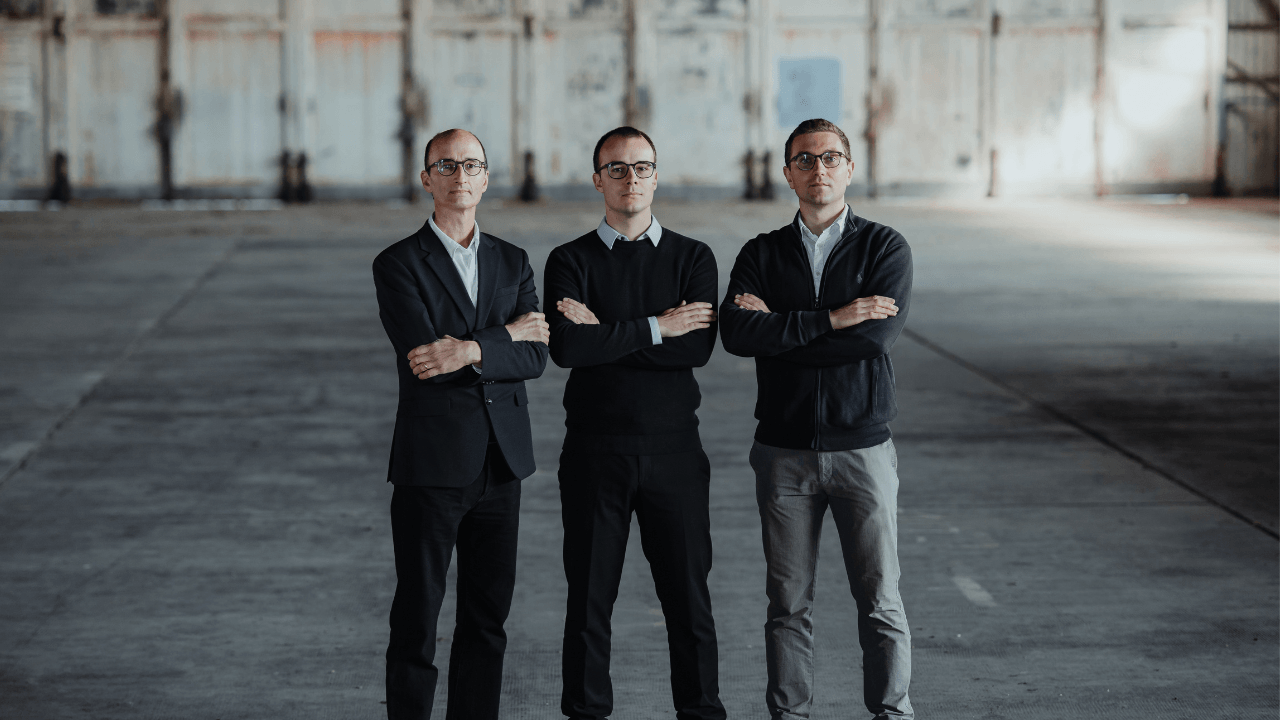
SE3 was founded by Lukas Koestler, Simon Klenk, and Daniel Cremers, bringing together expertise in robotics, computer vision, artificial intelligence, and defence technology.
The founding team has produced more than 400 scientific publications with over 87,000 citations, combining frontier AI research with experience from organisations including Nvidia, Tesla Autopilot, Boston Consulting Group, Skydio, and Isar Aerospace.
Cremers, who holds the Chair for Computer Vision and Artificial Intelligence at the Technical University of Munich, is president of the European Computer Vision Association, Director of the Munich Centre for Machine Learning, a member of the Bavarian Academy of Sciences and Humanities, and a recipient of the Gottfried Wilhelm Leibniz Prize.
The company is committed to putting cutting-edge spatial AI in the hands of the German Bundeswehr and allied forces operating in modern conditions.
SE3 participates continuously in military exercises across Europe, and in recent exercises has reduced the sensor-to-shooter timeline by an order of magnitude. The technology is also being validated in real operational settings today. The company has won multiple defence contracts and is operational with the Bundeswehr.
“Many teams excel either at frontier research or at operational deployment. SE3 is unusual because it brings both together in one culture. The team is deeply technical, close to the customer and unusually low-ego, yet the ambition is enormous: to build technology that becomes a core part of how autonomous systems operate in the physical world,” said Enrico Mellis, who co-led Lakestar’s investment in SE3.


Would you like to write the first comment?
Login to post comments