


Louise Ballard, co-founder and CEO of Atheni AI, has a mission — to ensure that when it comes to AI, nobody gets left behind.
“As AI becomes embedded across every profession, we don't want to create a two-tier society where only those who can afford expensive tools or specialist training are able to benefit.
Everyone should have access to the knowledge and confidence they need to use AI well.”
When it comes to AI startups, Atheni AI is an outlier. Its female founders, Louise Ballard and Mackenzie Howe, aren’t postdoc academics or 20-something men vibecoding their way to customers.
Ballard spent three decades in corporate communications before selling her PR agency to Huntsworth in 2009. After recovering from two cancers, she reconnected with future co-founder Mackenzie Howe, an entrepreneur and former institutional investment consultant. Together they realised the biggest challenge around AI wasn't the technology—it was helping people use it effectively.
And what they’ve created is Atheni.ai, a UK startup focused on successful AI adoption rather than AI model development. It helps organisations ensure that employees actually integrate AI tools such as ChatGPT, Claude, and Microsoft Copilot into their daily work in ways that improve productivity and decision-making.
The AI adoption problem
Ballard contends that “Anyone can open ChatGPT and ask it a question. The real question is whether they know if the answer is good. Can they provide the right context? Can they challenge the output? Can they connect different tools together? Can they build simple automations? Those are skills anyone can learn, but only if they have the confidence and support to explore them."
Talking to former clients across a range of industries, everyone described the same challenge. Ballard explained that they'd bought AI licences, rolled them out across the company and expected people to use them, but adoption was low.
“Those who did use the tools often weren't using them effectively, while many simply reverted to the way they'd always worked."
That experience reflects a broader industry trend. A global study released this week by CambrianEdge.ai, which surveyed 775 AI users across 104 organisations, found that 55 per cent of professionals see isolated individual use of AI and the lack of structured human-AI workflows as the biggest barrier to adoption.
The study found that more than a quarter of organisations still lack basic collaboration infrastructure, such as shared prompt libraries, training, and quality standards, while 18 per cent have already scaled back AI initiatives due to poor adoption and inconsistent results.
The findings mirror research from BCG, which found that although 96 per cent of 300 global CMOs say AI is driving business transformation, almost half still use it only for isolated tasks rather than embedding it across workflows. Organisations with comprehensive AI infrastructure — including shared tools, training, prompt libraries and governance — were dramatically more likely to report significant business impact.
“We quickly realised that real transformation doesn't happen because you have one or two AI champions. You need the whole team developing confidence together,” shared Ballard.
Why training isn't enough
Ballard argues that experienced workers often become the strongest AI users because they bring judgment that AI cannot replace. Some of the biggest barriers to adoption are fear of being replaced, habit — “If you've completed a task the same way for 10, 15 or 20 years, changing that workflow takes cognitive effort—especially when you're already busy.” and, importantly, relevance.
Ballard contends that traditional training, like workshops and demos, is too generic because you attend or watch something and think, "That's interesting." Then you return to work and immediately go back to your existing processes. AI is different because it's deeply personal. Even two people doing almost identical jobs will use it differently.
"We saw this repeatedly. We'd run workshops, everyone would leave enthusiastic, and six weeks later, clients would tell us very little had actually changed.
That's when we realised this wasn't primarily a training problem — it was a coaching problem. People need ongoing guidance while they're working.”
Coaching people while they work
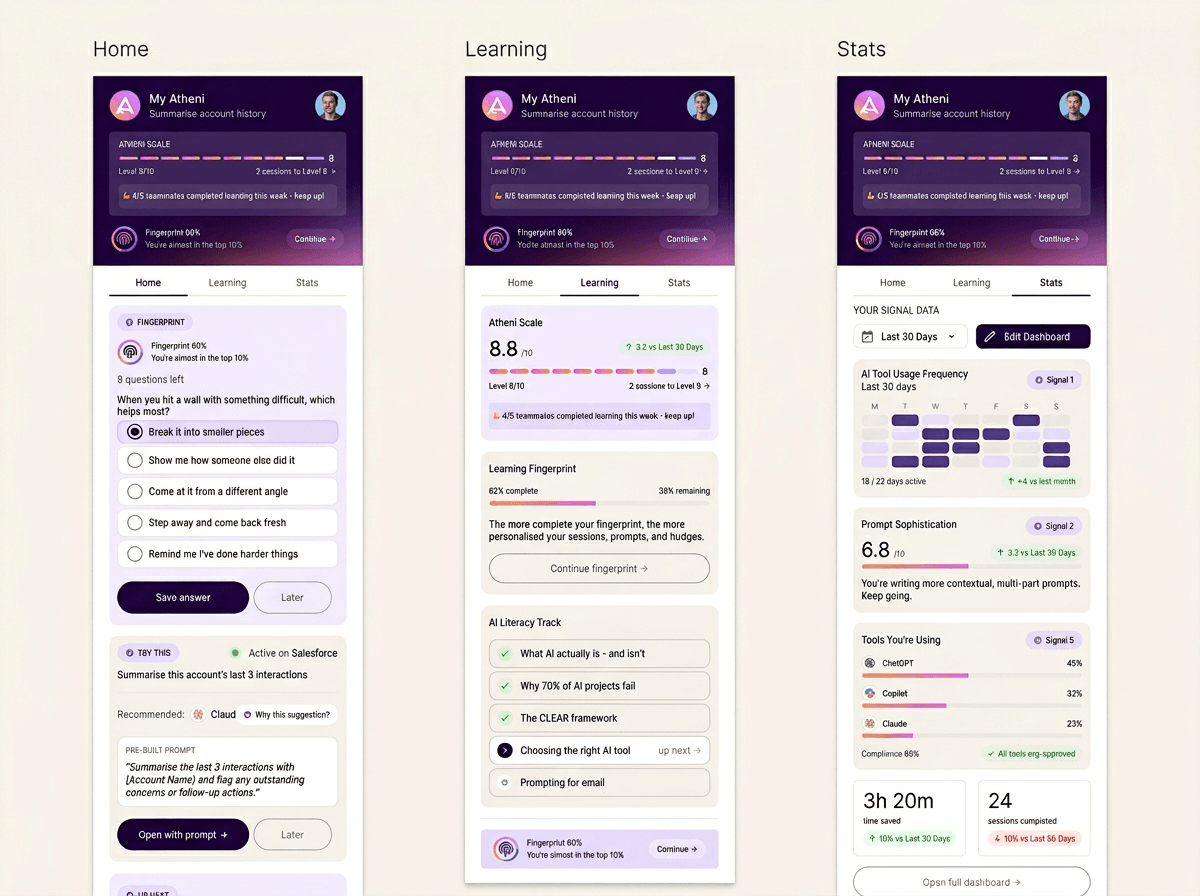
Atheni sits alongside people while they're working, understands their role and guides them through what the company calls the Atheni capability scale — from Curious through to Pathfinder.
Rather than delivering generic lessons, it coaches individuals based on how they're actually using AI, the quality of their prompts, the workflows they're building and the opportunities they're missing.
Through a browser-based assistant and analytics dashboard, the platform provides personalised coaching, tailored learning missions and practical recommendations based on an individual's role, helping teams progress from basic AI adoption to more advanced, strategic use.
It also gives organisations visibility into team-wide AI capability and adoption, enabling them to build AI literacy and drive meaningful behavioural change rather than simply measuring tool usage.
Success for clients of Atheni is ultimately adoption. For example, one client realised some people were using free AI tools independently and potentially exposing confidential information, so they wanted a proper strategy, while others described themselves as technophobes.
“Over three months, we worked with them consistently. By the end, they'd reached around 90 per cent adoption, with roughly a third of employees progressing into our highest capability tier. What changed wasn't simply that they were using AI more often.
They understood what good usage looked like. They realised AI wasn't replacing their expertise—it was extending it. They could stress-test ideas, explore scenarios, analyse information and solve problems they simply couldn't have tackled manually.”
Access doesn't equal adoption
Atheni works with organisations before, during and after AI rollouts, helping them move beyond simply distributing licences.
“The biggest misconception is thinking that access equals adoption. Giving someone a Copilot or ChatGPT licence doesn't automatically change the way they work.”
Ballard contends that it's critical to think about how the work gets done in the first place. For example, a client may want to use AI to free their people to spend more time thinking, solving problems, and working with customers, rather than getting buried in repetitive processes.
“One corporate finance client redesigned a monthly spreadsheet process rather than simply automating it. That's the real shift. It's not just efficiency — it's redesigning work.”
She contends that the companies that struggle are often those that have simply rolled AI out across the organisation and assumed adoption would happen naturally.
“They find themselves asking why everyone has a licence, but nothing has really changed, or why they're suddenly generating lots of AI-written emails that don't actually communicate anything particularly well.”
AI is like "driving a Ferrari to the supermarket"
Ballard likes to compare AI to "driving a Ferrari to the supermarket". People own incredibly powerful technology but use only a tiny fraction of its capabilities.
"Success isn't measured by how many prompts someone writes every day. It's measured by how deeply AI becomes integrated into the way they think and work.
Someone who uses AI only twice a day but has built sophisticated workflows creates far more value than someone who spends the day asking it to rewrite emails."
That's the difference between depth and volume, and that's what Atheni is designed to develop.
Building AI around how people actually work
Ballard believes that company expertise is essential to successful AI adoption:
“I've spoken to organisations that have brought in sophisticated AI systems designed entirely by external technology teams, only to find they don't reflect how the business actually operates.
They end up rebuilding everything because the people designing the workflows didn't understand the day-to-day reality. Increasingly, every professional will need two complementary skill sets.
One is their domain expertise—whether that's journalism, finance, marketing or law. The other is enough AI literacy to build and adapt the tools they need themselves. Rather than relying on a central technology team to solve every problem, people should be empowered to create solutions that fit their own workflows.“
Preparing for an agentic future
Of course, the risk is that AI systems become so intuitive that workers no longer need a platform like Atheni. Ballard admits it's a question the company considers often and asserts that the skills people need will continue to evolve alongside AI.
“Today, we spend a lot of time helping people write better prompts and understand how to work effectively with AI. In a few years, prompting may no longer be the key skill. Instead, people may be building increasingly sophisticated AI agents or orchestrating multiple systems together.
The underlying challenge doesn't disappear — it simply changes. You could use Atheni Ai in the future to coach negotiation skills, leadership, intergenerational communication or any workplace capability where people benefit from ongoing, contextual guidance while they're actually doing the work.”
Closing the credibility gap
Atheni.ai raised £350,000 in May this year. Ballard admits fundraising was one of the hardest parts of building the business. She admits that when they first started raising, the founders assumed investors would immediately understand the problem they were solving.
"Instead, many questioned whether the problem even existed. The reaction was often, 'AI is easy to use. Why would anyone need coaching?'"
The team paused fundraising, raised a small friends-and-family round and focused on building the product.
Ballard admits:
"As a female founder in my fifties, I realised we weren't just facing a funding gap—we were facing a credibility gap. We're two women who don't fit the stereotype of AI founders, despite years of experience building businesses and working with technology.
That meant people often underestimated both the problem and our ability to solve it. "I'd built and sold a business and advised CEOs throughout my career, yet suddenly we were having to prove our credibility in ways I'd never experienced before."
Finding the right investors changed everything.
Once they connected with people who understood the opportunity, Atheni closed its round in around six weeks.
"Because we're already generating revenue through our consulting work, we've been able to validate the problem before scaling the software platform. Traditionally, there was a clear distinction between consulting and software businesses. Today, particularly in AI, that distinction is becoming much less relevant.
If you're solving complex human problems, you need deep domain expertise, and that expertise often comes from working directly with customers before it's embedded into software. That's exactly what we've done."
Ballard hopes that, as AI reshapes the workplace, humans remain at the centre.
"We have an opportunity to shape what the future of work looks like, and I'd like that future to be one where humans remain firmly at the centre."
Lead image: Louise Ballard and Mackenzie Howe.


Would you like to write the first comment?
Login to post comments