
Today the German state of Mecklenburg-Vorpommern is embracing open source and rolling out a statewide collaboration platform based on Nextcloud – with the goal of reaching more than 50,000 employees across state and municipal administration in the long term.
Mecklenburg-Vorpommern follows the example of other frontrunners such as Schleswig-Holstein, the Austrian Ministry of Economic Affairs and the French Ministry for the Energy Transition, among others. The French Ministry of Education uses Nextcloud for 400,000 employees and plans to roll it out to 1.2 million employees. These successful projects demonstrate that digitally sovereign solutions are not a vague concept, but already exist and are being deployed at large scale and that European open source is a genuine alternative to big tech.
The project is part of a broader sovereignty strategy for the German state, which also includes the cooperation agreement with Schleswig-Holstein signed in November 2025.
The state is opting for an open-source platform that it can control, audit, and develop further itself. Responsible for setup and operation is DVZ M-V GmbH, the state's IT service provider, which provides the platform for the public sector in the German state. Mecklenburg-Vorpommern's digital strategy aims to increase the digital capability, independence, and security of public administration.
A key component is digital sovereignty – the ability to determine independently how the state manages its own IT infrastructure and underlying data.
"Digital sovereignty and open source are central goals and cornerstones of digitalisation policy in Mecklenburg-Vorpommern. We plan to continue expanding the use of open source and promote common standards and open interfaces for IT solutions in the public sector. This is the only way for the state and municipalities to have the power to act in the future. This is exactly where we are starting with Nextcloud," says Dr Heiko Geue, Minister of Finance and Digitalisation of Mecklenburg-Vorpommern.
The software runs under the free GNU AGPLv3 license. The state can review and audit the source code at any time and adapt it according to its own security and functional requirements. The project was built on the principle of "open source by design": it includes dedicated testing and production environments, operational training, security reviews, and prioritised integration of stability updates.
Currently, around 5,000 employees actively use the collaboration platform for file sharing. In the medium term, the solution is planned to be expanded, and include chat, videoconferencing, and groupware applications, and made available to more than 50,000 public-sector employees across Mecklenburg-Vorpommern – from ministries to municipal institutions.
"The transition away from Microsoft SharePoint has been completed step by step, without disruption or data loss for employees. Together with DVZ M-V, we have built a platform that runs reliably today and continues to expand step by step," says Marco Anschütz, CIO of Mecklenburg-Vorpommern.
The implementation of Nextcloud is part of a broader open source strategy of the state: in parallel to Nextcloud, Mecklenburg-Vorpommern is OpenProject as an alternative to proprietary project management tools and has developed LEA, an AI-based administrative chatbot built on OpenWebUI, as its own locally controlled AI assistant for the public sector.
"With Mecklenburg-Vorpommern, yet another German state is now committing to Nextcloud as a sovereign collaboration platform – in close alignment with Schleswig-Holstein. This shows once again that solutions are available and ready to deploy," says Frank Karlitschek, CEO and founder of Nextcloud.
With the project, Mecklenburg-Vorpommern is putting its sovereignty strategy into practice. The new collaboration platform strengthens the state's ability to act, gives it greater control over its digital infrastructure, and demonstrates how digital independence in the public sector can be achieved in practice.
Earlier this year, Nextcloud joined forces with a coalition of European enterprises and community organisations, including IONOS, Nextcloud, Eurostack, XWiki, OpenProject, Soverin, Abilian and BTactic, to launch Euro-Office, a solution for editing documents, spreadsheets and presentations, developed as a true sovereign community collaboration.
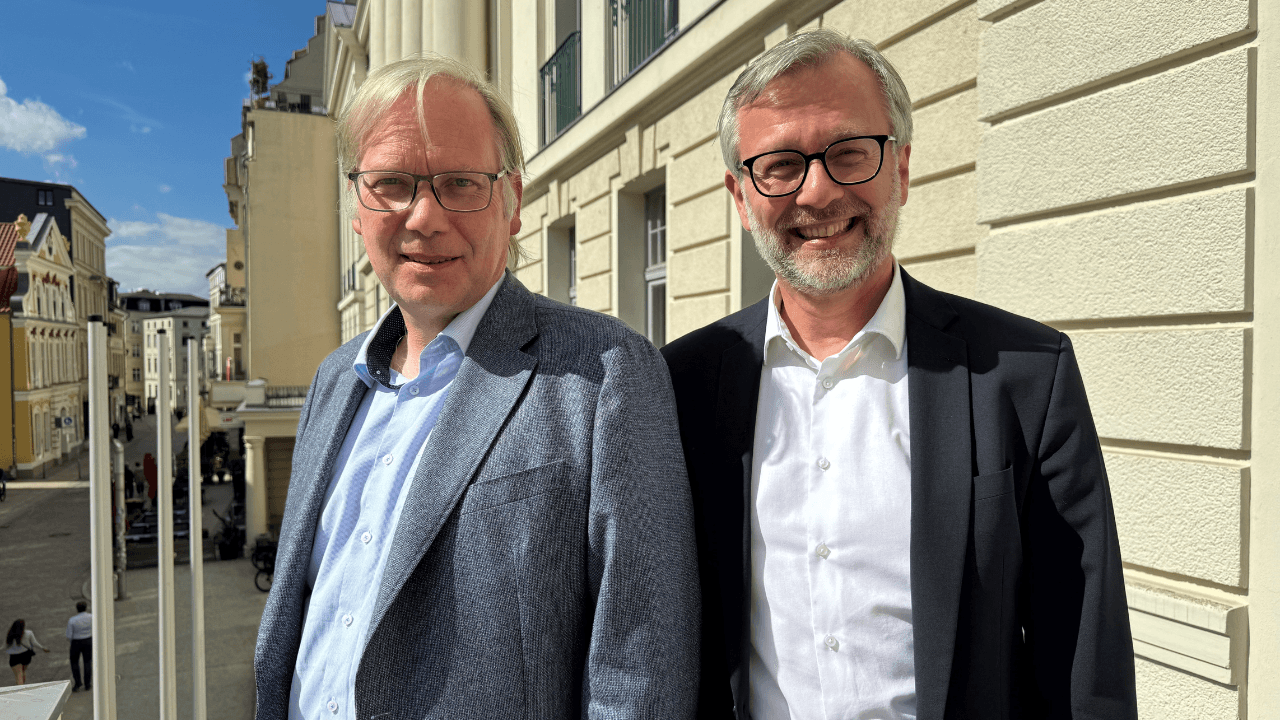
Lead image: Marco Anschütz, CIO of Mecklenburg-Vorpommern and Dr Heiko Geue, Minister of Finance and Digitalisation of Mecklenburg-Vorpommern. Photo: uncredited.


Would you like to write the first comment?
Login to post comments