


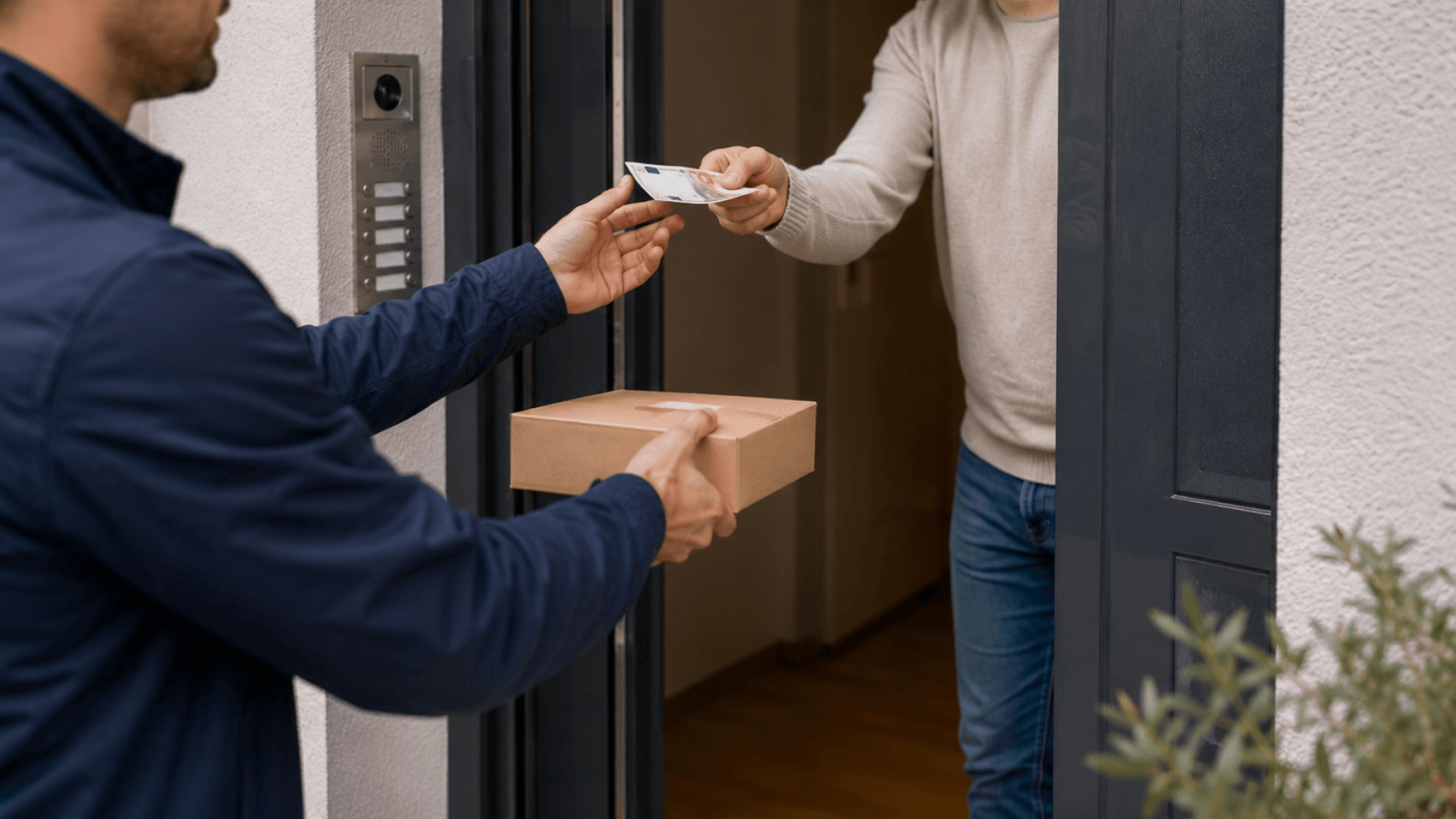
In a market that has spent a decade moving to cards, digital wallets and one-click checkout, cash on delivery can look like a relic. The customer pays the courier at the door, only once the parcel is in their hands. Yet in parts of Central, Eastern and Southern Europe, COD is not fading away. It still drives a meaningful share of ecommerce conversions, and for brands expanding across borders it often decides whether a new market opens up or stalls.
The reason is less about habit than about trust. In markets where shoppers are wary of paying upfront for an unfamiliar brand, the option to pay only once the parcel has arrived removes the single biggest barrier to a first order. That dynamic is strongest where local courier habits and category-specific trust barriers still support paying on delivery. It is precisely where cross-border sellers tend to look for their next stage of growth.
A payment method the obituaries got wrong.
COD has been written off repeatedly as card penetration has risen, but it has proved unusually durable. In several European markets it remains a normal expectation rather than a fallback, and it carries its own established local vocabulary: Nachnahme in Germany, contrassegno in Italy, contra reembolso in Spain, pobranie in Poland and dobierka in Slovakia.
Poland is a useful example of why COD needs careful definition. By transaction volume, Polish ecommerce is dominated by BLIK and account-to-account payments, yet COD remains a familiar and widely offered option, particularly for trust-sensitive categories and first-time purchases. According to WAPI, the cross-border fulfilment platform that handles COD across 19 European markets, the method performs most strongly where buyer trust gates the sale, in categories such as supplements, cosmetics and consumer electronics.
Who actually needs cash on delivery.
COD is not for every seller. For a well-known brand selling low-value repeat purchases to loyal customers, card checkout is faster and cheaper. The method earns its place in a narrower but valuable set of situations.
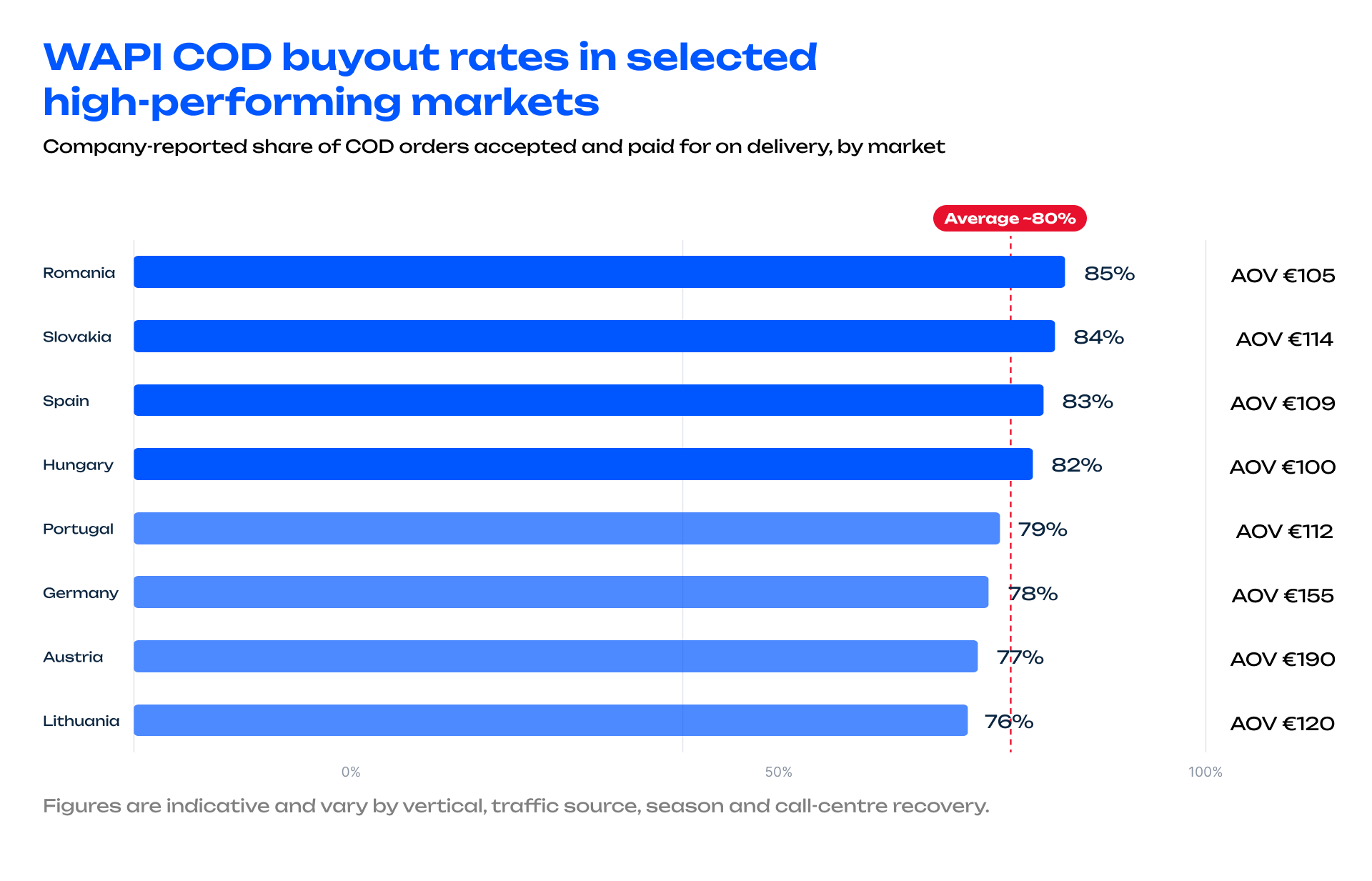
The clearest fit is the first-time purchase from an unfamiliar brand, especially at a higher price point. According to WAPI’s own network data, average order values on COD orders range from roughly €100 to €190 depending on the market, with supplements, cosmetics and electronics leading. These are exactly the purchases where a shopper hesitates to pay in advance, and where the reassurance of paying on delivery turns a browser into a buyer.
The second group is cross-border sellers and the media buyers running performance campaigns into those markets. For them, COD is often one of the few payment methods that can work at scale in the target country, and the economics of a campaign live or die on how many of those orders are actually accepted at the door.
The one number that decides everything.
Every benefit of COD eventually reduces to a single metric: the buyout rate, the share of COD orders that customers actually accept and pay for on delivery. A seller’s cost per acquisition, margins and cash flow all run through it. A campaign with a 60 percent buyout and one with an 85 percent buyout are different businesses, even on identical traffic.
According to WAPI, buyout across its strongest European markets typically sits between 75 and 85 percent, averaging around 80 percent. These are company-reported figures that move with vertical, traffic quality, season and the seller’s own pricing, but the spread is consistent enough to plan around.
The lever that moves that number most is recovery. When a courier flags a problem, such as a failed first attempt, an unreachable customer, an address mismatch or a refusal at the door, there is a short window to save the order before the parcel turns around. WAPI fires a real-time webhook to the seller’s call centre on each of those events, and the company says disciplined recovery on those signals can swing the buyout rate by 10 to 15 percentage points against providers that simply ship and hope.
What to weigh when choosing a COD provider.
Once a seller decides COD belongs in the mix, the choice of fulfilment partner matters more than it would for a card-based operation, because the provider’s infrastructure directly determines both the buyout rate and the cash flow. A handful of factors separate a partner that scales from one that quietly erodes margin.
Recovery infrastructure comes first. It is worth asking whether the provider exposes real-time delivery events and how quickly a call centre can act on them, because that is where buyout is won or lost.
Payout terms come next, and they are easy to underestimate. Many operators wait on individual carrier settlements before releasing a seller’s money, which ties up working capital at exactly the moment a campaign is scaling. A weekly, fixed payout schedule in a single currency removes that drag.
The pricing model is the third factor. A per-order commission can look cheap at low volume and turn punishing at scale, whereas a margin-based model aligns the provider’s incentive with orders that actually deliver and get paid.
Coverage and structure round out the list. A provider that pools inventory in regional hubs and ships cross-border lets a seller reach many markets on one contract and one integration, instead of building a separate operation in every country. It is equally practical to confirm the technical fit with your stack, and that the provider handles your vertical and its compliance requirements, before committing.
What COD infrastructure looks like in practice.
WAPI, a cross-border fulfilment platform that runs cash on delivery in Europe, is a useful illustration of how this is built. According to the company, it handles COD across 19 markets from more than 16 warehouses in Europe and Mexico, pooling inventory in regional hubs and shipping cross-border so a seller can reach many countries on one contract and one integration rather than a separate operation in each.
The commercial design follows the same logic. WAPI says it works on a margin-based model with no per-order commission, pays out weekly in euros regardless of when carriers settle, and exposes an open API that connects to the performance-marketing trackers media buyers already run. New clients, the company reports, typically go live within 48 hours to two weeks.
WAPI also reports that one cross-border supplements brand scaled from a single market to 10, including Germany, Italy, Poland and Romania, on one inventory pool and one integration rather than building local fulfilment in each. The figures are company-reported and indicative, but the pattern is the point: the infrastructure, not the payment method, is what lets COD scale across borders.
WAPI co-founder Aleksandr Fridman frames the company’s purpose around that kind of cross-border ambition:
WAPI is built out of love for the seller who wants their product to be everywhere, not only in the store around the corner. It is a story about ecommerce and the people who live and breathe online trade.
Aleksandr Fridman, co-founder, WAPI
What it means for sellers.
Cash on delivery in Europe is not a legacy payment method waiting to disappear. It is a practical tool for reaching buyers who will not pay upfront, and for cross-border brands it is often the key that unlocks a market rather than a cost to be minimised. The sellers who succeed with it treat it as an operational discipline, not a checkbox at launch.
That is why the choice of partner matters. Buyout infrastructure, payout terms and coverage decide whether a COD programme compounds into profitable growth or slowly bleeds margin, and those are the questions worth asking long before price.


Would you like to write the first comment?
Login to post comments