

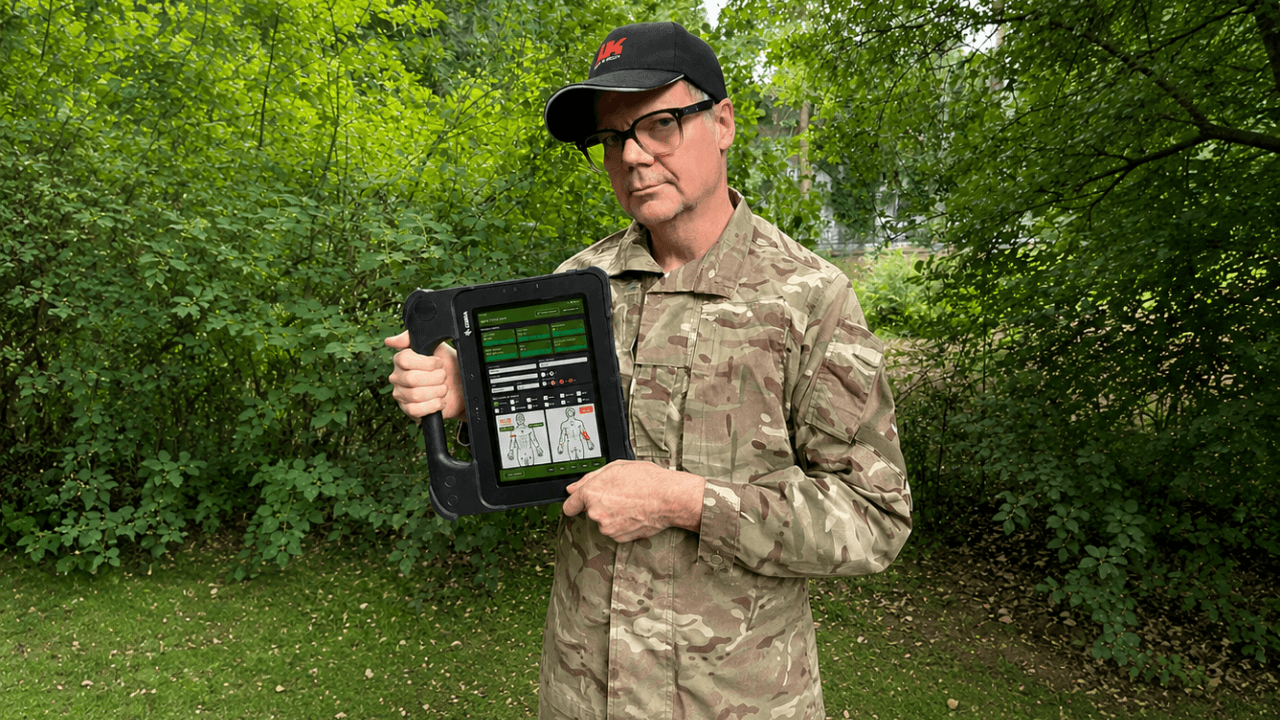
Drone warfare has fundamentally changed battlefield medicine. During four medical rotations with the Hospitallers Medical Battalion in Ukraine's Donetsk Oblast, startup founder and volunteer medic Howard Hunt (callsign Hunter) saw firsthand how the proliferation of drones has pushed casualty evacuation further from the frontline.
Medical teams can no longer safely drive directly to wounded soldiers during daylight hours. Instead, casualties are stabilised by combat medics before being transported after dark to Casualty Collection Points, where evacuation crews collect multiple patients simultaneously. This shift has exposed the limitations of a medical evacuation system that still relies heavily on manual processes.
Inside moving ambulances, medics caring for several critically injured soldiers must measure blood pressure with a cuff, count respirations manually and complete paper-based Tactical Combat Casualty Care (TCCC) cards while travelling over damaged roads. Those handwritten records accompany the patient through successive stages of care before eventually being entered into hospital systems, introducing delays, transcription errors and gaps in patient data. As casualty numbers increase, these analogue workflows become increasingly difficult to manage.
Medics spend valuable time recording observations rather than treating patients, while subtle physiological changes that could indicate a patient is deteriorating can easily go unnoticed. "Battlefield medicine is the complete opposite of a hospital environment," Hunter explains.
"You're working in moving vehicles, under extreme time pressure, often treating multiple casualties with limited equipment."
Hunter returned from Ukraine to Germany convinced that someone must already have solved this problem of continuously monitoring multiple vital signs inside a moving ambulance, transferring patient data digitally between medical teams and building a longitudinal record throughout the evacuation chain. They hadn’t, so this became the foundation of the startup The AO.
The battlefield problem nobody had solved
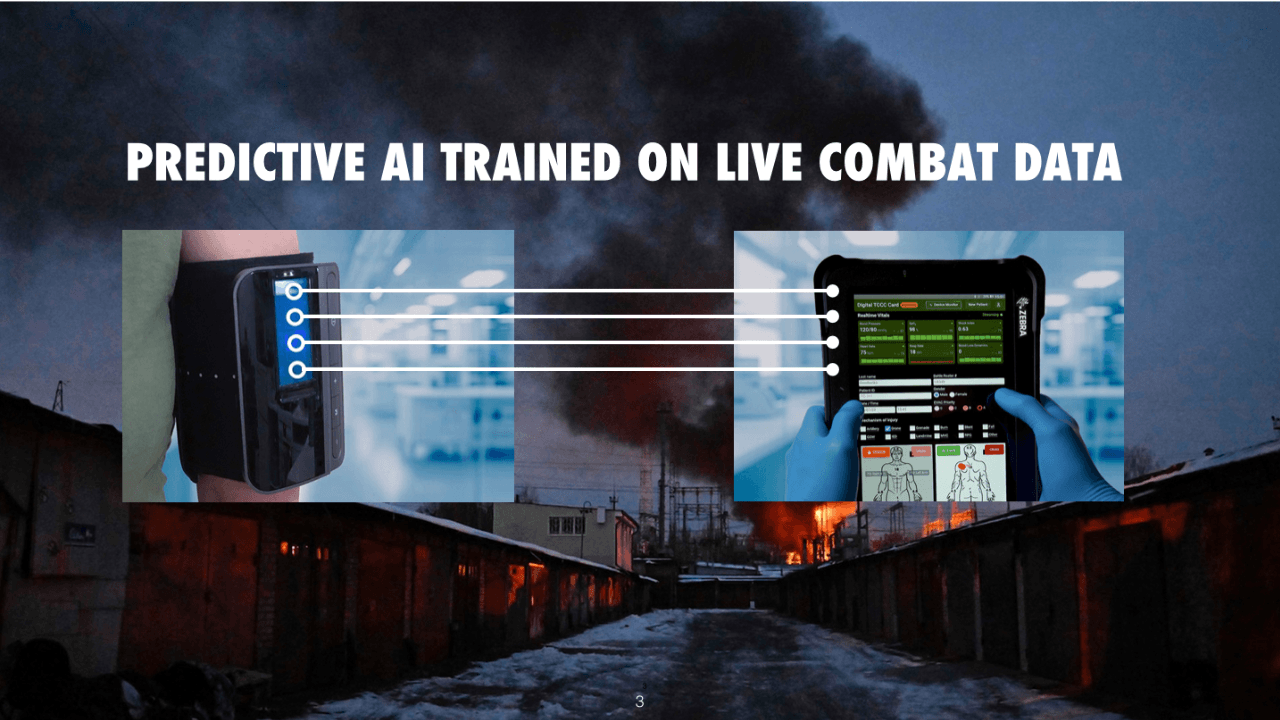
Berlin startup The AO is developing a battlefield patient-monitoring platform that combines wearable sensors, ruggedised software, and digital patient records to continuously measure pulse, blood pressure, respiration, and blood oxygen saturation during evacuation.
Rather than replacing medics, the platform is designed to automate data collection, allowing them to focus on treatment while every patient's physiological data follows them digitally through the evacuation chain. From casualty evacuations to company formation
Hunter has a rather unique founding story. He joined emergency evaluation services without military or medical experience. When the full-scale invasion of Ukraine began, he started hosting Ukrainian refugees in his apartment from March 2022. 13 people in total have stayed in his apartment, including a historian and graphic designer from Ivano Frankivsk, and two music producers from Kyiv.
“Listening to their stories completely changed my perspective on the war,” he says. He wanted to help, so he travelled to Ukraine and joined Hospitallers, the volunteer medical battalion.
Getting accepted as a foreigner who doesn’t speak Ukrainian wasn't easy, so he turned up at their base with a bag full of medical supplies and worked his way in, completing three rotations on their rescue bus before asking to move into medical evacuation and join an ambulance team.
He admits that it was initially difficult to get onto ambulance crews:
“Initially, I didn’t have enough experience to work as a head medic or paramedic. Second, they didn't have enough money to fuel all their ambulances.
Third, if I were killed, they'd have to organise getting my body home, which creates a huge amount of additional work. And finally, I didn't speak Ukrainian.
Then they said something that completely changed everything. "If you bring your own ambulance, you can have your own crew."
So he went back to Germany and raised money to buy three ambulances.
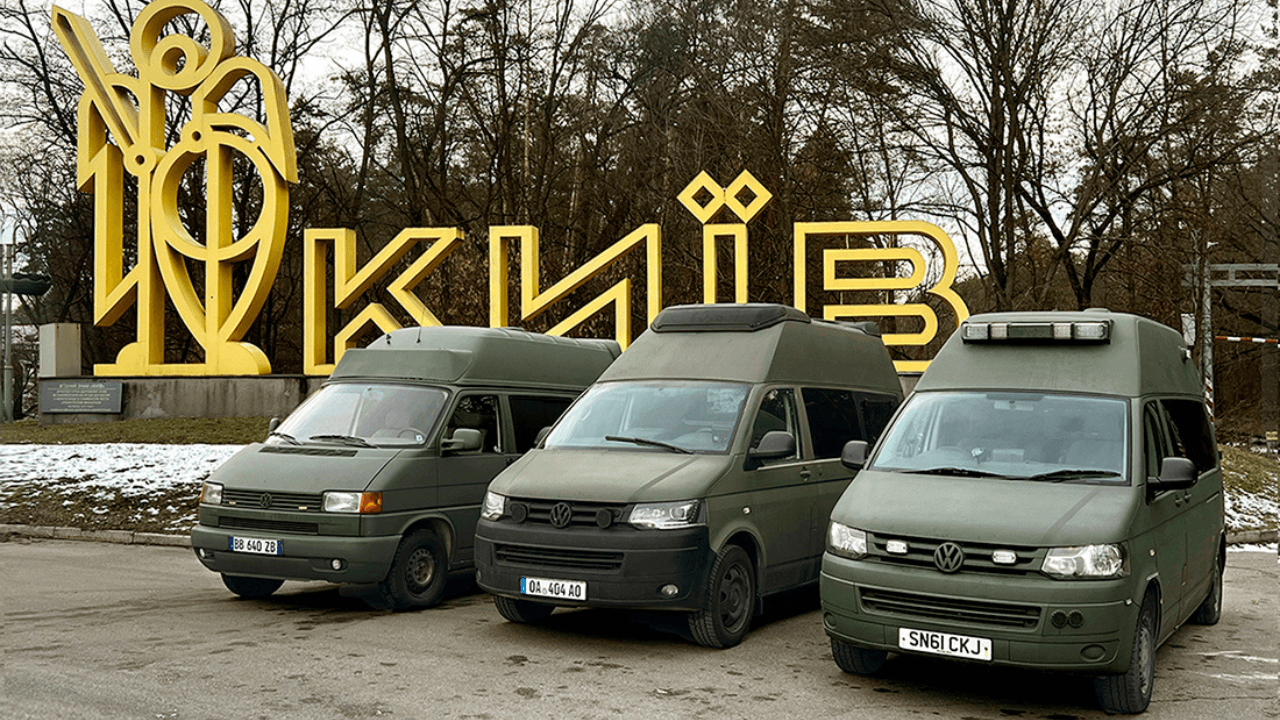
Eventually, he was based in the Donbas before relocating to Kyiv, where he continued working with evacuation teams. Hunter recounts that early in the war, you could often drive directly to the front line and collect casualties.
“That changed pretty quickly. Combat medics and combat lifesavers (soldiers with basic medical skills) now stabilise wounded soldiers near the zero line, before moving them to casualty collection points outside the kill zone of drone range.
From there, evacuation medics like me transport multiple casualties to stabilisation points further behind the drone-contested areas.
You're rarely transporting one patient. Quite often, you'd have five seriously wounded soldiers in a single ambulance. That changes everything about how you deliver medical care.”
Every evacuation becomes a data point
Presently developing medical technology in Berlin, Hunter argues that The AO is ultimately designed to become a data company rather than simply a hardware manufacturer.
"The hardware matters because it determines how you collect your information," he says.
"But the real value lies in the data you will generate over time. Every evacuation becomes another data point. And the data you collect can be extrapolated to forecast trauma outcomes using machine learning, and then predictive AI."
Rather than relying on intermittent manual observations, The AO's platform is designed to continuously record vital signs. As thousands of patient records are collected near the Ukrainian zero lines, the company aims to build a dataset unlike any that currently exists in combat medicine.
"Once you've collected enough real-world patient data, you can begin developing predictive algorithms," Hunt explains.
"A medic doesn't just need to know what a patient's condition is now. They need to know what's likely to happen next."
By identifying physiological patterns that precede clinical deterioration, The AO hopes to provide medical teams with advance warning before a patient reaches a critical state.
"If the system can recognise patterns showing a patient is likely to deteriorate in the next 15 or 20 minutes, it gives the medical team time to intervene before that happens. That's potentially life-saving."
Hunter estimates that it will require data from around 2,000 casualties before the battlefield management system can begin to develop reliable models capable of predicting trauma outcomes, including severe deterioration caused by massive blood loss.
"That isn't something you can simulate in a laboratory," says Hunter.
"You have to collect it during real medical evacuations in active conflict. It's difficult, dangerous and time-consuming, but there's simply no alternative. And, strangely enough, the safest place to collect this data is in Ukraine."
Although the platform is being developed on the battlefield, Hunter believes its long-term potential extends far beyond defence. Every ambulance service and first responder faces the same challenge: identifying which patients are about to deteriorate before the warning signs become clinically obvious.
The same predictive monitoring could ultimately support civilian emergency medicine worldwide, further serving disaster response teams, national security agencies, and first responders operating in high-risk environments, as well as the mining, energy and heavy industry sectors.
Building tech the military will actually use
For AO, the biggest competitive advantage isn't necessarily the technology—it's the relationships behind it. The company is already working with medical teams from Ukraine's 112th Brigade in Kyiv and 92nd Brigade in Kharkiv, giving its engineers continuous access to frontline feedback as the platform evolves. "The technology itself can be replicated," says Hunt.
"What's much harder is developing it alongside the Ukrainian Armed Forces, earning their trust, collecting operational data and continuously refining the system based on real-world use.
You can't do that remotely. It takes years of working with frontline medical teams."
That collaboration is critical because convincing militaries to adopt new medical technology is notoriously difficult. Medical protocols evolve slowly, and any new system must prove not only that it improves patient care, but that it is robust, reliable and intuitive enough to use under battlefield conditions.
Rather than asking military medics to change established NATO procedures, AO is digitising the existing Tactical Combat Casualty Care (TCCC) card that every NATO soldier already carries.
The aim is to improve how information is captured and transferred without disrupting familiar clinical workflows. Working directly with brigade medical teams has also fundamentally shaped the product itself. Early prototypes used large ruggedised tablets, but Ukrainian medics quickly rejected them as too bulky for combat casualty evacuation.
"We've redesigned major parts of the system because users told us they needed something smaller, simpler and easier to integrate into existing evacuation procedures," Hunt explains.
"That's exactly how product development should work."
That iterative approach appears to be paying off. According to Hunt, frontline medical teams have reached the point where they're telling AO:
"Bring the equipment and we'll use it."
"Trust is everything," he says.
"We're not turning up for a few demonstrations and then leaving. We're building the system alongside the people who'll ultimately rely on it. That takes time, but it's the only way to create something that's genuinely useful."
Today, the team combines frontline operational experience, biomedical engineering, hardware design, wireless communications, software development and machine learning.
Besides Hunt, technical development is led by CTO Hans Hübner and VP Eng Ota Fejfar, with support from collaborations with TU and Fraunhofer HHI in Berlin. Software development is led by Vladimir Skoupy, and ML/AI capabilities are provided by Stepan Reiben and colleagues in Prague and Ukraine.
The company is partnering with Zebra Technologies, and a sensor manufacturer planned through Harwario s.r.o. in Liberec, Czech Republic.
From Ukrainian ambulances to NATO
According to Hunt, the company is at TRL 7. The first deployments are expected to involve the 60 ambulances operated by the Hospitallers Medical Battalion.
AO is also in discussions with Dutch evacuation vehicle manufacturer Nixxen on a pilot with the medical corps of Ukraine's 112th Brigade, integrating the company's battlefield management platform into military evacuation vehicles. If successful, he believes the technology could eventually be deployed across the Ukrainian Armed Forces' fleet of approximately 4,000 military ambulances.
The company is also exploring future integration with emerging military "soldier cloud" architectures following discussions with developers from the Dutch and Ukrainian defence ministries.
Building a defence company from the frontline
Given I met Hunt as he pitched AO at Kyiv Defencetech Week in partnership with the European Defense Tech Hub, I was interested to get his take on the way forward for startups in the sector.
He contends that the biggest mistake founders make is building technology before fully understanding the problem.
“I see companies arriving in Ukraine with impressive hardware or software and then trying to find a use case afterwards. We approached it the other way around.
We spent months experiencing the problem ourselves before writing a line of code. That changes everything.”
He asserts that you can't really understand combat casualty evacuation from reading reports or watching videos.
“You have to understand what it's like trying to take someone's blood pressure while driving over damaged roads with multiple casualties in the back of an ambulance. Once you've lived through that, your priorities as a designer change completely.”
AO is currently fundraising to gain the runway to complete product development, continue testing in Ukraine and generate the clinical data that underpins its work.
“The product, the software, the sensor platform, the validation work—those all require time and capital. Our goal is to build something that's genuinely deployable rather than rushing an unfinished product into the market,” shared Hunt.
Hunt admits he spent enough time in Ukraine to see just how much of a difference small improvements can make.
“Sometimes a better process, better information or a few extra minutes can be the difference between someone living and someone dying. Once you've seen that firsthand, it's very difficult to walk away.
That's what continues to drive the company today.”
Meet The AO at Berlin Defense Tech Week, July 6 to 12.


Would you like to write the first comment?
Login to post comments