
Emmi AI is an Austrian deep-tech company that builds AI-driven physics simulation technology to accelerate engineering processes in fields like Fluid Dynamics, Multiphysics, and Solid Mechanics.
For a company doing this kind of work, how people collaborate matters as much as the tech itself. And it turns remote work on its head with its hybrid, remote-first approach. Every month, they fly everyone to Linz, Austria, for a week.
I spoke to Miks Mikelsons, COO, to learn all about it.
A research-heavy team, with applied outcomes in mind
Today, Emmi AI employs around 30 people, with research forming the backbone of the organisation. Roughly two-thirds of the team come from academic or scientific backgrounds.
“We’re very research and science-heavy,” says Mikelsons. “About 20 of our people come from academia.”
Around 40 per cent of the team is based across different locations such as Austria, London, and other parts of Europe.
Competing for talent without forcing relocation
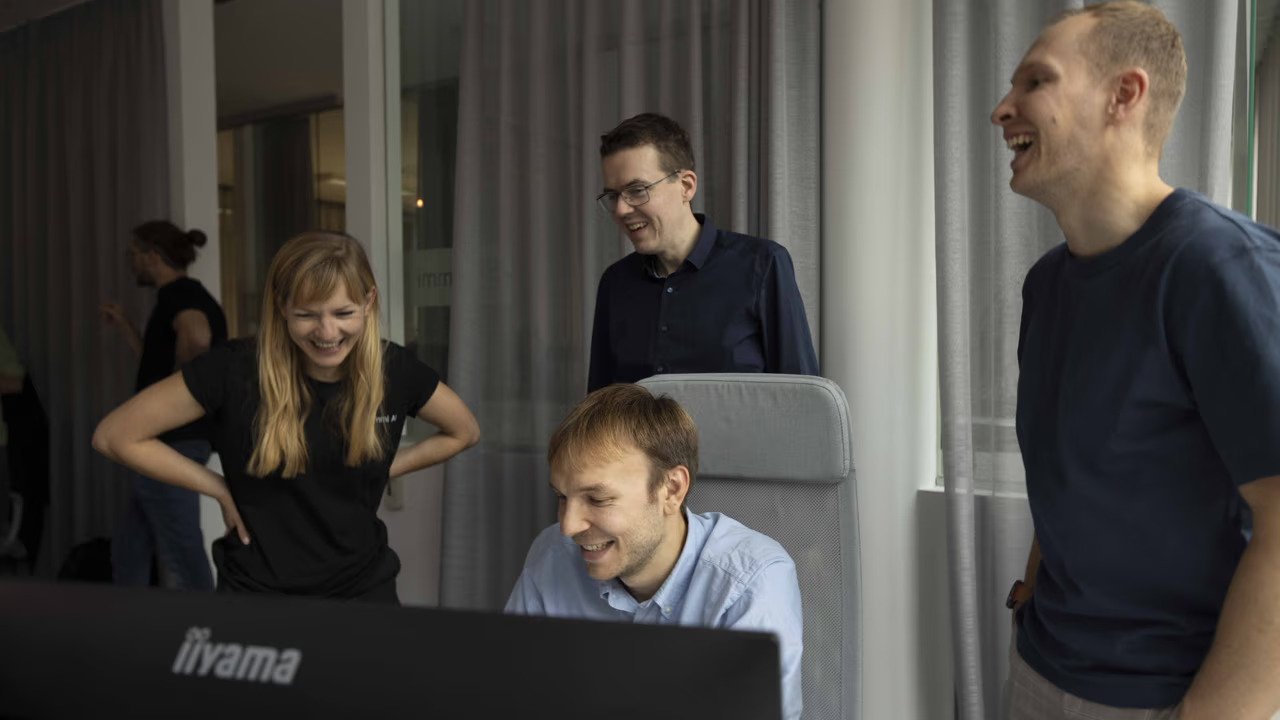
Once a month, for a full week — always the first week of the month, Emmi AI brings everyone together to the same location and covers all the costs of travel and accommodation. Mikelsons asserts:
“We’d rather spend an extra €1,000 per person per month on bringing people together than invest in the fanciest office or compete in the most aggressive hiring markets.
This allows us to attract talent who might not want to relocate.
“We’re still distributed across Europe, but this model works well here. It would be harder across the US, but in Europe it’s very achievable.”
For someone deciding whether to stay in the US or return to Europe, this model is very compelling. For example, the company hired someone originally from Spain who had been in the US, at the University of Pennsylvania.
Competing on culture, not compensation
From the beginning, Emmi Ai decided that as a scaling company in one location, it needed to differentiate.
“Especially for research-driven companies, culture matters a lot. We wanted strong chemistry and bonding early on, so we invested in being together."
“We’re not the company offering the biggest salaries in AI research right now. Some people are getting extremely high compensation offers, and we don’t compete on that,” Mikelsons admits.
And the result is that people recommend the company to their networks.
“What we offer instead is a way of working and a culture people value. That’s how we’ve been able to attract talent from places like Oxford and Cambridge.”
In-house tech by an all-star team
Emmi AI has developed its technology entirely in-house, with its core architecture built in Austria by co-founder and Chief Scientist Johannes Brandstetter and his research team. Brandstetter previously worked on Microsoft Aurora, widely regarded as the world’s first foundation model for weather forecasting.
Following the breakup of that original team, the researchers went on to found their own companies. Brandstetter chose to return to Austria from Amsterdam to build Emmi AI. “We have our own technology stack,” says Miks Mikelsons, COO of Emmi AI.
“The architecture was built by Johannes together with his team in Austria.”
Deeptech for real-world problem solving
“Johannes is a pure researcher,” Mikelsons explains.
Unlike many startup founders, Brandstetter comes from an academic background, with no prior business or operational experience. Emmi AI’s leadership team is intentionally structured to balance those strengths.
“Together with Dennis Just, our CEO, and myself focusing on operations and scaling, we bridge deep research with real-world deployment.. As we always say, we apply groundbreaking research to real-world problems and focus on business needs,” Mikelsons adds. “That combination is still relatively rare.”
How Emmi AI is rethinking how physical systems are designed and tested
In simple terms, Emmi AI uses AI to run complex physical simulations — like fluid flow, heat transfer, structural mechanics, and other engineering problems — orders of magnitude faster than traditional methods.
According to Mikelsons.
“People sometimes ask,:'What is simulation and what does it do in engineering?' I always tell the story that a hundred years ago, people tested designs by simply crashing them into a wall. Then came wind tunnels, where you could test how a design behaves under air pressure.
Later came numerical solvers — equations and formulas that calculate how a particular design will behave in the real world.”
However, this process is very expensive and computationally heavy and can take days or weeks.
“With AI, we can now do it in seconds or minutes. That changes the way you design and work in engineering entirely,” he shared.
Industrial use cases: where simulation meets reality
The company is active in sectors such as automotive and energy.
“For example, we have customers producing power transformers: those big machines you see near cities that convert high voltage to low voltage.
They’re full of metal and oil, and they involve very complex behaviours like transient simulations.”
Large grid assets such as power transformers are designed to last for decades, but they are also slow to replace. That reality shapes how electricity networks are operated today. “If you order one of these machines today—say from Brazil or another country — you might get it five years from now,” says Mikelsons.
With replacement timelines stretching into years, grid operators have little margin for error. Assets are therefore run cautiously, often well below their theoretical limits, to minimise the risk of failure.
“Because of that, grid operators run these systems very conservatively.”
AI-driven simulation offers a way to change that dynamic. By modelling how equipment behaves under different conditions, operators can gain a far more precise understanding of performance and risk.
“What we can build are models that simulate operational behaviour,” Mikelsons says.
“That allows operators to anticipate challenges and actively control how these systems behave in practice.” Rather than relying solely on conservative assumptions, grid operators can use simulation to make informed, real-time decisions—unlocking."
Letting the team self-organise
In terms of employee adoption, Mikelsons asserts that it's all about setting clear rules and planning upfront.
“From the interview process onward, people know exactly how this works. It’s always the first week of the month. It’s always the same location.
Costs are covered. People really enjoy it. Some take the night train, others fly in. The organisational overhead isn’t actually that big.”
In terms of logistics, the company’s office in Linz fits around 25 people comfortably, maybe 30 at a stretch and is hot desking by design.
The company is not aiming for hundreds of people, “but maybe 50 by the end of the year.”
Emmi AI also organises activities outside work, such as dinners, bouldering, and spending time in nature.
“We try to make it special without wearing people out,” shared Mikelsons.
One of the secrets is that the team increasingly self-organises. At the beginning, management structured everything. Now people suggest activities, breakfasts, and experiments. They try things, see what works, and adjust.
For people thinking of doing something similar, Mikelsons advises that clarity is key. You need to be clear about the identity you want to build:
“If you’re fully remote, set clear rules for that. If you meet once a year, plan everything around that. Budget, communication processes, meeting structures — everything follows from that decision."
Ultimately, Emmi AI believes that the best companies don’t invest only in the next fundraising round or the next customer. They invest in how they collaborate and how they work together.


Would you like to write the first comment?
Login to post comments