
As digital ordering reshapes how people buy food, one of the biggest operational bottlenecks in restaurants isn’t the kitchen — it’s the pickup counter.
Off-premises orders now dominate in many markets, yet the moment where digital orders meet the physical world remains largely manual, inefficient, and data-blind.
Startup Pickpad was founded in 2024 with a hardware-first system designed to bring automation and real-time data to restaurant pickup operations.
I spoke ot co-founder and CEO Yaro Tsyhanenko at Slush this year to learn all about it.
Tsyhanenko has been building technology for the restaurant and food-delivery sector for more than 15 years. He began with a simple city guide — a better way to help people discover where to eat and how to spend their time.
That product gradually evolved into a marketplace model similar to today’s delivery platforms. Across Europe, the company scaled the marketplace to 15 cities in Ukraine, facilitating millions of orders along the way.
“We started with a city guide, just helping people understand where they could go and what they could do,” Tsyhanenko explained. “That naturally evolved into a marketplace, and in Ukraine, we scaled it across 15 cities and delivered millions of orders.”
Building on that foundation, the team launched a ghost kitchen designed exclusively for delivery. The experience of running both the marketplace and the kitchen revealed the strength of the underlying infrastructure they had developed.
“Once we started operating ghost kitchens, we realised we’d built really strong internal technology,” he said.
"At that point, it made sense to turn it into a product.”
The company then began offering its platform as a service to third parties, including delivery providers and fast-food chains, effectively transitioning from an operator to a technology supplier for the broader restaurant ecosystem. “We started providing our technology as a service — first for delivery providers, and later for fast-food chains — because we knew it worked at scale,” Tsyhanenko added.
The pickup counter Is restaurants’ new front line
Then Russia invaded Ukraine, and he had to move his family abroad. Once in the US, he began rediscovering the restaurant space — not as an operator, but as an observer:
“I was sitting in different restaurants — fast food, fast casual, coffee shops — with my stopwatch and my notebook, making notes. Just to better understand how flows are changing.
Because tech is changing how millions of people order food and drinks, and how businesses operate.”
He observed a shift in demand, with many restaurants seeing pickup and off-premises orders overtake in-store dining.
“Statistics say that three out of four orders in the US leave the building. So it’s a complete change in consumption patterns. We all like ordering — grabbing and going, or delivery.” (In the future, it will be robots like with Estonia’s Starship). He discovered that every store has a designated place where all the digital orders are placed — the pick up area.
The data gap at the pickup counter
A new set of challenges is emerging at the intersection of digital ordering and physical pickup — and they all stem from the same issue: a lack of real-world data. The first is labour efficiency, he shared.
“Staff spend hundreds of hours of manual work every month just managing interactions with drivers and customers. Every interaction takes time. It creates an operational bottleneck.”
There’s also a huge problem with order accuracy. People forget drinks, mix up orders — it’s very common. That leads to food waste. And there’s a data problem.
“No one knows when an order was placed on the shelf or when it was taken. That means they can’t control the full order cycle — customer experience or delivery driver performance.”
In other words, restaurants don’t have the data to effectively monitor orders.
Pickpad provides that missing layer of data points.
How Pickpad connects digital orders to the physical world
Pickpad is a smart order-pickup system that connects the digital order world with the physical pickup counter in a seamless and automated way. Its proprietary hardware offers a differentiation from other order management services .
As Tsyhanenko shared,
“We can source those unique data points and make operations better for restaurants and delivery providers.”
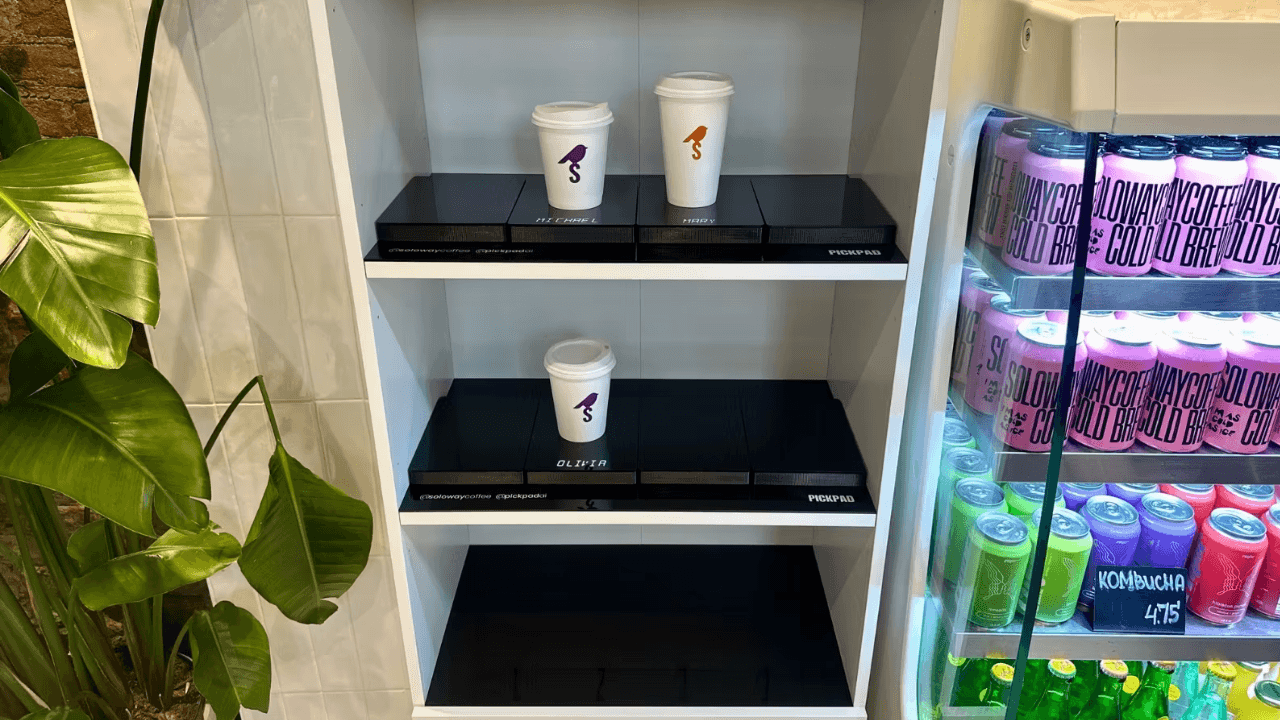
At the core of Pickpad is a modular system of smart pads placed in a restaurant’s pickup area, each equipped with sensors and machine-learning capabilities that automate the handoff between digital orders and physical pickup.
Each pad combines four sensors, a microcontroller, and a display into a simple, proprietary, and cost-efficient unit designed to work seamlessly at scale.
It helps restaurants measure their pickup operations:
- Was the order ready on time?
- Was it accurate?
- What was the prep time — from receiving the order to placing it on the shelf?
- What was the waiting time?
- Was there a delivery driver delay?
- Where exactly was the problem when the customer complained?
Pickpad sources those missing data points.
“We create a new data layer using sensors. A lot happens in the real world, and no one wants to build physical hardware because it’s harder. But someone needs to do it.”
The system integrates directly with existing point-of-sale (POS) software, pulling order data and updating statuses in real time as orders move through the pickup workflow.
When an order is ready, the corresponding pad lights up with a customer name or identifier, prompting staff to place the prepared order on the pad. Using its sensors, Pickpad verifies order completeness by matching the physical order against POS data, helping catch missing items before pickup.
Once the customer or courier collects the order, the system automatically updates the order status — eliminating manual clicks and reducing friction for both staff and customers.
The user experience is intentionally minimal. “The idea is to help people without bothering them with extra tech,” Tsyhanenko said. He illustrated the flow with a simple example:
“You order your coffee. The order goes into the system. The restaurant has shelves or a countertop — that’s the pickup area — and they upgrade it with Pickpads."
And here the order flow works like this: “For example, Starbucks uses stickers. We just print the pad number on it. And they know where that order goes. No RFID, no expensive tags — nothing special about the cup.”
The system assigns the order to a pad, which can show a number or a customer name. If something’s missing — like a doughnut — the pad shows a red light. When it’s complete, it turns green.
“At that moment, we record a timestamp automatically. Staff don’t press buttons — no one does that in reality. Customers and delivery drivers get notified. The order is ready, you grab it, and it’s done.”
Pickpad has gained traction for its frictionless tech. Restaurants are small — especially in cities like Berlin, New York, and London. Drivers are milling around, space is tight, and if you add complexity, it breaks.
“So this is about synchronisation — timing, statuses, readiness. Not fancy displays. Data and protocols,” shared Tsyhanenko.
Making hardware viable for price-sensitive hospitality
Pickpad’s business model is straightforward. Restaurants receive a box containing 10, 15, or 20 smart pads, which connect to each other and require minimal setup.
“It’s very simple,” said Tsyhanenko.
“We ship a box with 10, 15, or 20 pads. They connect to each other, and you just plug one into a socket.”
Installation is entirely self-serve, with no need for specialist technicians or complex configuration. “The setup is like IKEA,” he explained.
“You unpack it, arrange the pads based on your layout, and plug them in.”
Pickpad operates on a subscription model, with pricing starting at $9 per month per pad, including the hardware itself. “You pay a subscription — there’s no capital investment,” Tsyhanenko added.
“Hospitality is very price-sensitive. Price can’t be the blocker.”
So far, the product has gained the most traction in the UK and US, especially in fast food, fast casual, and coffee chains, where up to 80 per cent of orders leave the building. “We want inexpensive hardware for reliability and scale. We’re building physical infrastructure. Both our hardware and software are patent-pending.”
Why timing beats temperature
Of course I wondered about temperature monitoring as a potential data asset. Tsyhanenko admits that this was his first idea:
“I tested mug heaters, disassembled them, and talked to Starbucks managers. But temperature isn’t the problem. Many cups contain plastic. Some foods shouldn’t be reheated.
It’s a timing and data problem. If you know how long an order has been waiting, you can remake it quickly and make the customer happier.”
Industry validation for Pickpad’s pickup tech
Pickpad’s proprietary tech has gained significant interest from tech enthusiasts and industry insiders:
- CES 2025 Innovation Award honoree in the Artificial Intelligence category.
- Best of Tech Podcast Network recognition during CES 2025.
- Winner in Fast Company’s 2025 Innovation by Design Awards, which celebrate excellence in design and innovation across industries.
And in terms of sector support, Pickpad won at MURTEC Startup Alley 2025 — a competition for emerging tech solutions in restaurant and hospitality operations.
50 locations, seven countries — and this is just the beginning
Today, Pickpad have LOI in over 650 locations across seven countries as the startup is still in the pilot phase, rather than a full commercial rollout. Tsyhanenko is building the hardware in-house, with early versions produced using three 3D printers in his lab.
“The first pilots were really about proving the concept,” he said.
“Now the second wave is focused on measuring everything, building strong case studies, and getting ready for mass production.”
Pickpad has built 50 new pads for the next pilot wave, which will include one large Ukrainian brand with hundreds of locations and a US brand with about 100 locations.
“The pads are approved by cybersecurity and IT teams. Now we measure everything, then scale production and sales. That’s why I’m raising a pre-seed round,” shared Tsyhanenko.


Would you like to write the first comment?
Login to post comments