
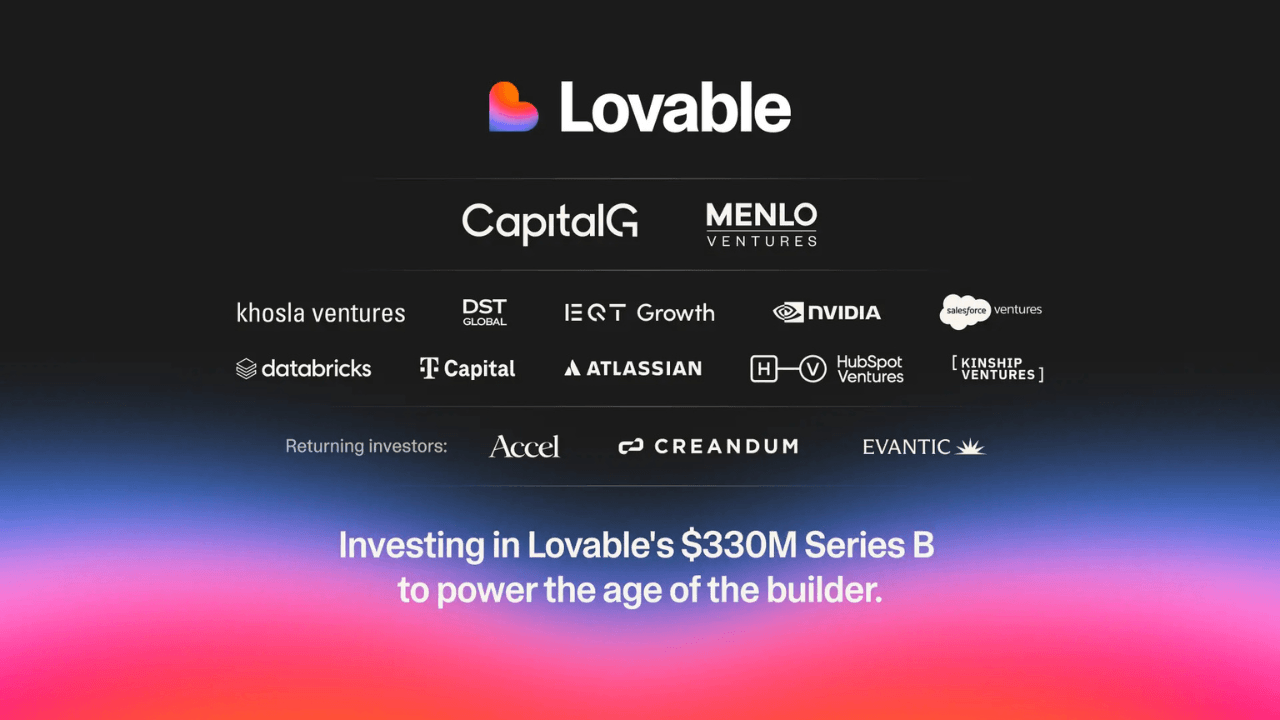
Lovable has raised $330 million in Series B funding at a $6.6 billion valuation, led by CapitalG and Menlo Ventures' Anthology fund.
Additional investors in this round include the venture arms of leading companies building the future of work: NVentures (NVIDIA’s venture capital arm), Salesforce Ventures, Databricks Ventures, T. Capital (Deutsche Telekom), Atlassian Ventures, and HubSpot Ventures.
They’re joined by Khosla Ventures, DST Global, EQT Growth, Kinship Ventures, and returning investors Accel, Creandum, and Evantic, among others.
According to a blog post published by the company, Lovable was launched to empower the 99 per cent — the people who've had ideas but lacked the technical skills to bring them to life.
In response a new category of people has emerged: builders.
“They're the product manager who wants to show, not just tell. The marketer with projects stuck in engineering backlogs. The ops team using outdated software for internal tooling. The nurse who sees a better way to visualise patient journeys. The artist in need of a website with an e-commerce platform integration—in time for the holidays. The founder turning a side hustle into the main thing. And they're building at a scale we never imagined:”
The company has experienced prolific user growth:
- 100,000+ new projects built on Lovable every day25 million+ total projects created in its first year
- Half a billion visits to Lovable-built websites and apps in the last six months
- 6 million+ daily visits to Lovable-built sites and apps (200 million+ monthly)
What they're building
Lovable's product-building platform is used by large enterprises such as Klarna and Deutsche Telekom are already doing.
Deutsche Telekom uses Lovable for UI projects that require rapid stakeholder alignment and time-boxed decision-making. Teams build functional prototypes early, making value tangible and enabling faster, more confident decisions across large, multi-layered teams. This has reduced time-to-market and development cycles from weeks or months down to days.
According to Lovable, a leading ERP platform, replaced traditional specs and slide decks with working prototypes, compressing a project that once took four weeks and 20 people into a four-day sprint with a four-person team. The change has allowed the organisation to take on four times as many projects, with around 75 per cent of its front-end now generated directly through the platform.
A global ride-sharing and delivery platform cut design concept testing from six weeks to just five days, enabling non-UX staff to build end-to-end flow demos themselves. In one case, a product manager created a functional prototype in 30 minutes — work that previously would have taken three months.
Jorge Luthe, Senior Director of Product at Zendesk, shared:
"Thanks to Lovable’s rapid prototyping and real-time collaboration capabilities, we’ve dramatically streamlined our product development process.
What once took six weeks — from idea to working prototype — now takes just three hours. This shift has enabled our product management, UX, and engineering teams to collaborate faster and more effectively than ever before."
Shipping real products in production
Other examples of compelling usecases:
- A nurse at one of the world's largest healthcare organisations built an app that visualises patient journeys — it's now included with every invoice as standard.
- A global professional services firm moved from static decks to functional prototypes for competitive bids, targeting 50% efficiency gains and helping their team win more business.
- A leading enterprise human capital management platform rebuilt their onboarding workflow tools in days rather than months, adding complex features like task tracking, progress monitoring, and AI assistance.
New startups emerging
Lovable has showcased some of the startups that have emerged from the use of its tech:
- Henrik and Peter built Lumoo, an AI-powered fashion platform with virtual try-on — $800K ARR in nine months, serving 15+ of the largest fashion brands in the Nordics.
- Allan built ShiftNex, a healthcare workforce staffing platform — $1M ARR in five months with 5,000+ healthcare users.
- Jaleel and Hussein quit their jobs with 60 days to make money, built QuickTables on Lovable, and are now making over $100K/year.
- Brickwise got into Y Combinator and secured $500K to help tenants and landlords solve property management issues — built on Lovable.
- Q Group, a leading Brazilian edtech company, built a premium version of their platform in one month and generated $3M in revenue in 48 hours.
According to Lovable, the investment accelerates its work in three key areas:
Deeper integrations. Builders don't work in isolation. They use Notion for docs, Linear for tickets, Jira for sprints, Miro for brainstorms. Lovable already connects to these tools, and we're going deeper — so the context you've already built informs what you create next.
Enhanced collaboration and governance. As more teams adopt Lovable, they need the features enterprises expect. We're continuing to invest in making Lovable ready for organisations of every size.
Infrastructure to take products from prototype to production. Lovable isn't just for demos. With built-in hosting, databases, authentication, and payments, people ship real products — not just mockups. We're continuing to build out the capabilities that make this possible.
According to Laela Sturdy, Managing Partner at CapitalG:
"Lovable has done something rare: built a product that enterprises and founders both love. The demand we're seeing from Fortune 500 companies signals a fundamental shift in how software gets built."
Matt Murphy, Partner at Menlo Ventures, shared:
"Lovable is a beloved product for all the right reasons. They've done what was previously unimaginable by turning a latent market of tens of millions of people into web developers and content creators.
We love category builders like our previous early investments in Uber and Anthropic — companies that have the opportunity to be enormous. Lovable is showing exactly that trajectory. "
According to Lovable:
“This is the age of the builder. A seismic shift in what's possible. The story belongs to the teachers, product managers, founders, and dreamers who now have the tools to bring their ideas to life. “


Would you like to write the first comment?
Login to post comments