


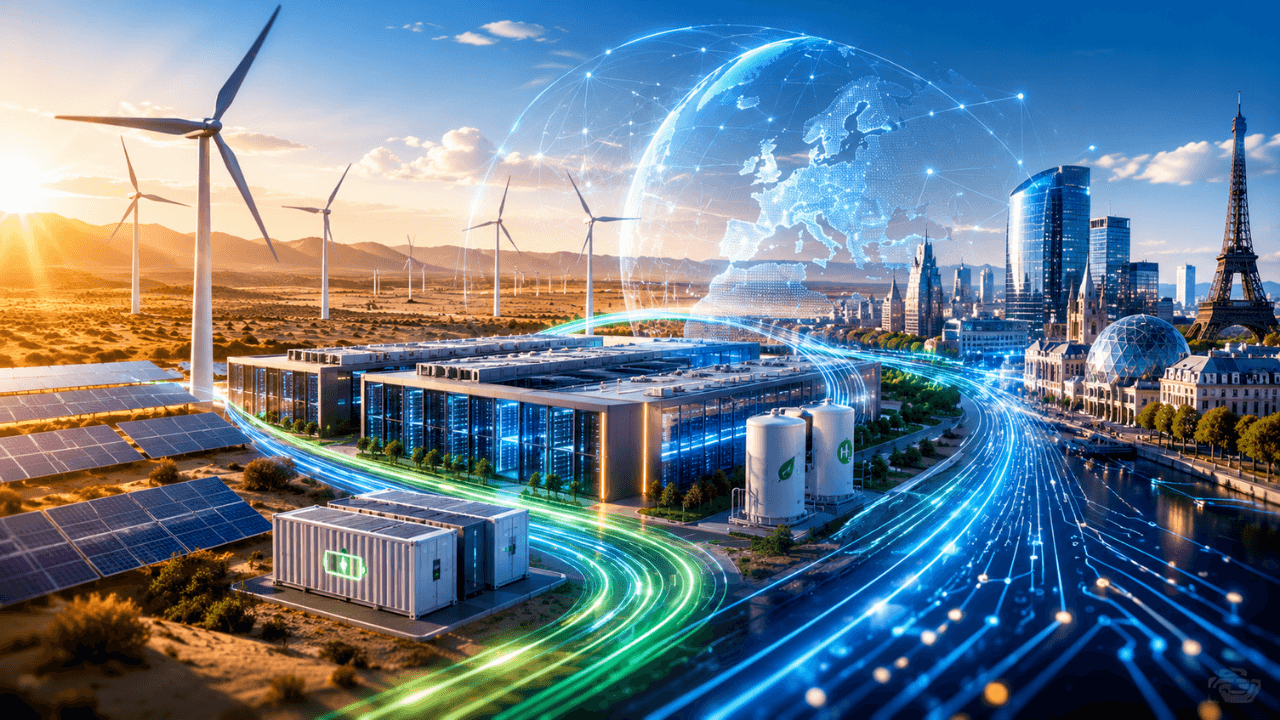
At VivaTech's tenth edition, the question was no longer whether AI reshapes the physical world, but how nations can secure the infrastructure that powers it. Envision's Mission Gobi offers Europe one answer: build AI where renewable energy is abundant, rather than concentrating demand where people already compete for power.
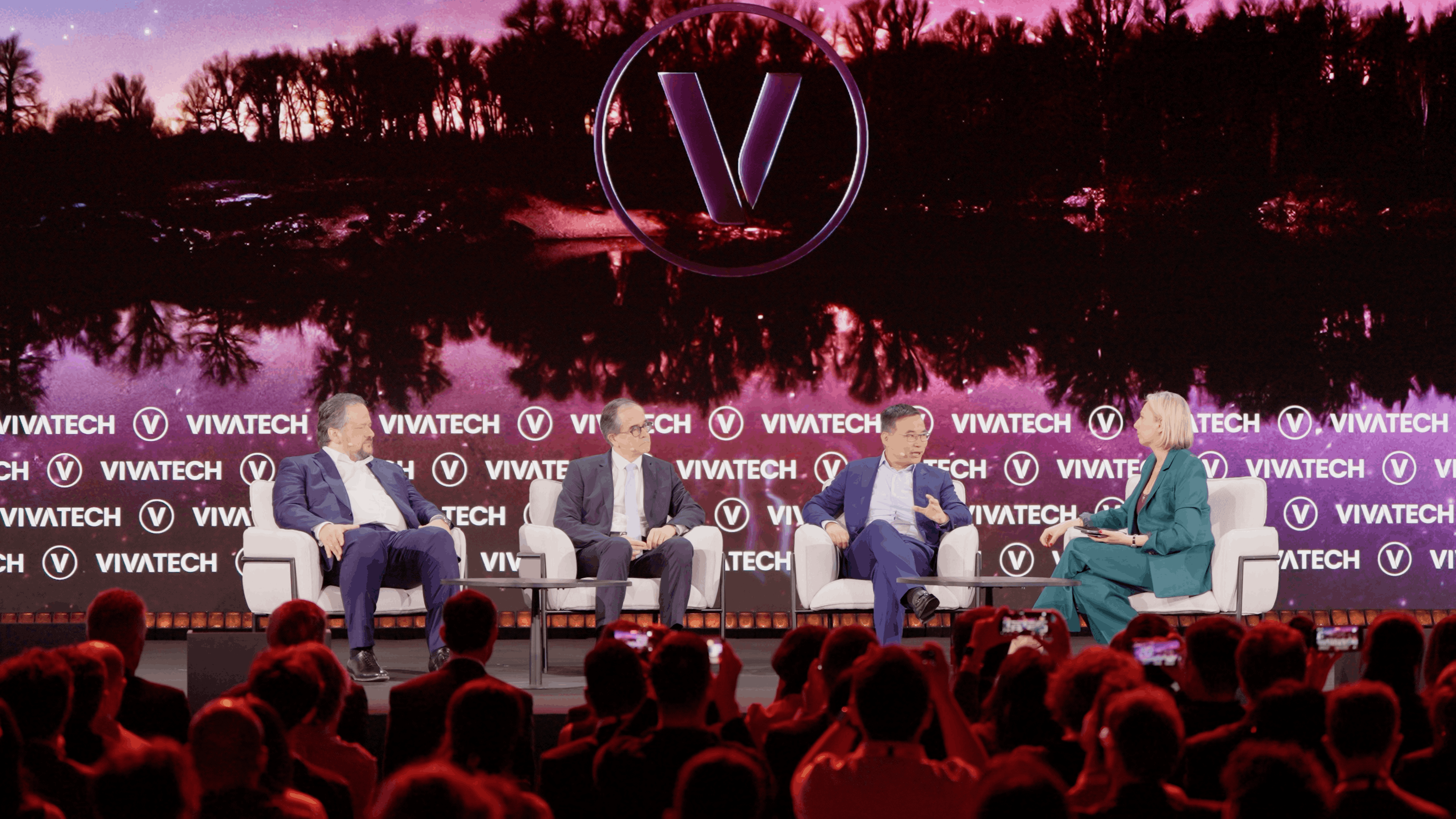
When Emmanuel Macron and Narendra Modi shared the stage at VivaTech this year, the discussion moved past product demos to something more structural: who can secure the infrastructure, data, cloud and energy on which all AI now runs. For Europe, the question lands hard. The continent's power grids average around 50 years of age, and AI's appetite for electricity is colliding with that ageing infrastructure in real time.
The strain is already visible. As data-centre demand climbs, the cost of grid upgrades increasingly lands on household bills, and local opposition to new builds is spreading. The IEA estimates data centres took around 1.5 per cent of global electricity in 2024, rising toward 3 per cent by 2030, with AI demand tripling over the period. Modest in aggregate, but in hubs such as Dublin and Frankfurt the local share is already far higher, and that is where the politics bites.
Beyond electricity demand, Europe faces a broader challenge of digital and energy sovereignty: ensuring that future AI growth is supported by infrastructure that is secure, affordable and sustainable.
Against that backdrop, the industry is exploring several possible pathways.
Elon Musk's SpaceX has floated launching AI satellites to build data centres in orbit, drawing uninterrupted solar power above the atmosphere. The vision reflects a growing realization that the defining constraint of the AI era may not be computing power, but energy.
Envision Energy's answer is nearer to the ground, and nearer to deployment. At VivaTech the global green-tech firm launched Mission Gobi, a global initiative to develop 5GW of green AI data center (AIDC) capacity in desert and arid regions by 2030. The premise is straightforward: place compute where the renewable power is, on land with strong sun, steady wind and no competing residential demand, then coordinate generation, storage and load as one system. Envision points to operational reference sites in China, including a 2GW renewable-powered demonstration in Chifeng and the world's only gigawatt-scale AIDC powered by directly connected renewable energy in Envision Galaxy Campus in Ulanqab.
SpaceX looks to space for the answer. Mission Gobi looks to the desert. Both begin with the same premise: the next generation of AI infrastructure must be built where energy is most abundant. If SpaceX is opening a frontier in space, Mission Gobi is opening a frontier in energy.
For European stakeholders, Envision is not an unfamiliar name. Its DuoAi plant in France is the only operational power-battery facility in the country. Renault Group CEO François Provost notes that the Renault R5, one of Europe's best-selling EVs, runs on batteries from Envision's French gigafactory, highlighting the importance of global industrial collaboration in accelerating Europe's energy transition. Société Générale CEO Slawomir Krupa has called Envision “an outstanding and exceptional enterprise.” The point those endorsements make is simple: a firm already embedded in European manufacturing and finance is a more credible partner for a desert-compute blueprint.
The model targets four headaches European policymakers know well. It keeps AI load off residential grids, so households are not subsidising compute through higher tariffs. It runs on wind, solar, storage and hydrogen, aligning with EU carbon-neutrality targets. It lowers operators' total cost of ownership by co-locating cheap green power with the racks. And it draws on new renewable capacity rather than diverting existing civilian supply, sidestepping the energy-poverty risk. Deserts and arid zones span more than 30 million square kilometres globally, an underused resource that, in principle, extends to Europe's own low-density renewable regions.
The competitive field is taking shape. NVIDIA is pairing with utility AES on on-site-powered AI campuses. Siemens and Schneider Electric offer source-grid-load-storage software platforms. Envision's pitch is fuller vertical integration, from wind turbines and storage through AI models to compute orchestration, backed by large-scale industrial deployment. Its Chifeng Net Zero Industrial Park anchors a green ammonia project that already trades across borders, with a first bulk cargo shipped this year to South Korea, a working example of renewable energy moving as a tradeable commodity.
Whether the 5GW pledge arrives on schedule remains to be seen. But the blueprint is coherent, and it aligns with the EU's Green Deal industrial ambitions: build AI capacity on new clean power, in places that do not pit data centres against residents. The projects in China provide large-scale proof points for an approach that could be adapted to different geographic and regulatory environments, including parts of Europe.
The defining infrastructure challenge of the AI era is not computing. It is energy. The question for Europe is whether AI will compete with households, industries and communities for finite electricity, or whether new models can unlock entirely new sources of clean power. Mission Gobi represents one possible answer. Not by asking people to consume less energy, but by ensuring AI is built where energy is most abundant.


Would you like to write the first comment?
Login to post comments