

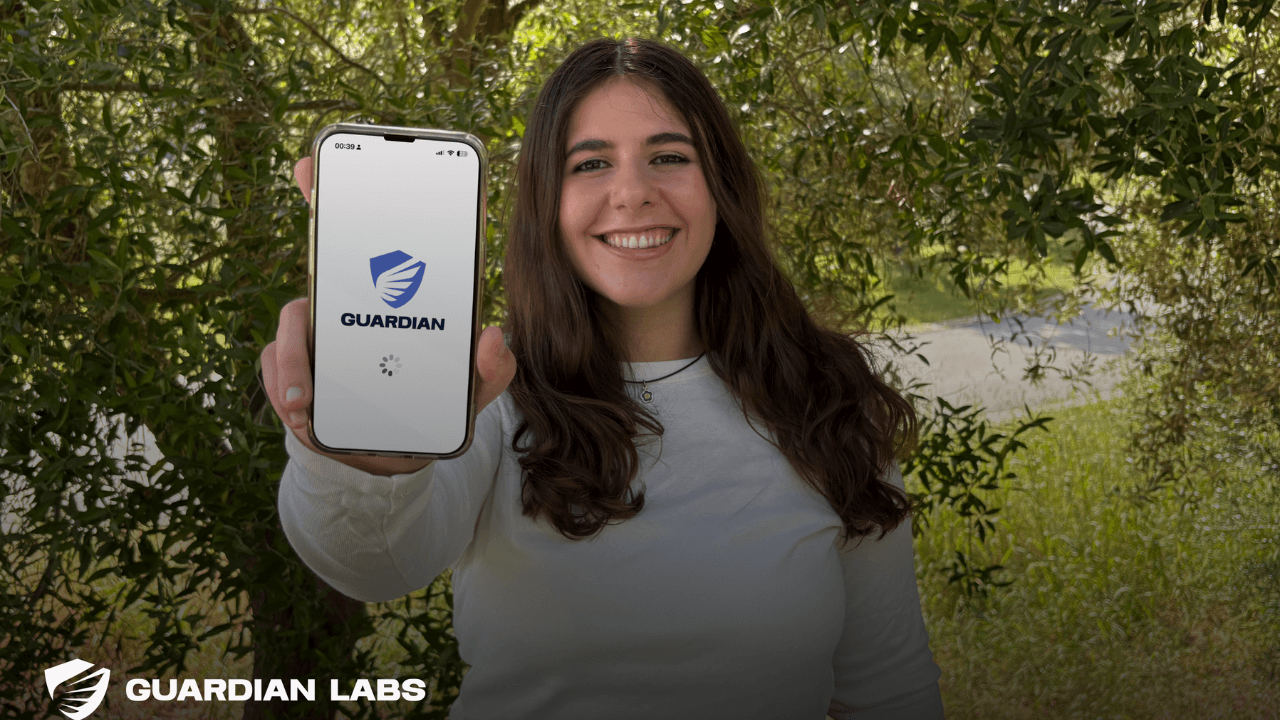
For Rita Barbosa, the idea for her startup, Guardian Labs, began when a phone scam targeted her grandmother. She recounts:
“The scammers told her that the water she was drinking wasn't safe. They led her to believe there was something wrong with the water — there wasn’t — and that she was, in a way, contaminating her and us.
She thought, "I can't live with contaminating my grandchildren and children."
So she bought four water filters, each for around €1,000, when each filter was actually worth around €20.”
For Barbosa, “it was such a shock — not because she was scammed, but because of the way she reacted to it. "
"She basically said to herself, "After this, I can't really use technology. This isn't something I should be doing alone." It really took a toll on her independence. She stopped picking up the phone altogether. At the time, I thought to myself, what can I do to prevent this, besides telling her, "Hey, don't pick up the phone"?
This thought gained legs after she attended a hackathon in Germany, where she won first place with a prototype of what would become Guardião.
Since then, it has grown from a hackathon project into a startup that partners with the Portuguese Public Security Police and two leading engineering universities in Portugal, collaborates with one of the country's largest accelerators, and has secured the support of the President of the Republic.
Stopping the scam before the phone even rings
Guardião serves as an AI layer between an incoming call or message and the recipient. Its models run locally on the phone, rather than sending the contents of calls or messages to a remote server.
For SMS, the AI analyses the message before it generates a notification, looking for signals such as spoofing, phishing links, and patterns of manipulation. With calls, Guardian Labs found a way to do this even before the phone rings.
Guardião checks known scam information and analyses the content for tactics such as artificial urgency, emotional pressure, or requests for banking codes.
If it determines that the interaction is fraudulent, it can block the message or call before the user is exposed to it. If Guardião detects a suspected scam, the call does not ring, or the message is intercepted before it reaches the user in the normal way. Instead, the app sends a notification alerting the user to the attempted contact. Users can also view a history of intercepted calls and messages in the app, along with Guardian’s reason for blocking each one and its assigned risk level.
“It's proactive because it's already there as the first line of defence. You don't need to protect yourself manually,” explained Barbosa.
“It's also invisible because you don't really need to know that it's running. You install it, give it the permissions, and then it's always running in the background and defending you.”
According to Barbosa, the tech behind it was only recently possible because there weren't super-small AI models that could run locally on your phone:
“We don't want to have our calls or messages analysed by someone else on a server just to check whether they're scams. But if the AI models run locally, the calls and messages don't leave your phone. And this is exactly what Guardião is doing.”
The Portuguese police provided the company with a lot of their data from reports they'd received about phone scams, which the company uses to fine-tune its AI alongside other data it's collecting through its reporting system.
Scams change when you cross a border
Guardião is designed to address a broad range of scams, from voice phishing and fraudulent messages to malicious links. But Barbosa says understanding scams requires a country-by-country approach, as the tactics used in Portugal, for example, can differ from those seen in Germany.
One of the most common scams in Portugal is the "Hi Mum, Hi Dad, I lost my phone" scam in which fraudsters impersonate a victim's child, claiming to have lost or broken their phone and to be contacting them from a new number. They then create a sense of urgency, typically asking the parent to transfer money or pay an outstanding bill on their behalf.
“We also see a lot of scams where you receive a message supposedly from our national healthcare service saying, "You have an outstanding payment. You need to pay €46 or €47." It's a very specific number, but it's always the same one. So many people don't even think twice about it because they may have gone to the doctor recently," shared Barbosa.
"I think last year it was around €2 million to €3 million from this scam going to these bank accounts."
Combining this local data with intelligence from other markets could also help Guardian Labs identify scam campaigns as they spread between countries and adapt its models accordingly.
“Having this overview across different countries and different data means we can protect against a lot of different scams: voice phishing, message scams, malicious links, and all of these different scams before a cent is transferred.”
And because the company gains an overview of different countries, they can identify a scam campaign and potentially stop it at a higher level.
What happens when the AI gets it wrong?
I was curious about the risk of false positives, but Barbosa contends that, at this stage, preventing false negatives — allowing a genuine scam to slip through — is the greater priority.
“We mitigate false positives by continuously training on the data.
If our systems are 99 per cent accurate and there’s 1 per cent false, we feel like that small number of false positives isn’t the worst thing because you can see all the messages and calls directly on your dashboard. “You’re not being denied any data. You can see the spam calls, messages, everything.
Someone falling for a scam is much worse than someone missing a message and then going into the app and saying, ‘Oh, this message was actually something I wanted.’"
By continuously training its models, Guardian Labs has very high accuracy.
Taking scam detection beyond the individual
Besides Guardião, the company is also developing an intelligence platform that enables fraud to be stopped at the corporate and institutional level. It's providing banks, telecom operators, and law enforcement authorities with intelligence on active international scam campaigns.
This can, for example, enable mule bank accounts — accounts used to receive, move, or withdraw money obtained through fraud — to be flagged and reported to banks, potentially allowing them to be frozen before victims transfer money.
The company is currently finalising its first international pilot partnerships with banks and telecommunications companies. Guardian Labs plans to make money through B2B relationships with banks, insurers, and telecom operators, which themselves incur costs from fraud through refunds, insurance, and legal action. Relationships with public authorities would operate as partnerships, and would keep Guardião free for individuals.
“This type of protection is really needed. It's like a human right. We already have so much AI controlling and scaring us, creating so many different types of problems, that having to pay for this kind of protection just doesn't sit right with us. It should be free,” asserts Barbosa.
From hackathon winner to 20,000+ followers
In case you’re wondering about the power of hackathons, Barbosa explained that after winning the German hackathon in February, the company went viral in Portugal.
“We started growing exponentially across Instagram, Facebook, and now WhatsApp. We have almost 20,000 followers on Instagram alone since February, which is very fast. Because of this, we got a lot of exposure.
But the really important point is that it's such a big problem anyone can see. It's very relatable and understandable.
Everyone I talk to tells me, "Oh, I have a cousin," or, "My dad," or, "My sister has fallen into one of these scams." They know firsthand what it's like to not only lose the money, but also lose some of the trust you have in using your own phone. It's a problem that needs innovation and new ideas to solve it.”
Guardian Labs has achieved a lot in less than a year, with a lean team of three — the CTO is Barbosa's brother Tiago, who has a background in entrepreneurship as a startup founder and cybersecurity
“I've known him for all of my 25 years, so it's really nice to be working with him,” she joked.
It raised pre-seed funding earlier this year. In the future, because the AI runs locally, Guardião could even be embedded into platforms such as Telegram, WhatsApp, or Instagram as an additional feature.
“We see a lot of scams that start in messages, then go to WhatsApp, then go to Instagram. If you have an overview directly on your phone, and your phone already has this information, it's easier to stop these scammers,” she said.


Would you like to write the first comment?
Login to post comments