

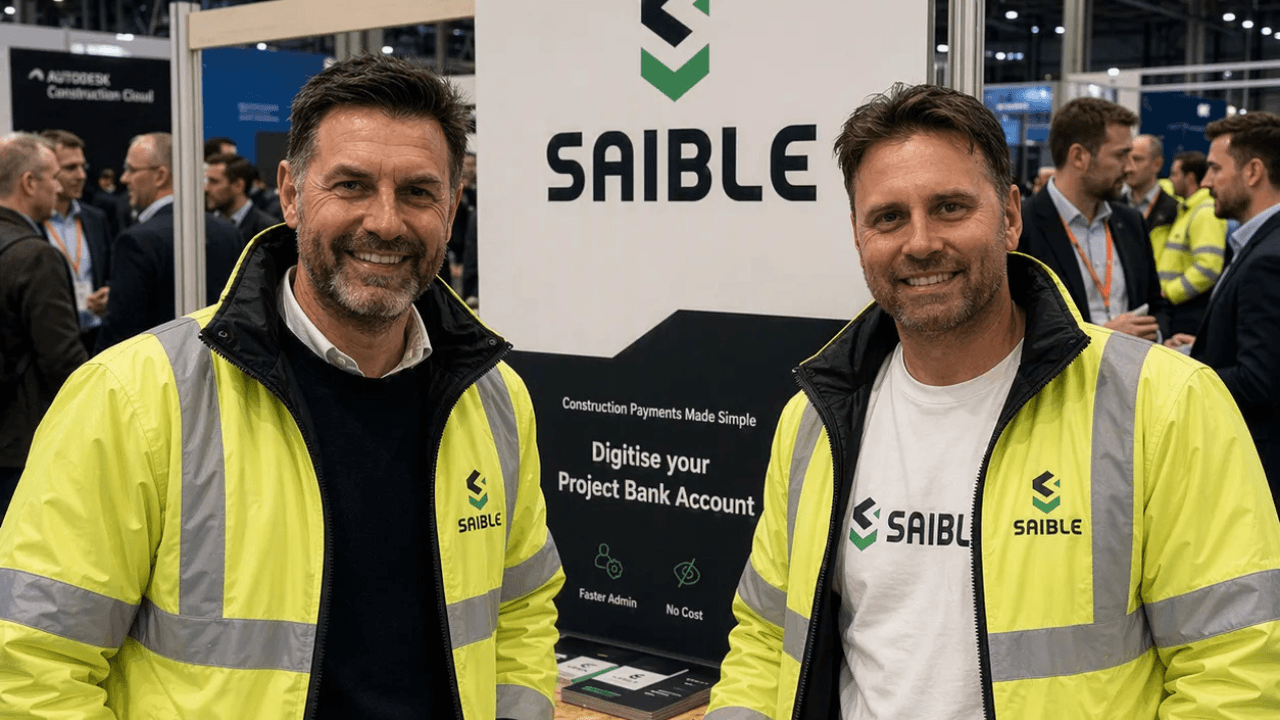
Saible, a UK construction fintech building software to stop project money from being delayed, withheld or trapped before it reaches suppliers, has raised £2.9 million from angel investors. The funding comprises £2.1 million already raised and a further £800,000 angel round, taking Saible’s total funding to £2.9 .
Saible tackles one of construction’s most persistent problems: systemic cash extraction by late and non-payment. On a large project, four or five tiers can separate the project owner and the smallest supplier. At each stage, a payment can be delayed or held back, often because the firm holding it can use it as free credit to fund their operations.
In the worst cases, the money never arrives: when ISG collapsed in 2024, it left more than £1.1 billion in unpaid debts, with hundreds of subcontractors unpaid for completed work.
The cost falls hardest on smaller firms and on the people who run them. Late payments mean missed payroll, staff layoffs and owners working unpaid to keep their businesses afloat.
Recent industry research from UK accountancy and advisory firm Menzies found that for the fourth year running, construction recorded more insolvencies than any other sector in the UK, with 4,450 firms failing in 2025 (up 9 per cent) and a further 1,180 in Q1 2026 alone.
The issue is moving up the political agenda. New and proposed late-payment legislation, tighter public procurement rules and the Construction Playbook are increasing pressure on construction clients to show that suppliers are paid fairly and on time. Project Bank Accounts were designed to help by ring-fencing project funds, but in practice, they often protect only the top tiers of the supply chain and can be cumbersome to set up and run.
Saible’s Digital Parallel Payment Account (‘DiPPA’) is designed to extend that protection further. Saible provides the software platform for approvals, verification and audit, while project funds are held in a trust with a regulated banking partner Griffin.
Project funds are released directly to approved firms across every tier of the supply chain simultaneously, rather than moving down the chain from contractor to subcontractor. That means a smaller firm several layers below the main contractor does not have to wait for each company above it to pass the money on. The project owner pays Saible a 0.25 per cent fee of the payment value; the supply chain pays nothing.
Jarvey Moss, co-founder and chief executive of Saible, said:
“Late payment in construction goes beyond the balance sheet. It creates pressure that runs through businesses, workers and families. When firms are waiting months beyond agreed terms, people are left worrying about whether they can pay staff, suppliers, and themselves.
“Payment in construction is dysfunctional and is in desperate need of better control. This funding allows us to expand our platform, support our regulatory work, and take Saible into more live projects with project funders that need clearer control over how money moves through the supply chain.”
Saible is working with the Environment Agency and BAM Nuttall on public-sector pilots designed to test its payment-control model on live, government-backed construction projects. The first pilot is expected to be a £1.5 million to £2 million footbridge replacement, due to commence in summer 2026, with a programme duration of 12–16 months.
The pilot followed work by a Cabinet Office-sponsored group examining payment problems in construction and is intended to generate early evidence on payment visibility, supplier payment timing and supply-chain reach that can inform wider public-sector payment reform.
“Project Bank Accounts recognised the right problem, but they were never built to protect payment all the way down the supply chain,” said Phil Brown, founder and executive chair of Causeway Technologies and a Saible investor.
“Saible is different because it gives clients and contractors a practical way to make sure money reaches the firms doing the work, not just the businesses at the top of the chain.”
Alongside the angel round, Saible is opening a limited £50,000 Crowdcube-hosted allocation from 15 July to 31 July, intended to allow smaller construction businesses and industry participants to invest alongside Saible’s angel backers.
Lead image: Dr Tim Whitehill (CSO) and Jarvey Moss (CEO) of Saible. Photo: uncredited.


Would you like to write the first comment?
Login to post comments