

Urban mobility is increasingly shifting toward electrification as cities aim to reduce emissions and improve air quality.
However, while more than 60 per cent of new passenger cars sold in the EU were electrified — hybrid, plug-in hybrid or battery-electric — fewer than 6 per cent of new motorcycles sold last year were electric.
Rui Bento, co-founder and CEO of the Lisbon startup Pollen, attributes this to several factors. Electric motorcycles are still more expensive than petrol models because batteries account for a much larger share of the vehicle's overall cost.
“In a car, you can spread that battery cost across a much larger vehicle while also eliminating many mechanical components. Motorcycles simply don't have that advantage.”
The second issue is charging. Riders have to stop frequently, and recharging typically takes five to eight hours.
According to Bento, no one wants a motorcycle that's more expensive than a petrol bike.
“For someone who uses a motorcycle professionally all day, it's a complete deal-breaker. That's the real reason why there are still so few electric motorcycles on European roads today.”
The road to solving the gap in urban electrification
Bento has spent the past 12 years working in urban mobility and logistics. In 2014, he returned to Portugal to launch Uber, eventually leading the company's operations across Portugal and Spain. In 2019, he co-founded foodtech startup Kitch with a former Uber colleague.
"Little did we know that within a year, there would be a pandemic that completely transformed the restaurant industry. We built the product, scaled across Europe, and eventually exited to Delivery Hero."
Following this, he met Miguel Morgado (Co-Founder and CTO at Pollen
He shared:
“We kept coming back to one problem: while vehicles in cities are electrifying at a much faster pace than most people realise, motorcycles are not.”
Building a universal battery instead of redesigning motorcycles
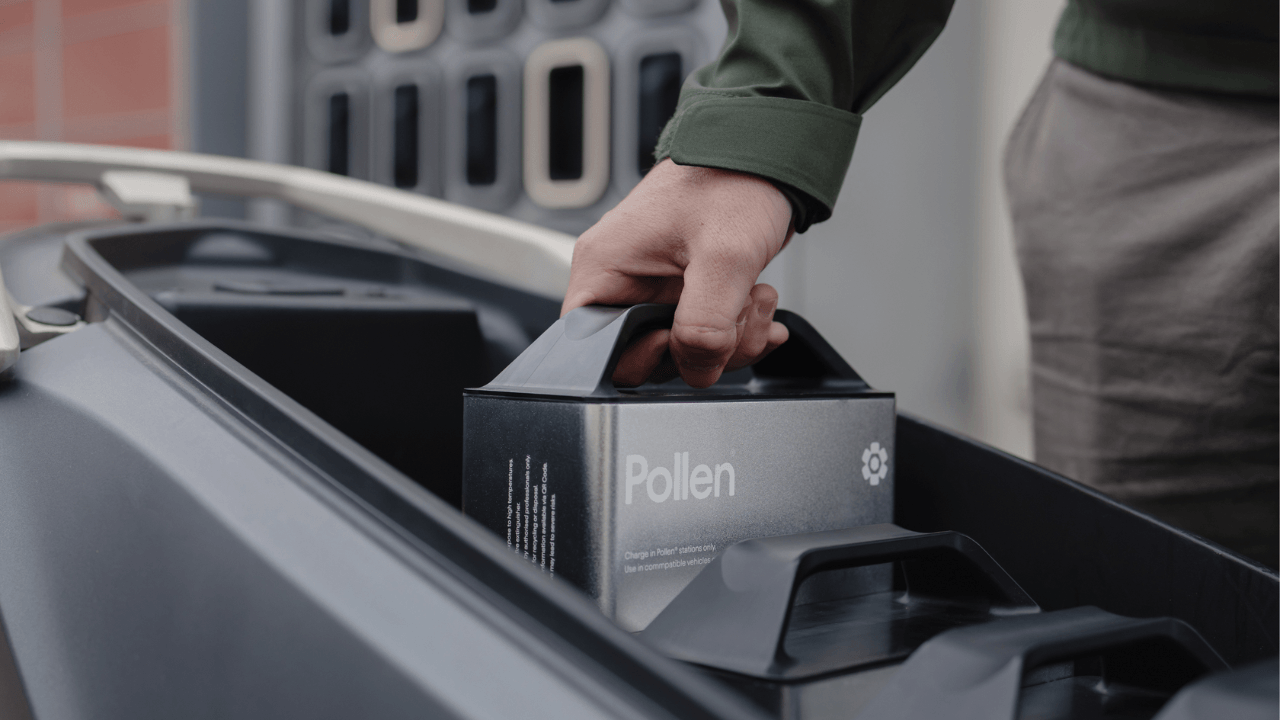
Pollen is a Lisbon-based clean mobility startup developing a universal battery-swapping network for electric mopeds and motorcycles.
Currently, every battery-swap network operating today for OEMS such as Gogoro, Honda, KYMCO, and Ionex requires OEMs to design vehicles around their battery. The result is that swapping has stalled outside a few Asian markets.
Pollen’s universal battery is built to solve these barriers.
Its ECS (Electronic Cell Switching) technology lets a single battery safely power vehicles from different makes and models, without loss of performance, making fast, network-wide swapping possible for the first time, alongside a multi-protocol comms layer that lets the battery communicate with any bike, and a form factor compatible with most existing two-wheelers.
As a result, OEMs can adopt the battery without redesigning their vehicles or introducing new SKUs.
Turning every battery swap into a health check
Pollen launched in Lisbon first, with three stations already operating at Galp service stations in Amoreiras, Alvalade, and Lumiar, and several more planned in the coming months. The stations are automated, available 24/7, and swapping takes seconds: no lines, no range anxiety, no downtime.
Each battery-swapping station is equipped with sensor technology. Whenever a battery is returned, the station communicates directly with it and performs a complete diagnostic. It analyses everything that's happened since the battery last left the station and ensures it is safe and healthy enough to be returned to another customer.
With battery swapping, every battery is effectively inspected daily. Each inspection checks whether individual battery cells remain balanced while monitoring temperature, pressure and data from the battery management system. If any parameter falls outside operating thresholds, the battery is automatically removed from circulation for maintenance rather than issued to another rider.
For Bento, the critical question is always: Is this battery in perfect condition to be issued to the next customer?
“That's one of the major advantages of battery swapping compared with battery ownership. If you own your own battery, it may only be inspected once a year during routine servicing.”
Using real-world riding data to improve battery design
The battery-swapping stations also provide valuable operational data about how people are actually using the batteries, which, according to Bento, “feeds back into the design of future generations.”
An example is data about terrain. Some cities are extremely flat, so vehicles don't require rapid acceleration or high current draw. Lisbon, on the other hand, has a lot of hills. Riders accelerate much harder, which creates repeated peaks in power demand and much higher discharge currents. For Pollen, that raises interesting engineering questions. Bento explained:
“Should we use exactly the same battery everywhere, or should we optimise batteries for different operating environments? It even affects the type of cells we select. Do we prioritise long-term cell life, or do we choose cells that can better support repeated high-current discharge during steep climbs?”
Giving batteries a second life
Given that many Pollen end users are likely to be couriers and delivery riders using their bikes intensively, Pollen designs the batteries for approximately 1,200 charge cycles. How long that translates into in calendar time depends on how heavily the network is used. Bento explained:
“If the network is highly optimised and riders are swapping batteries constantly, the batteries will reach those 1,200 cycles more quickly—but they'll also deliver a tremendous amount of useful work during that time.
If utilisation is lower, they'll simply take longer to reach the same number of cycles. The important point is that the lifespan is determined by charge cycles rather than years.”
Further, battery swapping increases battery lifespan. Today, most electric vehicles have their own dedicated battery. Often, the vehicle reaches the end of its useful life while the battery still has significant capacity remaining. This means, in effect, you're retiring a battery that still has plenty of useful life left. Battery swapping changes that.
“Because batteries are shared across many users, they're utilised much more efficiently. You extract far more value from each battery before it reaches the end of its automotive life,” explained Bento.
“In other words, you get many more kilometres from every kilogram of lithium.”
Increasing grid-resiliency
Once a battery reaches around 70 percent of its original capacity, it may no longer be ideal for powering a motorcycle because riders expect maximum range but it's still perfectly suitable for stationary energy storage systems that interact with the electricity grid — charging when there's excess renewable energy, such as during periods of strong solar generation, and supplying electricity back to the grid during periods of peak demand, for example when renewable generation is low and electricity consumption suddenly increases.
According to Bento:
“Even before we launched, municipal organisations approached us."
Last year, Portugal and Spain experienced a major blackout caused by grid instability. One of the biggest issues was the lack of backup power for critical infrastructure. Traffic lights stopped working, intersections became chaotic, and there was no local energy storage to keep essential systems running.
"That led us to ask a simple question: what if a second-life battery station were connected to a major intersection? A single battery could keep traffic lights operating for several hours, maintaining a critical piece of city infrastructure during a power outage. That's definitely an area we'd like to explore because we think these batteries could create value well beyond transportation,” shared Bento.
Two-wheelers are just the beginning
Beyond motorcycles and mopeds, Bento sees the adaptable battery as a technology platform rather than a product that's limited to motorcycles. One example is commercial delivery vehicles that currently carry a single battery and have to return to a depot once it's depleted. Swappable batteries could allow them to complete an entire route without returning to recharge.
Looking further ahead, there are applications in food trucks, recreational vehicles that currently rely on propane or diesel generators, and electric boats.
For Bento, Marine applications are particularly interesting because charging infrastructure is often limited. “Instead of returning to a marina for several hours to recharge, a boat could simply swap batteries and head straight back out.
"More broadly, we see this as part of a future of portable, adaptable energy. Anywhere reliable grid access is difficult—or where remaining off-grid is valuable — a swappable battery system could become an important part of the solution.”
Pollen is seeing strong interest from fleet operators that already have commitments to electrify their vehicles.
“Until now, those commitments often came with higher costs,” shared Bento, but now there's a genuine economic incentive.
“Companies can reduce operating costs while moving to zero-emission vehicles. That's especially important at a time when petrol prices remain high. Anyone using a motorcycle professionally feels the impact of paying more than €2 per litre.
Once electricity becomes both the cheaper and more convenient option, the decision becomes much easier than it was even a year ago.”
Scaling a European battery-swapping network
Last week, the company announced it has raised €3.2 million in seed funding as it seeks to accelerate the adoption of electric two-wheelers and expand its infrastructure across Europe.
The funding round was led by Pale Blue Dot and Mustard Seed Maze, with participation from Kfund, Bynd Venture Capital, 4P Capital, Masia, and a group of mobility-focused angel investors. The newly raised capital will be used to expand Pollen’s battery-swapping infrastructure, grow its team, and support commercial deployment in additional European markets.
By the end of the year, the company’s goal is to triple the network again, reaching around 30 to 40 stations across the city.
According to Bento, the focus isn't on entering as many cities as possible. Instead, Pollen wants to build dense, highly functional networks where riders are never far from a swapping station.
“We believe that's the best way to deliver a great customer experience while also building a sustainable business.”


Would you like to write the first comment?
Login to post comments