

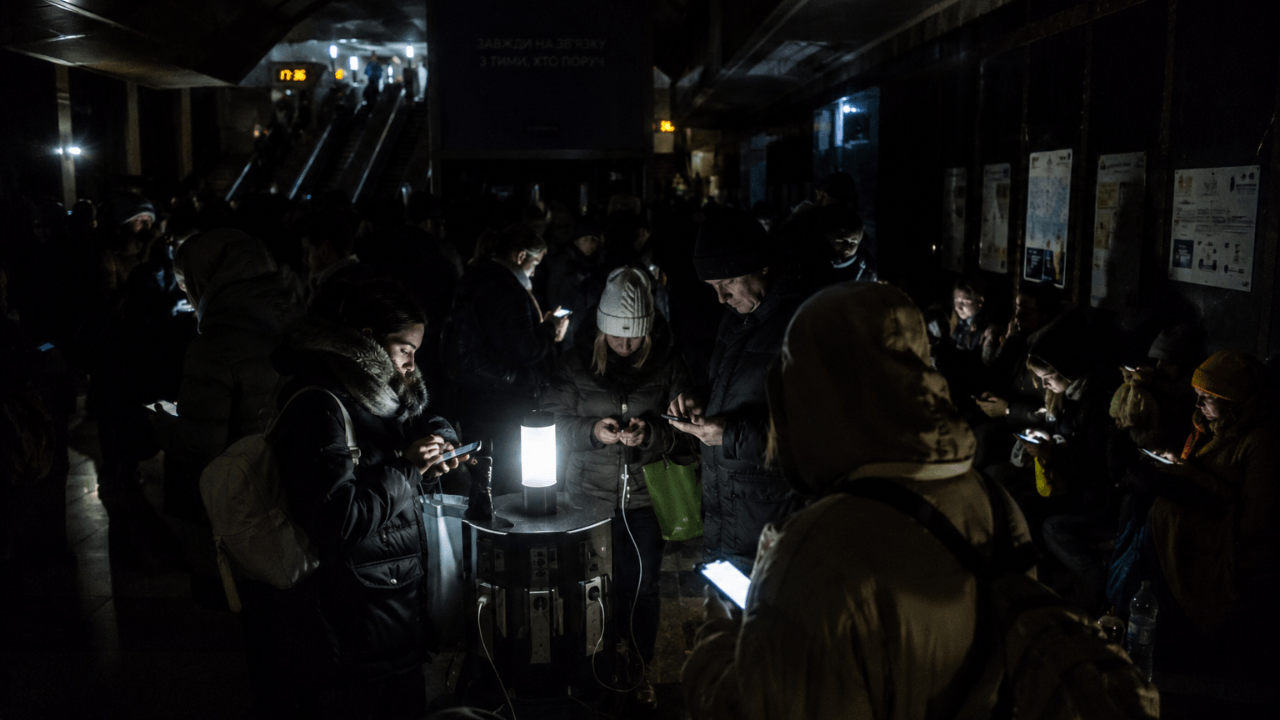
What would your life be like right now without electricity?
You wake up in the dark. You can’t charge your phone or laptop or make a cup of coffee.
The shower is cold. You head out to work and have to walk down six flights of stairs as the elevator isn’t running. The streets are chaotic because the traffic lights are out. The trains aren’t running, and you can’t access the platform anyway as you can’t validate your ticket to get through the gate. All digital signage is black. You can’t book a Bolt or get cash from the ATM.
You can’t use Google Maps to find the safest walking route, check the news, or contact your friends. It lasts for hours and happens again and again.
Now imagine this not as a one-off failure, but as a repeated feature of daily life during wartime.
For many Ukrainians, this became a reality during Russia’s full-scale invasion of Ukraine.
Russia’s attacks on energy infrastructure
Since the start of the full-scale invasion in 2022, Ukraine has faced more than 400 missile and drone attacks targeting its energy infrastructure, particularly during the winter months.
Power stations, substations, district heating systems, and transmission lines became frontline targets intended to weaken civilian morale and economic stability.
According to Ukrainian officials, the attacks have included 84 strikes on nuclear, thermal, and hydroelectric power plants.
However, Ukrainians did what they have repeatedly done throughout the war — innovate and adapt.
In the process, Ukraine has become Europe’s real-world laboratory for telecom and digital infrastructure resilience, while the EU is only now beginning to develop policy frameworks such as the Digital Networks Act (more on that later) aimed at strengthening European digital sovereignty against both natural disasters and hybrid threats.
Learning from Ukraine’s telecom resilience
On my last visit to Kyiv, I sat down with Karen Madoian, Key Expert for Strategic Communications for the EU Project "Digital Regulation Support to Ukraine" to learn about how Ukraine’s telecommunications sector survived, adapted, and in some areas strengthened despite wartime conditions.
Ukraine shows Europe that telecom connectivity is as important as electricity resilience during major infrastructure crises. Mobile connectivity is vital not only for personal communication but also for emergency alerts, banking services, navigation, military coordination, medical support, and helping civilians locate heating and shelter during outages.
According to Madoian, telecommunications is also important to counter disinformation at the local level and sustain public trust.
Why decentralisation helped keep Ukraine connected
It might surprise you to learn that despite Russian air strikes that destroyed the energy grid, Ukraine has maintained a remarkable 90 per cent telecommunications network uptime.
According to Madoian, critical to this is the fact that Ukraine’s telecom sector is not dominated by simply its major players —Kyivstar, Vodafone Ukraine, and lifecell — but instead includes a large number of smaller local internet providers, many operating close to frontline communities.
“That fragmentation ultimately became a strength, creating a more decentralised and adaptable system with fewer single points of failure. Local providers had the flexibility to adapt quickly and continue delivering services.”
Madoian admits that the toughest challenge came during the winters, especially when there were major power outages.
“Early in the invasion, if electricity went down, mobile communication would often go down too.
At the beginning, there was often only partial coverage. If you were close to a transmission point, sometimes you could still get unreliable service.
But over time, operators installed backup generators and additional power systems. International partners also helped provide backup infrastructure, especially in frontline regions.
The war forced the telecom sector to adapt very quickly because people needed communications even during blackouts.”
Ukraine’s 72-hour connectivity rule
With the onset of large-scale attacks on energy infrastructure, the Ukrainian government introduced a clear requirement for internet providers and mobile operators to ensure uninterrupted communications for up to three days (72 hours) in the event of a power outage. Mobile operators must equip 25 per cent of their networks with generators to ensure they can operate for 72+ hours during power outages. The remainder of the mobile network must be able to run on backup batteries for 10 hours. These batteries operate on the same principle as power banks, powering the base stations during blackouts.
This standard became a catalyst for rapid network modernisation. Further, energy-independent tech like Passive Optical Network (PON) technology became particularly relevant.
xPON technology delivers internet connectivity via fibre-optic infrastructure using network components that can be powered by batteries or generators during outages and can continue operating for up to 72 hours. As a result, such networks are significantly more resilient to power disruptions.
As of the end of 2025, fibre-based FTTP networks accounted for 92.9 per cent of Ukraine’s fixed broadband infrastructure.
In 2023, the Ministry of Digital Transformation launched an interactive map indicating which households retain internet access during power outages depending on their provider in every region of Ukraine.
The Ukrainian Telecom Regulator, the National Commission for the State Regulation of Electronic Communications, Radio Frequency Spectrum and Postal Services (NСEС), plays a key role in state supervision and monitoring over the implementation of requirements for stability and resilience of the telecom infrastructure during power outages.
From the first days of the full-scale invasion, NСEС contributed to shaping decisions and implementing measures aimed at ensuring the stability and resilience of Ukraine’s telecommunications infrastructure.
It has also helped maintain a flexible and responsive regulatory environment capable of addressing the unprecedented challenges faced by the sector.
According to Liliia Malon, Chairwoman of the NCEC:
“While no country can prepare for every challenge, Ukraine’s experience in maintaining telecommunications networks during Russia’s ongoing full-scale invasion shows that adaptability and innovation are key to ensuring connectivity under the most demanding conditions.”
Kyivstar's satellite connectivity breakthrough
Ukraine also became a testing ground for next-generation satellite communications.
Ukraine's largest mobile operator Kyivstar became the first in Europe to launch Starlink's direct-to-cell satellite technology, enabling millions to stay connected.
The technology allowed regular 4G smartphones to connect directly to satellite networks without requiring additional hardware. While the initial service provides satellite SMS messaging, the roadmap expands to mobile data and voice capabilities during 2026.
According to Kyivstar, by January 2026, more than 3 million Kyivstar subscribers had registered for the service and over 1.2 million SMS messages had been sent via satellite.
Ukraine is also emerging as a pioneer in testing new satellite communication technologies, including Direct-to-Device (D2D) connectivity.
In emergency situations, D2D technology can provide critical communication capabilities for first responders and affected communities when terrestrial telecommunications infrastructure is damaged or in areas without mobile network coverage.
Ukraine Enters the EU's Roaming Zone
In January 2026, Ukraine became part of the EU’s “Roam Like at Home” zone, allowing its citizens to enjoy the same free roaming benefits that EU citizens have had since 2017. Ukrainian citizens can now use their mobile phones – including making calls, sending SMS and using mobile data – across all 27 EU Member States without incurring additional charges.
Despite millions of Ukrainians moving abroad, many people continued using Ukrainian telecom providers.
According to Liliia Malon, Chairwoman of the NCEC:
“Roam Like at Home” is not only about borderless connectivity and the freedom to communicate, which is especially important for Ukrainians staying connected while in the EU.
It is a tangible sign of trust and Ukraine’s integration into the European digital space.
This achievement reflects the successful cooperation of Ukrainian and EU institutions in the interests of our citizens and it brings us one step closer to the EU Single Digital Market.”
Why investors are still backing Ukraine
Despite the unprecedented challenges of the ongoing full-scale war of aggression, Ukraine’s telecom sector has remained competitive, resilient and dynamic, while preserving its financial stability. This resilience helps explain the continued interest of foreign investors.
The telecom sector in Ukraine even increased its revenues during the war. It demonstrated strong financial results in 2025, with total service revenues reaching €3.58 billion.
Capital investment in electronic communications reached €680 million, a 35 per cent increase compared to 2024 — a striking signal of long-term confidence in a country still at full-scale war.
Network coverage also expanded: fibre-optic internet access now reaches 17,099 settlements across Ukraine, 777 more than the previous year. Mobile operators continue actively to roll out new networks across the country, and 5G testing pilots were also launched.
Ukrainian mobile operator lifecell was even acquired in 2024 by a consortium led by French billionaire Xavier Niel, through his NJJ group — proof of confidence in Ukraine’s telecom sector and long-term digital future despite the ongoing war.
In 2025, Kyivstar became the first Ukrainian company to be listed on the Nasdaq Stock Market under the ticker symbol KYIV, providing international investors with direct access to Ukraine’s largest digital operator and underscoring confidence in the country’s long-term growth potential (Nasdaq).
Vodafone Ukraine has continued to expand its investment programme, announcing significant investments in critical infrastructure and advanced technologies. Among its flagship projects is the Kardesa submarine cable system in the Black Sea, which is expected to strengthen regional connectivity and enhance the resilience of digital infrastructure that links Ukraine to Europe and Asia.
Europe's Connectivity Wake-Up Call
Grid instability does not only stem from cyberattacks or deliberate sabotage.
In April last year, a major energy outage hit Spain when a cascade of generator disconnections occurred after a voltage surge and loss of synchronisation in the grid, severing ties with France and collapsing the Iberian network.
Millions were affected, with metros, trains, traffic signals, airports, and telecommunications all shut down. Some travellers were trapped in stations, and at least seven deaths were linked to the outage, including carbon monoxide poisoning from generators, a house fire, and failure of medical devices.
The Iberian blackout warning Ukraine's experience might appear unique because it emerged during wartime. Yet recent events suggest that Europe faces many of the same vulnerabilities, even in peacetime.
Learning at speed during crisis
The technical solutions matter, but Madoian argues that Ukraine's biggest advantage was moving at speed. Ukraine learned very quickly that protecting critical infrastructure cannot wait until a crisis begins. Once the war escalated, the government immediately brought together telecom providers, regulators, and infrastructure operators to coordinate responses.
He explained:
“We moved extremely fast because they understood there was no alternative. It was very much “learning by doing.” Once people realised the war would continue for a long time, the question became: how do we keep infrastructure functioning under this “new normal”?
Providers had the freedom to experiment, adapt quickly, and introduce new solutions without excessive bureaucracy. However, there was also a very strong business motivation.
Telecom companies understood that if they didn’t adapt, they simply wouldn’t survive.”
These wartime lessons are increasingly shaping how European policymakers think about digital resilience and infrastructure preparedness.
Strengthening Europe’s telecom infrastructure for future crises
The proposed European Digital Networks Act (DNA) is expected to become one of the EU’s most significant telecom and digital infrastructure reforms in over a decade. It is designed to address growing concerns that Europe’s communications infrastructure is fragmented, underinvested, and insufficiently prepared for an era of geopolitical instability, cyber conflict, AI-driven data demand, and climate-related disruption.
The DNA aims to modernise Europe’s telecom framework by encouraging greater investment in fibre, 5G, cloud infrastructure, subsea cables, satellite connectivity, edge computing, and cross-border digital resilience. The legislation is also expected to simplify regulation across member states and strengthen Europe’s technological sovereignty while linking telecom resilience with energy resilience and civil preparedness.
However, the European Commission published the legislative proposal on 21 January 2026, and it is now entering the legislative process with the European Parliament and Council.
It will likely take months, and maybe even years, before the final regulation is adopted and implemented.
Europe’s need for a Starlink challenger
The reliance on Starlink further highlights the need for a European challenger. In 2023, French telco Eutelsat merged with the UK’s OneWeb. It currently operates around 650 low-Earth-orbit (LEO) satellites through the OneWeb constellation and is arguably the only ecosystem player that can realistically compete with Starlink in at least some markets.
Fortunately, the EU’s sovereign satellite communications network IRIS² (Infrastructure for Resilience, Interconnectivity and Security by Satellite) is also underway.
Backed by more than €10 billion in investment, it aims to deploy a constellation of around 290 satellites to provide secure communications for governments, defence, critical infrastructure, businesses, and citizens across Europe.
However, the system is not expected to become operational until around 2030.
Ultimately, Ukraine shows that telecom resilience is no longer simply an issue for the telecom sector, but a matter of civil protection, economic continuity, and national security. The question is whether Europe can absorb those lessons fast enough before its next crisis arrives.


Would you like to write the first comment?
Login to post comments