


Paris-based startup Upstream today announced the general availability launch of its AI-native inbox platform, alongside a $3 million pre-seed funding round backed by Y Combinator, Connect Ventures, Roosh Ventures, and more than 30 founders and operators from companies including Framer, Algolia, Asana, Alan, and Webflow.
Following months in invite-only beta, Upstream is now publicly available, positioning itself as “the first inbox designed for humans and agents.”
The company has rebuilt email infrastructure from the ground up to support AI agents that can read, write, organise, and act on behalf of users, rather than layering assistants onto traditional email clients originally designed only for human interaction.
I spoke to Upstream CEO and co-founder Louis Lecat to learn more — and I gave it a try myself.
So much for the death of email
Lecat asserts that people have been predicting the death of email for decades, but it never happens.
“Email remains one of the most deeply embedded communication systems in work. It’s where work arrives, where work gets delegated, and where decisions happen.
We believe the inbox is still the natural interface for collaboration between humans and AI agents.”
From Asana and Algolia to Upstream
Lecat was born and raised in France, studied at Stanford, and spent about 10 years in the US before moving back to Paris.
Prior to founding the company, he was an early member of the product team at Asana, where he helped drive growth and adoption as the company scaled toward $100 million in annual recurring revenue.
He later joined Algolia (YC W14), where he led the product organisation through the company’s Series B and C growth stages as Head of Product, building and managing a team of more than 20 product professionals while helping grow ARR 2.5x to more than $100 million.
He recalls:
"The idea for the company really started during my time at Asana before the IPO. We had a way of working together that felt incredibly efficient because everything was structured.
We relied heavily on asynchronous communication, which meant less constant chatting and fewer things getting lost in Slack or Teams."
Later, when he moved into another role, he returned to an environment where communication was nonstop chat messages, and he realised how inefficient it felt.
"I became convinced that nobody was really solving that problem properly, and that’s what pushed me toward building this company.
At the same time, AI was becoming mainstream. What originally started as a vision to improve structured communication evolved into something bigger — enabling humans and AI agents to collaborate effectively."
According to Lecat:
“We’re not just helping someone write replies faster. We’re trying to create a system where humans and AI agents can work together seamlessly — sharing context, handing tasks off, collaborating across teams, and making sure important information doesn’t get lost.”
Putting the platform to the test
To be transparent, I rarely get time to test products these days, but given the woes of my email box, which receives at least 160 emails daily, I had to give it a try.
The product looks familiar to anyone who already uses Gmail, but adds layered intelligence and collaboration directly into the inbox experience. AI-powered prioritisation and drafting.
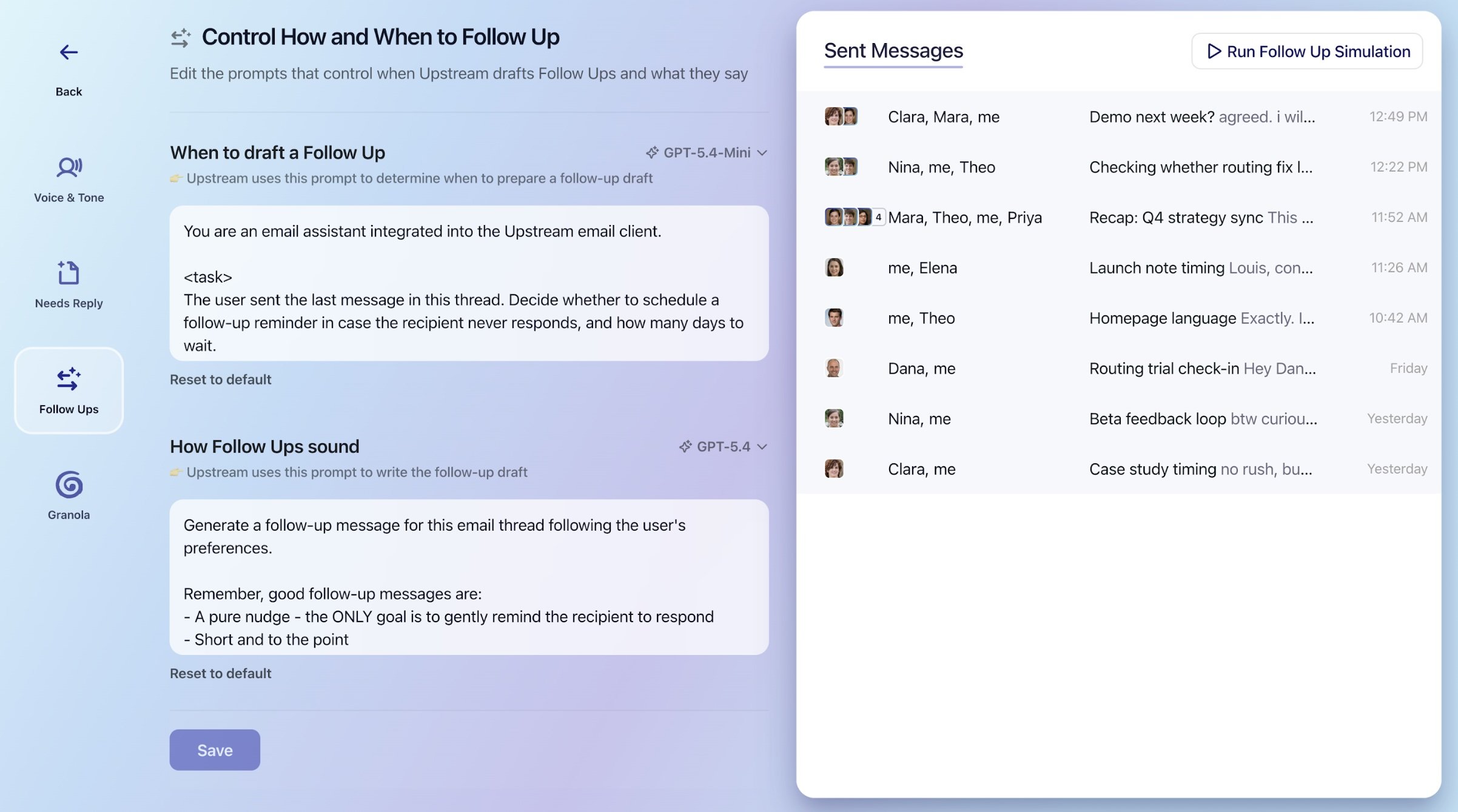
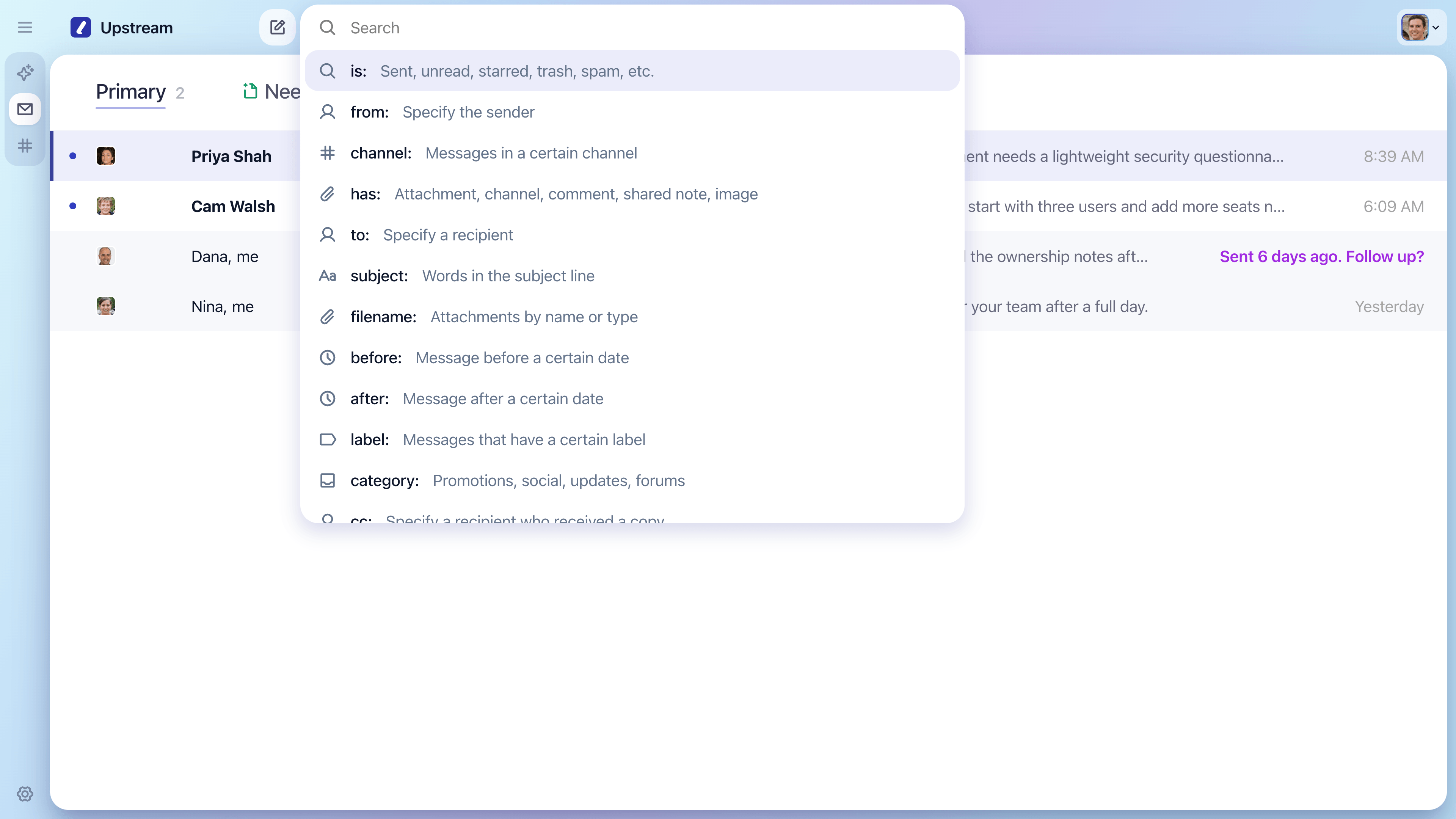
For example, the system identifies which emails genuinely require a response and surfaces them separately from low-priority messages. It can draft replies automatically, prepare follow-ups if someone hasn’t responded, and organise workflows into collaborative “channels” where teams can work together around email threads.
Importantly, all AI-generated drafts still require user approval before being sent. This is an important distinction — I’m sure I’m not the only person who gave Gmail text prompts a whirl with less-than-stellar consequences — in my case, it ended more than one “thanks for your email” sentence offering people an interview slot, which I only realised after clicking send.
Even better, with Upstream, users can also customise how the AI behaves through editable prompts and communication preferences.
To do this, the system analyses previous writing styles and communication habits to adapt responses to the user’s tone, language preferences, formatting style, and even the types of emojis they use. That’s a “cheers” send-off from me.
Search, scheduling and collaboration features
The platform’s AI agents can sort inboxes, draft replies in a user’s writing style, schedule meetings, retrieve information such as receipts — If you’ve ever spent an age searching through your email for a plane ticket receipt, you know how helpful this is — and also follow up automatically, and integrate with external knowledge sources including meeting notes and calendars.
User control and privacy
Not gonna lie, I was concerned about privacy. But Upstream users retain control over what agents can access, draft, and send with emails private and accessible only to the user and the people they intentionally choose to collaborate with. Lecat explained:
“We do not train AI models on customer data. The system may analyse previous messages temporarily to help generate contextually accurate drafts, but none of that data becomes part of a training dataset.
The AI essentially operates using prompts and contextual analysis at the time of the request, rather than permanently learning from user information.”
Perhaps one of the biggest ways Upstream stands apart from more standard agentic email drafting is its power as a collaboration tool. Lecat contends that while people assume AI collaboration will happen primarily in chat windows, that's not where most work actually happens.
"People live in their inbox. Email was never built for teams of humans and agents working together. Upstream is.”
The system also supports external AI tools and workflows through MCP compatibility, allowing users to connect services such as Claude or Codex or bring their own agents into the platform. Early traction and user engagement
Thousands of users have already tested the platform during its private beta period, with the company claiming strong engagement from professionals.
Lecat sees time saving as the clearest return, detailing that many users claim they’ve reduced inbox management from over an hour a day to around 15 minutes “because the product filters noise, prioritises important messages, prepares drafts, and surfaces follow-ups automatically.”
“But we’ve also found that the productivity gains become even more powerful when teams use the platform collaboratively. Instead of email being siloed inside individual inboxes, teams can work together around conversations in real time.
For example, an engineer can begin troubleshooting a customer issue before the account manager has even opened the email. That kind of asynchronous collaboration dramatically speeds up response times and reduces bottlenecks.”
Shared context as a competitive advantage
As always, when you’re dealing with a product that aims to solve the pain points of existing platforms like Gmail, I wondered about defensibility.
What’s to stop Google creating a competing product? Lecat isn’t concerned, pointing out that traditional email platforms were built long before AI collaboration was part of the equation, and their systems are fundamentally designed around solo inbox management.
“We rebuilt the inbox with shared collaboration, AI agents, and unified context at its core.
For example, our system creates a unified thread view across collaborators, so everyone sees the same context and conversation history. Large incumbents also face the challenge of supporting billions of users with wildly different workflows. Even relatively small interface changes can create friction at that scale.
That gives startups like us room to innovate much faster around specific professional workflows.”
The funding round includes institutional backing from Y Combinator and Connect Ventures, alongside angel investors including Framer founders Koen Bok and Jorn van Dijk, Algolia founders Nicolas Dessaigne and Julien Lemoine, Webflow CEO Linda Tong, Alan founders Jean-Charles Samuelian and Charles Gorintin, and entrepreneur Xavier Niel through Kima Ventures.
The new capital will be used to continue developing a high-quality, design-focused email experience inspired by products such as Linear, Arc, and Granola.
Upstream is also working on Android support and Outlook compatibility, in response to user requests. The platform is currently available on the web, desktop (Mac and Windows), and iOS, with Gmail support available at launch and additional providers planned.
Upstream offers both a free tier and a paid Pro plan that includes expanded AI usage and team functionality.


Would you like to write the first comment?
Login to post comments