

UK startup CurvLabs began with a simple question: why, after years of appointments, scans and physiotherapy, did founder Rohan Kotecha still not understand what was causing his back pain?
Diagnosed with non-specific back pain at 13, Kotecha experienced first-hand a healthcare system where specialists treated symptoms in isolation and assessments were limited to brief clinic visits. Frustrated by the lack of continuous, real-world data, he set out to build a better solution.
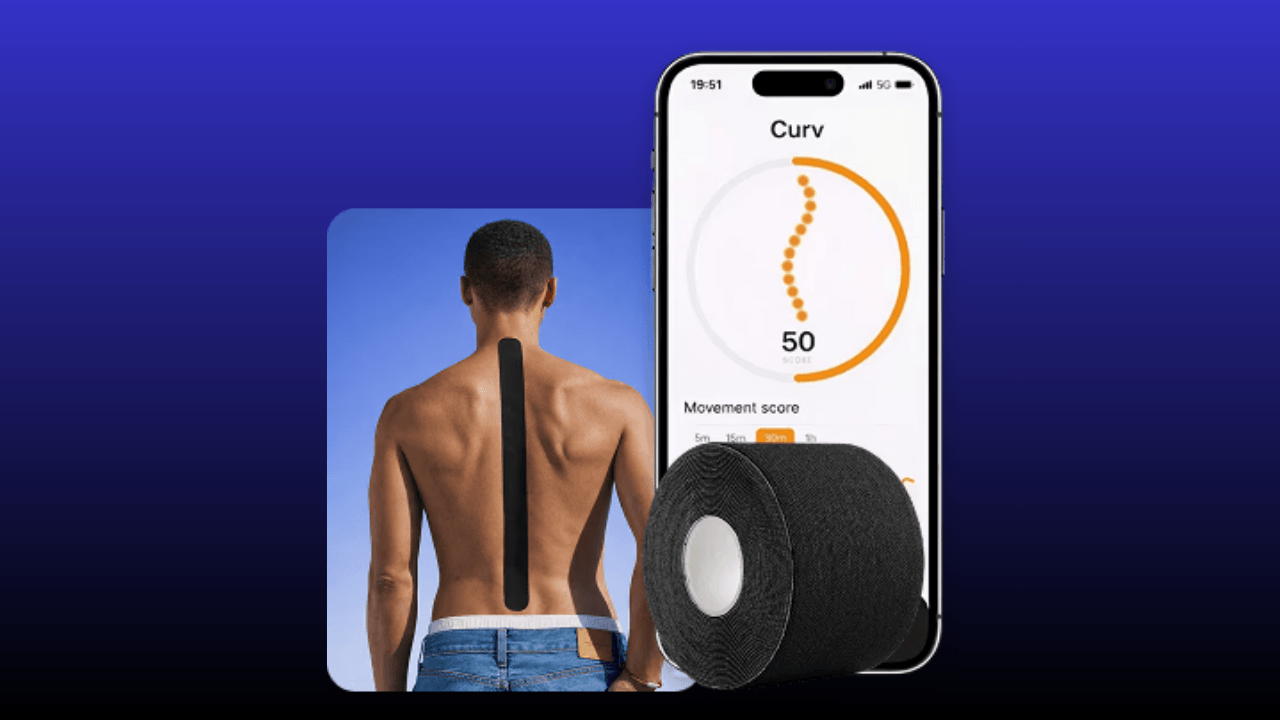
The result is Curv, a wearable spinal sensor device designed to help people better understand how their spine moves throughout everyday life.
According to Kotecha, “like many people, I spent years going between physiotherapists, chiropractors and osteopaths. I honestly felt pretty let down by the healthcare system.”
During COVID, he had a major flare-up while he was studying biomedical engineering at University College London. The NHS waiting list for treatment was around six months, so as a student he decided to pay for private physiotherapy instead.
He recalled:
“The physiotherapists kept telling me that back pain is largely influenced by how you move—how you sit, stand and carry yourself throughout the day. “
One therapist even asked him to take his shirt off while he worked, set up a phone on a tripod next to him and record himself.
“I remember thinking, 'This is a bit strange.' Then it struck me: they only saw me for 30 minutes each week. If movement throughout the rest of the week is what matters, how could they possibly know how I was moving during the other 167 hours?”
At the same time, he was building an ECG as part of a university bioengineering project. He realised that if we could continuously measure something as complex as heart activity, surely measuring spinal movement should be possible.
“I thought, maybe I could build something that lets me see how my spine is actually moving throughout the day. At the very least, I'd know whether my movement was improving and whether my treatment was actually working.”
The tech behind you
The Curv Labs wearable is built into a strip of kinesiology (KT) tape. It adheres along your spine and contains sensors embedded within the fabric — it's a bit like a snap wristband — you position it behind you, it naturally follows the contour of your back, and then you stick it in place.
The wearable tracks your spinal movement throughout the day. It connects to a corresponding mobile phone app via Bluetooth, which tracks and analyses range of motion, velocity and which sections of the spine are moving freely versus staying stiff.
The device is manufactured locally in the UK, although Kotecha temporarily relocated to Shenzhen previously for faster prototyping.
Using research — not posture myths — to shape the product
For anyone on the internet, you’ll see ads for plenty of hardware over the years that attempts to monitor posture from devices that buzz when you slouch to posture corrector braces.
For Kotecha, the starting point was always clinical research. “Coming from a biomedical engineering background, my instinct was to read the scientific literature first and understand what the evidence actually says.” He explained that one of the biggest misconceptions is that posture causes back pain.
“Clinically, that's simply not supported by the evidence. It's a very common cultural belief that you should "sit up straight", but physiotherapists often say that the best posture is the next posture.
The important thing is to keep your spine moving rather than holding one supposedly perfect position.
That's why we deliberately avoided building another posture alarm. Devices that constantly buzz every time someone slouches are actually something many physiotherapists advise against.”
Learning from experts before launching
While studying at UCL in London, Kotecha had access to a wealth of medical expertise. Rather than rushing into product development, he spent months speaking with physiotherapists, clinicians, researchers and academics, reading scientific literature and reaching out to experts around the world to understand which measurements would be genuinely clinically meaningful.
Those conversations ultimately shaped the direction of the product. Across conversations with physiotherapists, doctors and osteopaths, one message kept coming up.
“The clinicians consistently told me that their biggest challenge is getting patients to move more and to become more aware of how they move throughout the day.
Awareness is the first step. Beyond that, they want patients to build confidence that movement is safe — even if it feels uncomfortable at first. That confidence helps people stop guarding every movement, which creates a positive cycle where they're able to move more naturally again.
That's exactly the type of behaviour we're trying to support with CurvLabs.”
Getting up close and personal with end users
At the same time as networking with healthcare professionals, Kotecha started sharing the project on Reddit. Curv’s first customers literally came from the r/backpain community— “people who, like me, had lived with chronic back pain,” he shared:
“They've been incredibly valuable because we're building the product alongside them. We continually ask them what's actually useful in day-to-day life, rather than just building technology for technology's sake.”
So far, Curv Labs users have been younger than many people would expect. There's a common perception that back pain mainly affects older adults, but according to Kotecha, the research doesn't really support that.
“Prevalence is actually fairly consistent across adults aged 18 to 65, with only a modest increase somewhere around the 45-to-55 age range. Most of our early customers have been people around my age, up to their mid-thirties.”
Unsurprisingly, almost all of them work at desks. The users so far are already tracking all sorts of health metrics through wearables, but many of them assert that while they can measure lots of things they don't particularly care about, they have almost no information about the condition that's actually affecting their daily lives.
“They want meaningful data about their back and how they're moving.”
The value of data-driven insights
While the hardware is important, the real value comes from the software and the insights derived from the data. Kotecha explained that one interesting fact is that the spinal discs don't have a direct blood supply — “they're essentially avascular. That means they rely on movement to receive nutrients and stay hydrated.”
“Because we're measuring movement continuously throughout the day, we can estimate whether you're moving enough to support spinal health. It's a simplified way of thinking about it, but you could almost ask: are your spinal discs getting enough movement to "feed" themselves?”
Beyond that, the platform looks at metrics such as range of motion, movement variability and whether those measures improve over time.
“Movement variability is particularly interesting. People with chronic pain often become fearful of movement and adopt very rigid movement patterns,” shared Kotecha.
“As confidence returns, movement naturally becomes more varied. We think movement variability could become an important biomarker—almost like a musculoskeletal equivalent of heart rate variability (HRV).”
The app presents these insights at the end of each day and then suggests a practical action the user can take.
From Reddit to pre-seed funding
Having gained traction by conversing with those experiencing back pain on Reddit, the company has continued to work very closely with its early customers, and even hand-delivered the first unit to a customer in Washington, DC after meeting him on Reddit.
Whenever possible, Kotecha will actually go and meet people in person to help them get set up.
“I want to understand exactly how they're using the product, what problems they're trying to solve and how we can make it more useful. If I can't meet them, I'll jump on a FaceTime call and guide them through the setup.”
He still texts customers personally to remind them to do their exercises.
“It's very hands-on, but it's also been a lot of fun because we're learning directly from our users,” shared Kotecha.
Given Kotecha's willingness to reach out to strangers for advice and use of internet forums to find potential customers, it's perhaps no surprise he took the same approach to fundraising.
To secure CurvLabs' first investment, he cold-messaged hardware investors on Twitter. The first investor he contacted said yes, setting the company on the path to raising $450,000 in pre-seed funding.
Beyond back pain: a future of continuous health monitoring
When it comes to Curv’s wearable device gaining traction from the healthcare sector – often one of the biggest challenges for early stage startups — Kotecha believes that we're approaching an inflection point in healthcare.
“If you look ahead 10 or 15 years, I believe a significant proportion of primary care will be supported by AI. Instead of asking only your GP a medical question, AI systems will increasingly help interpret health information.
In that world, wearables become incredibly important because they provide the underlying data that AI needs to make informed decisions. They become the source of continuous, real-world context.”
Coupled with the increase of consumer spending on healthcare outside of traditional health insurance offerings, he believes that while the company started with the spine, the broader opportunity is much bigger.
While Curv today focuses on the spine, Kotecha believes the underlying technology has applications far beyond back pain. Kotecha foresees a future where people are effectively wearing a distributed hospital— a collection of unobtrusive sensors that continuously monitor different aspects of the body through lightweight patches.
“So far, most consumer wearables have focused on the wrist, fingers or continuous glucose monitors. There's still a huge amount of the body that isn't being measured.”
One application Curv Labs is interested in exploring is objectively testing ergonomic products such as office chairs.
“Manufacturers often claim a chair is better for your back, but we want to ask a much more measurable question: does this chair actually encourage healthier movement? That's something we're hoping to investigate in the near future.”


Would you like to write the first comment?
Login to post comments