

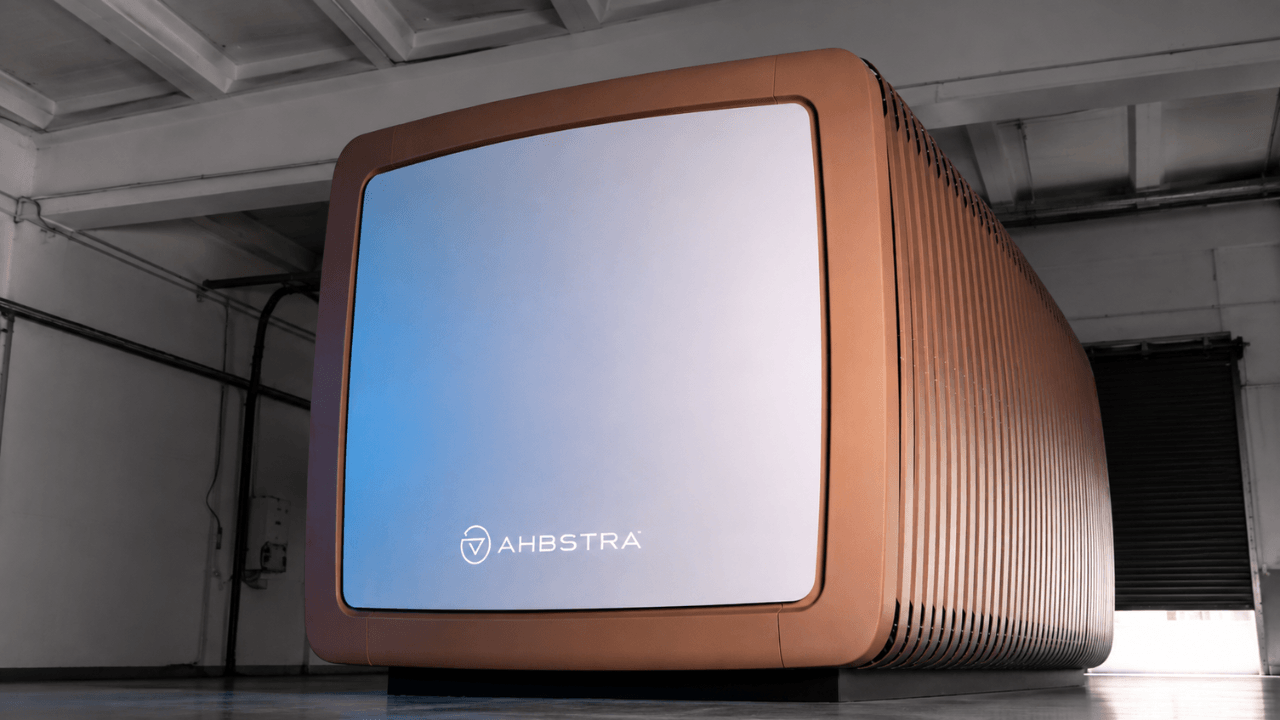
This summer, many southern European countries face constant states of emergency due to water shortages, with around 30 per cent of people facing permanent water stress across the region. 36 per cent of people in Cyprus, and 32 per cent of people in Greece, reported difficulties accessing clean water in 2025, and in 2026, several Greek islands have entered states of emergency due to water stress.
Many parts of the region are facing what the UN has termed ‘water bankruptcy’ – in which groundwater and aquifers reach a state of no return to normal levels.
This week, UK climatetech company Ahbstra launched the ARK, a plug-and-play machine that harvests high-quality drinking water from air at up to 500L/day, even in dry and hot climates. This means the ARK can support a household (the average European uses 144L of tap water per day).
When the wells ran dry
I spoke to Ahbstra CEO Hashem Arouzi, who told me he was inspired to start the company when wells on his own property in Ibiza ran dry.
‘In Ibiza alone, there are over 15,000 properties that are not connected to the water supply, and need to secure their own water. The wells that have previously supplied them are running dry.
For now, many of these property owners are reliant on water deliveries by truck, but these trucks need to fill up at reservoirs that themselves are running dry. Islands are developing desalination, but water from these plants will not be available to these properties.”
The first customers of the ARK are largely located in the Balearics, where water scarcity is acute.
Turning Nobel-winning chemistry into a product
Ahbstra can harvest high-quality drinking water from air at scale by using advanced nanomaterials known as MOFs (metal organic frameworks). These particles are engineered to have a huge internal surface area – the equivalent of a whole football pitch in one gram of material, which makes them ideal for capturing water or CO2 molecules from the air. MOFs were the subject of 2025's Nobel Prize in Chemistry.
For more than a decade, researchers have argued that MOFs could transform atmospheric water harvesting, producing drinking water even in arid climates where other systems (such as dew-point technology) struggle.
The chemistry has shown strong results in laboratories, but turning it into a machine that can produce large volumes of water every day at a practical cost has remained a challenge. The main difficulty is moving enough air through the MOF system while efficiently cycling the temperatures needed to capture and release water.
In response, Ahbstra’s patented solution, the Suspended Particle Reactor, cycles air through MOF granules in a fluidised state to maximise their performance, for the first time reducing energy requirements of MOF-based harvesting to commercially practical levels.
The ARK is the first commercially available water-harvesting machine powered by MOFs to operate at this scale. It produces high-quality drinking water free of PFAS chemicals and microplastics, which are commonplace in both tap and bottled water.
Built for the world's driest climates
The ARK can operate in a range of temperatures and humidity levels – including extremes seen in arid areas, where water scarcity is most serious. According to Arouzi, this is where ARK represents a real step forward from previous technologies:
“Even at 10 per cent humidity and 45 degrees, we can still produce around 300 litres of water per day. In areas with higher humidity, we can increase output even further while reducing energy consumption.
Our 500-litre-per-day performance is achieved at 30 degrees and 30 per cent relative humidity, which equates to a 10-degree dew point – the point where other atmospheric water harvesting methods, such as dew point harvesting, typically struggle."
The tech also offers a point of difference to existing atmospheric water generators, which are based on dew-point systems and use cooling coils to condense ambient humidity. These are only efficient in hot, humid conditions. In arid or cooler climates, the coils must run far colder, the energy required per litre rises sharply and output collapses.
The ARK produces water across most climatic conditions, and especially in dry environments where the need is greatest.
“This means that atmospheric water harvesting now works in places like water-stressed islands in southern Europe, the southwest US, or the Middle East, where previously it would have been impossible,” he added.
He also explained that while there are other MOF-based systems in development, “none of them currently available have managed to maximise the yield from each cycle of MOF in the way that we have, largely because of the challenge of cycling a high volume of air past the MOFs.”
A machine tuned to local climates
The ARK's performance varies depending on environmental conditions, particularly relative humidity and temperature, but also on the specific metal-organic framework (MOF) used and the amount of power supplied. Unlike conventional atmospheric water generation technologies, the system can be adapted to different climates by changing the MOF chemistry.
"What's really exciting about the MOF field is that we can tailor the chemistry to different environments, so we can fine-tune the system for Southern Europe, Spain or the Middle East, rather than relying on a one-size-fits-all solution," shared Arouzi.
The company currently deploys a MOF optimised for Southern European islands, where average relative humidity is around 20 per cent, while different MOFs are available for much harsher climates, operating at relative humidity as low as 10 per cent and temperatures above 40°C.
Even in these extremely dry conditions — similar to summer in Riyadh — the system can produce around 300 litres of water per day, with output increasing to around 500 litres per day at 30 per cent relative humidity.
Arouzi explained:
"We calibrate for Southern Europe because it delivers significantly better energy efficiency while maintaining year-round water production.
We could use a MOF designed for desert conditions, but in a temperate climate it would simply be overkill.
As humidity increases to 60 or 80 per cent, we can also run the machine in dew point mode, which either boosts water production even further or reduces the amount of energy required to produce the same volume."
This approach enables the system to maintain reliable output across a wide range of climates while maximising efficiency for local conditions.
Water independence for off-grid properties
In many regions around the world, properties and developments are at risk of being devalued or abandoned if they cannot demonstrate independent water security.
The ARK is aimed at developers and owners of off-grid properties that rely on private water supplies. Across many islands, seawater intrusion and declining groundwater levels are making those supplies increasingly unreliable.
The device is priced at £150,000 and is currently manufactured in-house using components sourced from a range of suppliers.
“As we scale up, we will bring in manufacturing partners to help us grow,” shared Arouzi.
Operating in a typical Southern-Mediterranean climate consumes around 10kW of power — that's 0.48 kWh per litre of water produced — and many customers are installing it alongside solar to meet this need.
Water from the ARK can be used to replenish wells and cisterns, or be sent directly to a property’s mains water system.
Ahbstra is scaling up production of the ARK in Barcelona, and is also developing systems for smaller water volumes.
From luxury villas to critical infrastructure
To date, Ahbstra has raised £7 million from a select group of family offices and key strategic corporate distribution partners, and is building towards a Series A investment round.
The first purchased units are due to be installed by early 2027. Arouzi sees the premium villa market as just the beginning.
“Every major clean technology like solar or EVs begins with early adopters who can help test reliability, generate real-world data and support the initial manufacturing scale that brings costs down.
Our immediate R&D is focused on bringing power requirements down further, and creating smaller, less energy-intensive versions of this technology to serve a broader section of the residential market.”
Long-term, the company is looking at broader applications:
“We know that 500L/day unlocks use cases for off-grid facilities such as mining or construction sites, or use cases in humanitarian aid and disaster relief,” shared Arouzi.
“Datacentres are a major source of waste heat – in fact, almost all the energy that goes into a datacentre ends up turning into heat. Using that heat to create pure drinking water would be a part of a more sustainable ecosystem for datacentres.”
There are also many industries, such as pharmaceuticals and cosmetics, that specifically require pure water, which they currently obtain by purifying tap water. For these industries, getting pure water directly from the air would be a logical next step.


Would you like to write the first comment?
Login to post comments