

Every minute one person in Europe dies from sepsis or septic shock. Sepsis arises when the body’s response to an infection injures its own tissues and organs. It may lead to shock, multi-organ failure, and death – especially if not recognised early and treated promptly. Sepsis is the final common pathway to death from most infectious diseases worldwide, including viral infections such as SARS-CoV-2 / COVID-19.
In 2021, there were an estimated 166 million cases of sepsis worldwide, resulting in 21.4 million deaths — nearly one-third of all global deaths.
One company looking to address this challenge is Austria-based Efferon, which is developing technology designed to intervene in the inflammatory response that can make sepsis so difficult to treat.
Founded in 2016, its blood-purification devices work alongside existing treatments, removing bacterial toxins and excessive inflammatory molecules from the bloodstream to stabilise critically ill patients with sepsis and septic shock.
“We are selling time”
Time is critical in sepsis diagnosis and treatment: patients can deteriorate rapidly, while the inflammatory response can continue even after treatment of the underlying infection has begun.
Antibiotics and standard therapies have to be used as the first line of defence. Current sepsis care largely focuses on controlling the underlying infection and supporting failing organs, but there is no single treatment that directly addresses the complex, dysregulated immune response driving the condition.
Rather than treating the infection itself, Efferon’s technology aims to remove bacterial toxins and excessive inflammatory mediators from the blood while conventional treatment tackles the underlying cause.
According to Efferon CEO and co-founder Dima Romashin, Efferon buys time for a patient:
“We're helping to interrupt the inflammatory process so that during those first critical days, the patient can be stabilised and the other therapies have time to work.”
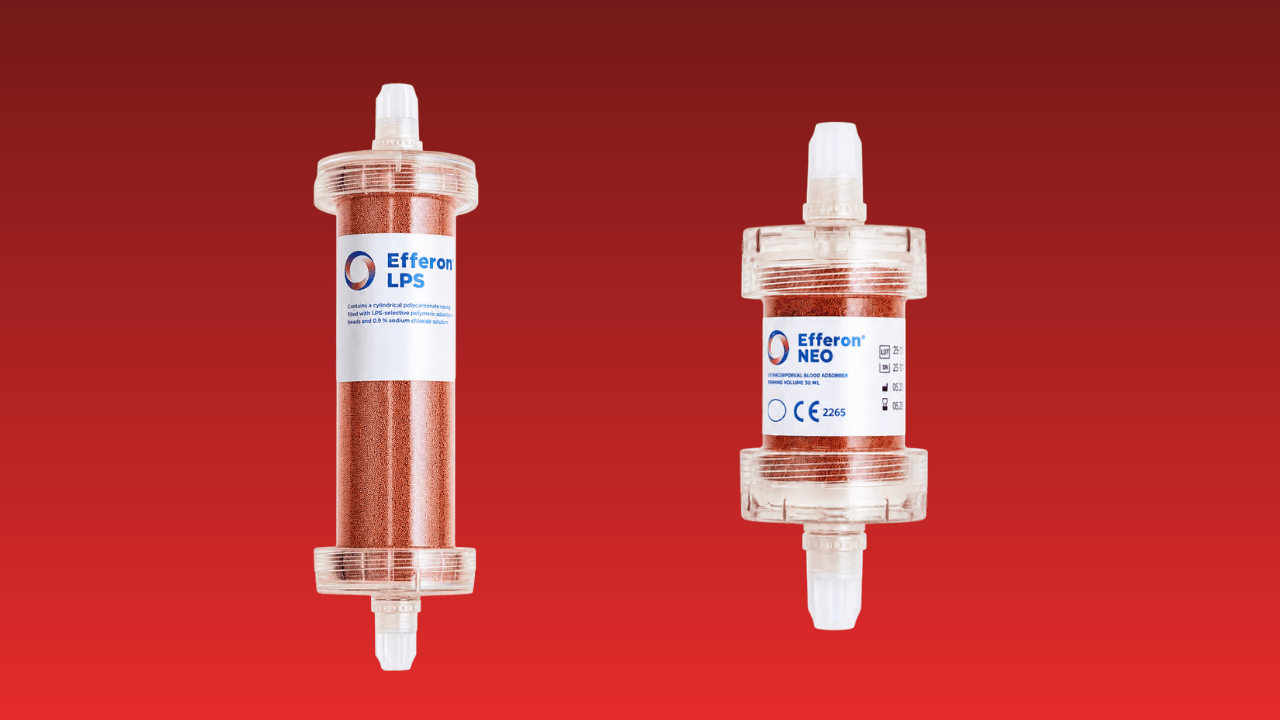
Efferon currently has two main devices: the first is designed for treating sepsis and septic shock in adult ICU patients, and the second is for treating sepsis and septic shock in paediatric intensive care.
Efferon LPS is a single-use blood-purification cartridge primarily designed for critically ill patients, including those with sepsis and septic shock.
The easiest way to understand it is as a specialised filter that sits outside the body. Blood is taken from the patient, passed through the cartridge and then returned to them. It can be integrated with equipment already used in intensive care, including renal replacement therapy, ECMO and cardiopulmonary bypass systems. The filter contains specially engineered porous polymer beads that tackle two problems simultaneously:
- The surface of the beads binds LPS (lipopolysaccharide), also known as endotoxin. LPS is associated with Gram-negative bacteria and can trigger a powerful inflammatory response.
- The pores inside the beads adsorb excessive inflammatory molecules, including cytokines such as IL-6 and IL-1β, as well as other inflammatory substances.
In simple terms: it aims to remove both a trigger of severe inflammation and some of the excessive inflammatory substances produced in response. It's been approved for use in Europe since April 2024.
Efferon NEO uses the same underlying approach as LPS but is specifically designed for neonatal and paediatric patients.
“The distinction matters because children have much smaller circulating blood volumes than adults, meaning extracorporeal treatments need to be designed accordingly rather than simply using an adult-sized cartridge,” explained Romashin.
Efferon sees many cases where premature infants have complications because their internal organs are not yet fully developed, and unfortunately there are many things that can go wrong.
“Our smallest champion so far weighed just 1.2 kilograms," shared Romashin.
Filtering the flame and the smoke
Efferon is not the only company working on haemoadsorption and blood purification. But the company takes a different approach. The first difference is the approach underpinning the technology itself. Romashin compares inflammation to a fire:
“When you have a fire, you have two things: the flame itself and the smoke it produces. In our case, LPS is the flame, while the cytokines released by the immune system in response are the smoke.”
There are devices on the market that capture endotoxin, so effectively they target the flame. Others capture cytokines, so they target the smoke.
He contends that both approaches can be effective, “but ours is designed to deal with the flame and the smoke simultaneously."
"We target both LPS and the cytokines produced as part of the inflammatory response.
Our studies indicate that doing both at the same time can make the process quicker and more effective. That's the main technological distinction for us.”
The overlooked burden of pediatric sepsis
In April 2026, NEO received CE MDR certification, becoming what Efferon says is Europe’s first multimodal extracorporeal blood-purification device approved for paediatric use and enabling its use in neonatal and pediatric patients in Europe. Romashin describes the process as “probably the most difficult regulatory procedure in the European Union.”
It's difficult to get precise figures for pediatric sepsis because, according to Romashin, the most comprehensive epidemiological reviews of pediatric sepsis explicitly exclude low-income countries, because the data infrastructure to even measure the disease properly doesn't exist there yet.
“We built Efferon because the gap between how serious this disease is and how little attention it receives didn't make sense to us. It still doesn't.
The true global burden is almost certainly higher than the 1.2 million pediatric cases a year that get counted.”
Building the clinical evidence
In treatment trials, there’s a control group receiving all standard therapies, including antibiotics, compared with a group that receives Efferon in addition to standard treatment.
The company has undertaken more than 30 clinical studies, including its LASSO study, published in the medical journal Shock, which assessed several clinical endpoints, including recovery from septic shock, length of stay in intensive care, and mortality.
The study found that, among survivors, septic shock lasted around 57 hours with Efferon LPS compared with 101 hours in the control group. Treated patients spent less time on mechanical ventilation, required less blood-pressure support and showed improvements in organ and kidney function, alongside reductions in inflammation and bacterial endotoxin levels.
“In the adult study, we saw around a threefold reduction in three-day mortality,” Romashin said.
When I spoke to Romashin, he was preparing to present Efferon’s latest research findings at a Sepsis Alliance conference in Washington.
The company’s multicentre pediatric study investigated the use of Efferon LPS NEO in children with sepsis and septic shock, with Romashin describing the results as a potential breakthrough for the company.
According to Romashin, children can, in some respects, provide a “cleaner” clinical population because they generally have fewer underlying health conditions than adults.
“They don't usually have decades of underlying conditions such as diabetes, cholesterol problems and other diseases that can complicate the picture,” he said.
“In children, we were also able to demonstrate a statistically significant impact on 28-day mortality. We saw around a fourfold reduction in mortality over that period.
I think that's very important data. For us, it's a potential breakthrough.”
The long shadow of sepsis
Those who survive sepsis can be left with significant long-term health consequences, with the impact particularly profound for patients who have experienced septic shock, the most severe form of the condition.
Romashin says Efferon is among a relatively small number of players in this field looking closely at what happens to patients after sepsis “because we see them through our clinical trials and continue monitoring them afterwards.”
He contends:
“I sometimes describe it as a nuclear blast for the immune system. The immune system has gone through an extraordinary event, and the consequences don't simply disappear because somebody has survived the immediate crisis or has been discharged from hospital.”
Mortality remains high even after discharge, particularly during the months following severe sepsis.
“That's an important part of the condition that I don't think receives enough attention.”
Why sepsis innovation moves slowly
When it comes to innovation in medical treatment for sepsis and broader blood purification processes, Romashin asserts,
“Unfortunately, it's not AI. Things don't happen that quickly
There are technologies in this field that have existed for decades without becoming the global standard of care. There are also haemoadsorption technologies that have been on the European market for more than a decade and still haven't completed the FDA process in the US.”
There is also a wider problem with investment in sepsis. The burden of sepsis is enormous, yet only a tiny fraction of the investment going into some other major diseases comes into sepsis.
“Cancer, for example, attracts enormous amounts of venture capital and pharmaceutical investment.
There are established protocols, treatments, drugs, patient organisations and huge amounts of attention around the disease.
Sepsis is different. It's not a single disease; it's a condition that can develop incredibly quickly. Either you stabilise the patient or, unfortunately, they can deteriorate very rapidly. That makes it a difficult area both clinically and commercially,” asserts Romashin.
Playing the long game
Efferon’s blood-purification technology has been used in more than 25,000 treatments across 44 countries, generating over €1 million in revenue.
The company is now focused on increasing adoption and integrating its devices into routine clinical practice.
When it comes to adoption, Romashin admits that there’s no silver bullet.
“Getting regulatory approval is one step. Then you need clinical trials, ongoing post-registration studies and clinical adoption.”
Efferon’s customers are specialist medical professionals working in intensive care.
“These doctors are extremely well educated because they have to manage an enormous number of interventions. They're dealing with different drugs and therapies, fluid management, continuous renal replacement therapy and many other technologies simultaneously.
You can talk to these doctors only in the language of data. That's why we focus on bringing them the clinical evidence and having very frank conversations. It takes time."
Clinical trials aren't quick, and they aren't cheap. But according to Romashin, once you're there, and once a doctor becomes familiar with using its devices and incorporates it into their clinical practice, they continue using it.
"We're playing a long game.”
Beyond intensive care
One of Efferon’s biggest priorities right now is the US. There is a special US pathway called the Humanitarian Device Exemption, which can provide a route to market for devices intended for relatively small patient populations. We're now preparing the documents to apply for that pathway.
The company is also targeting China. By targeting systemic inflammation, a core driver of critical illness, Efferon is expanding beyond intensive care into the broader spectrum of inflammatory diseases
The company is also developing a product that could potentially be used to treat post-sepsis, Long Covid and other forms of persistent or low-grade inflammation in an outpatient setting rather than the ICU. It could become available in 2027.


Would you like to write the first comment?
Login to post comments