

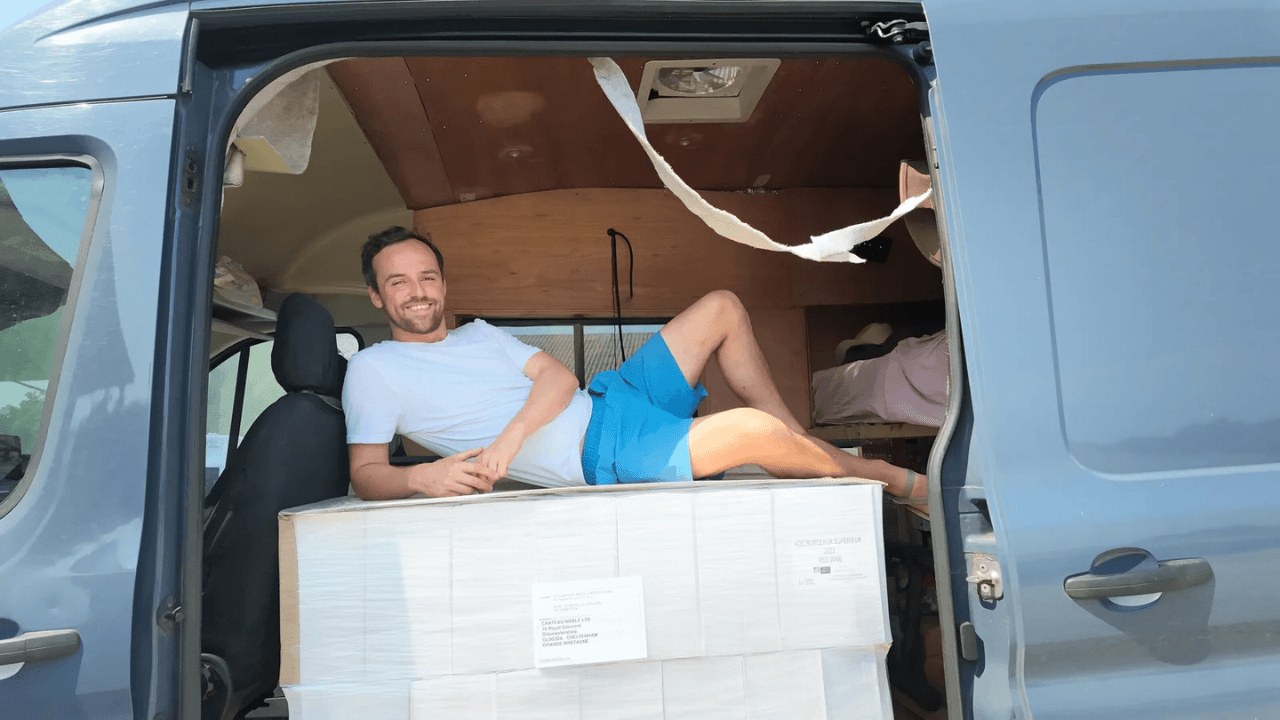
There’s a meme I often see doing the rounds: “Give me the confidence of a middle-class white male.” And, well, British entrepreneur Tom Noble encapsulates it. But he combines that confidence with an unusually vulnerable approach to building businesses: doing it in public, while crowdsourcing opinions on LinkedIn and other social media.
From sustainability to farming attention
Noble studied sustainability for two degrees before becoming an accountant and working at an energy company. He later founded a sportswear business, which he ran for five years until COVID and Brexit prompted a change in direction.
He then moved into tech, building AI-powered websites, but quickly realised that the technology was making it increasingly easy for customers to build websites themselves.
“It became so easy to do things that actually getting people's attention was starting to become the hard part. I thought,
“I don't mind being on camera. Why don't I create some media channel through which I can build and grow businesses?””
That's when Flat White or F*ck Off happened.
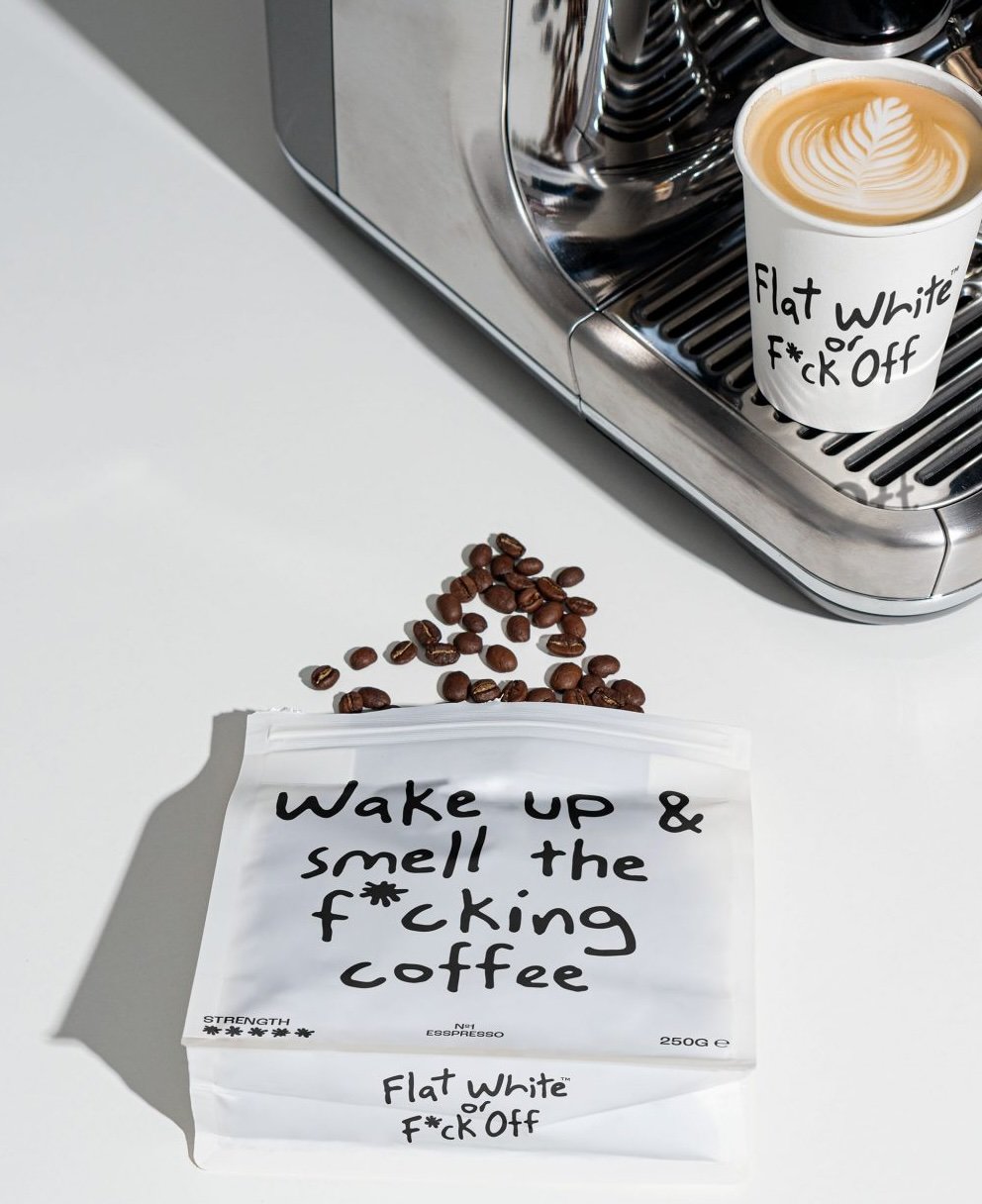
Back in early 2025, advertising and behavioural science heavyweight Rory Sutherland loated the idea of Flat White or F*ck Off, a coffee chain that served nothing but flat whites. If you didn’t want a flat white, the clue was in the name. Noble originally came on board to make a fun video around the messaging, but it went viral with around 30 million views in total, and the Instagram account reached over 46,000 followers.
On 28th January, at 7 am last year, the first Flat White or F*ck Off opened to the public at OUTERNET, outside Tottenham Court Road Station. They were unsurprisingly “flat out”, and served 1,500+ flat whites across 12 hours.
When 30 million views aren’t enough
Documenting the endeavour every step of the way on Instagram, from pop-ups to partnerships with sportswear brands, with brutal honesty, Noble admitted that the endeavour cost £27,000 but only made £5500. And there were other problems, as he explained:
“We all met online and didn't know each other. And you know how it is with founders (especially when you don't know each other): We all had different ideas and we all thought that we owned it. It was doomed to fail.
He admits that while some of his videos got a million views, “it became very clear that views aren't money. I was basically farming views. I knew it was going to drop off at some point because it was so flash in the pan. At the peak of our fame, we did nothing. We sat and waited.”
Further, he asserts, “You probably can't build a business selling basically just flat whites unless you're in exactly the right location.”
And with that name, they couldn't get into somewhere like a train station. Much less compete with locations peppered with Pret, Starbucks, and other big chains already paying huge rents. He’s particularly frustrated that Flat White didn’t sell coffee beans:
“I was quite angry about that because we had a supply lined up. A supplier gave us beans for the first event, and we could have sold them from day one. Instead, we didn't use that supplier commercially until two months later.
I found that incredibly frustrating, so I left. But I thought: if I can do it with Flat White F*ck Off, I can try to do it again.”
From flat whites to wine
After the fallout from Flat White F*ck Off, Noble took a month off. He visited a vineyard and spoke to the owner.
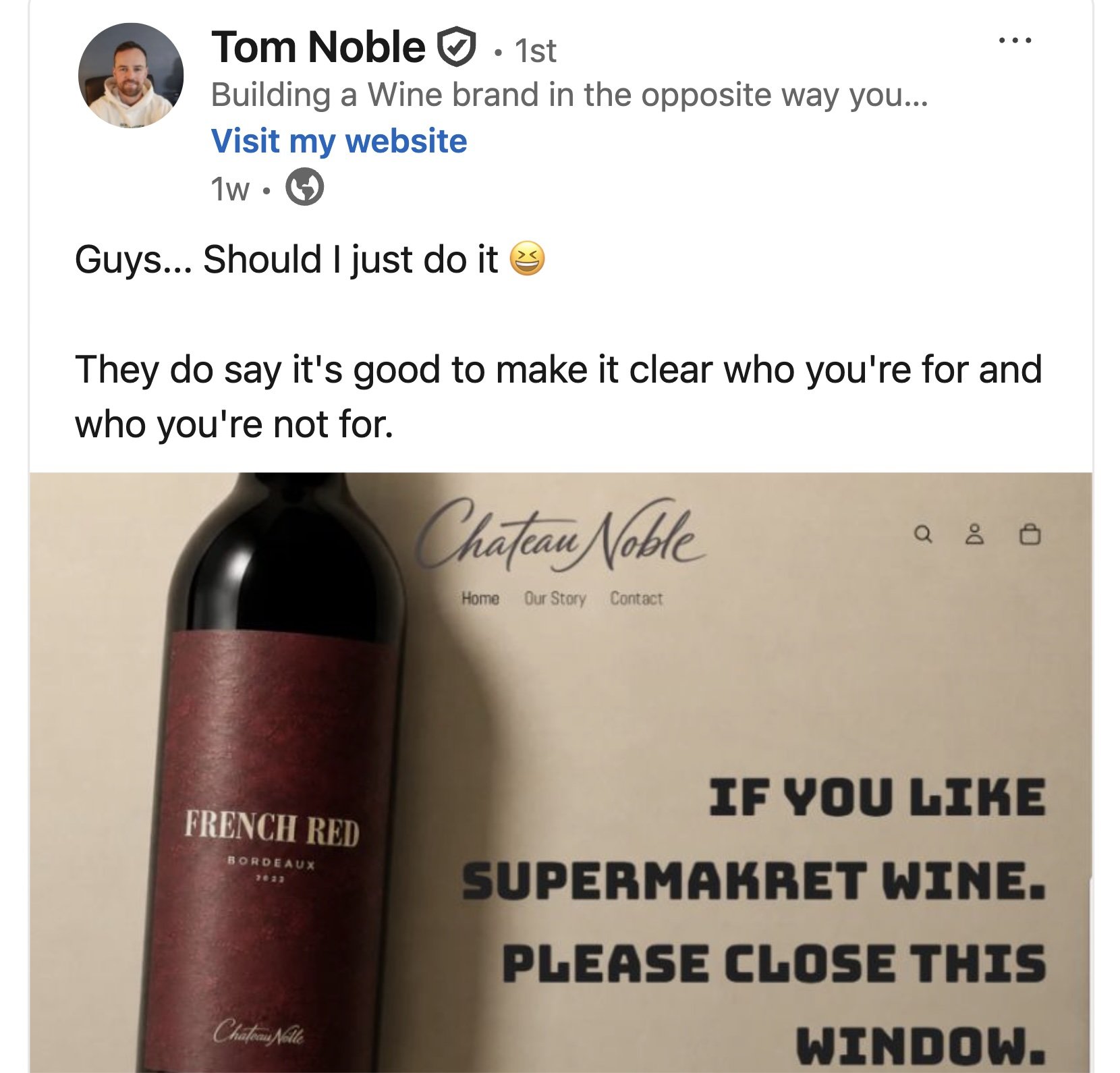
“I said, “Can I just start my own wine brand?” She said, “Yeah, go on then.” So I bought a bottle, crossed out their name, and wrote my name underneath it.” He posted on LinkedIn saying, “If I can sell 20 bottles, I'll start this wine business.”
“I failed. I sold 16. But then the post saying I was going to close the business went viral. So I thought, “I probably should keep going.”
He named his business Chateaunoble, and argues that the wine business is already commercially viable. Noble spent around £4,600 to acquire and collect 150 bottles of wine, with potential revenue of around £7,000 if they all sell.
“I'll probably lose money on this batch because I'm giving wine away and doing various marketing stunts. But I'm doing those things deliberately to sell more later.”
Putting the wine on a credit card
Noble says the early stages of building Chateaunoble have meant personally financing the business, including putting the cost of wine on his credit card. While the venture is gaining attention, that has yet to translate into enough revenue to cover the costs of building a physical product and brand.
“I’ve hit my first £3k month — and it’s not in sales. It’s credit card debt. Welcome to running a business and putting it on your credit card.”
Despite the financial pressure, he remains convinced that Chateaunoble has potential. He also sees his growing profile as a creator as closely connected to the wine brand's development, with each helping generate attention for the other.
“I truly believe Chateaunoble will be something one day, as well as myself becoming a creator alongside it. Both feed each other.”
Noble says his move towards physical businesses was partly driven by the limitations of creating content around digital products.
“I started making videos of myself building websites, and no one cares. All I can film is myself sitting at a screen.”
Vineyards and coffee shops, for example, offer an aspirational element that translates readily to social media.
“If I’m at a vineyard or in a coffee shop, that’s visually engaging. Who doesn’t want to go to a vineyard? It’s aspirational.”
Noble believes physical businesses are often judged more harshly on their commercial success than startups — consider, for example, how readily restaurant failures are scrutinised compared with the oft-cited 80 per cent startup success rate.
“You can throw money at a young tech founder with no track record, but if someone starts a physical business, suddenly everyone wants to know where the profit is.”
“Why should I listen to you about wine?”
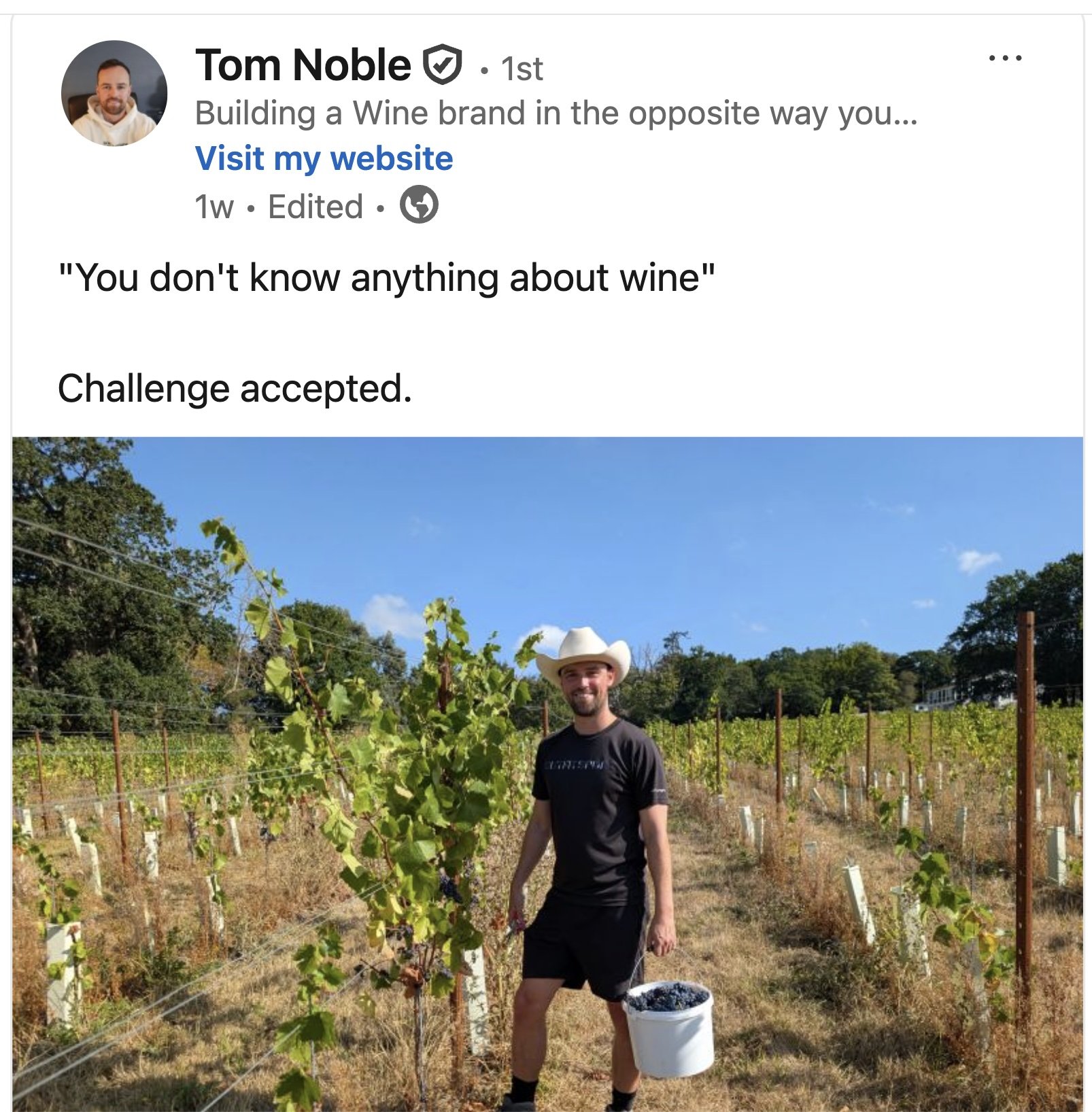
Unsurprisingly, Noble pushes back against the idea that he needs formal wine qualifications to select wines for Chateaunoble. He says feedback from customers who have opened the wine has been overwhelmingly positive, and some buyers have even chosen to keep their bottles as collector's items.
“I’m not a trained sommelier, and I don’t have a wine degree, but I know what a good glass of wine is.”
Noble says the concept is deliberately straightforward: source established varieties from respected wine regions and work with credible, affordable producers. For his first wine, he chose a producer whose previous vintages had scored above 90 points.
“That’s kind of the point of what I’m doing here: good wine, from a good wine-making region, in a good wine-making country.”
His approach is also relationship-driven. He wants to find affordable vineyards, ideally organic, and work directly with producers whose stories can become part of the Chateaunoble brand and its content. Noble is now looking to deepen his practical understanding of winemaking, including taking part in three harvests this year.
“Time to learn wine like I learned how to navigate customs with my own paperwork.”
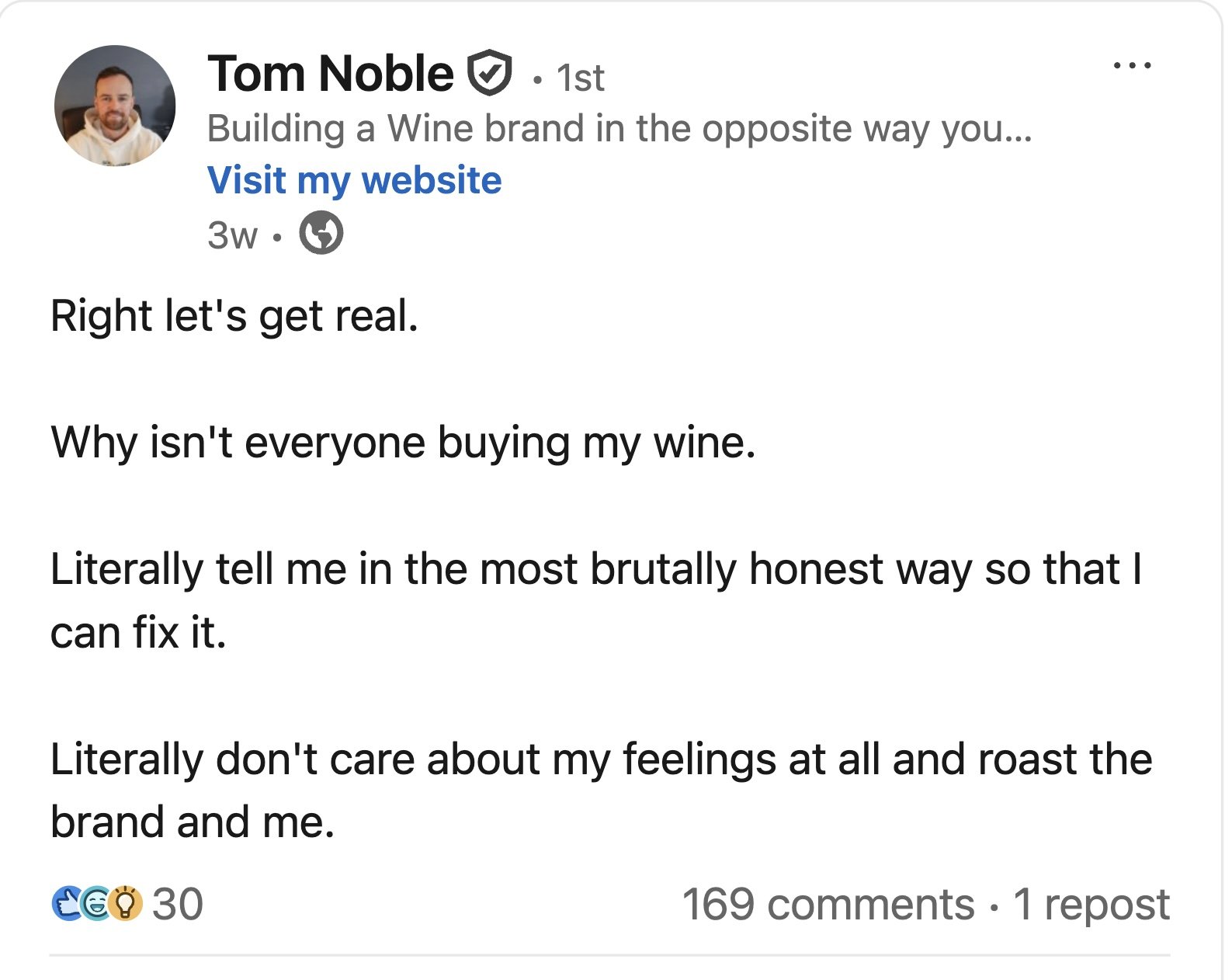
After directly asking followers why they weren't buying his products, he received 137 comments — ranging from constructive criticism to outright trolling.
Basically: "why is the wine good? Why should I trust Tom that the wine is good? Tell me about the vineyards. Your website sucks."
Among the most common responses, 10.2 per cent questioned the quality of the wine, 8.8 per cent asked why they should trust Noble’s judgement, and 8 per cent wanted more information about the vineyards. Another 8 per cent criticised the website, while comments also raised issues around the label design, pricing, sampling, and Noble’s relative lack of recognition.
The exercise highlighted a gap between Noble’s personal connection to wine and what he had communicated to potential customers.
“I went all in on building the business and forgot to mention that I’ve been drinking wine for the past eight years.”
Rather than dismissing the criticism, Noble says he intends to use it to adjust how he presents Chateaunoble, particularly by explaining more about the wine, the vineyards, and his own journey into the industry.
“Time for a slight course correction.”
Stop worrying about the algorithm
Noble’s theory of content is that you're trying to get a second glance — a double take. You're trying to stop someone's thumb. Noble cites various founders including George Rawlings, co-founder of the dating app and IRL events brand Thursday, as one of his LinkedIn inspirations. Thursday has grown from an app that only works one day a week into an events and media brand with a reported 3.5 million-person community.
“He didn't take any of it seriously, and his posts were absolutely going off.”
Noble has a great love for LinkedIn, asserting that he's probably seen too other people doing the same thing, which is "being honest and taking the piss out of it. "
"It does really well. I've done about four million impressions this year.
You need to do something different because people's feeds are so bad. If you can be somewhat relatable and personable on LinkedIn, you can do really well because hardly anyone else is doing it.
At one point, LinkedIn made a change, and everyone's views dropped. I thought, “I give up. I don't care anymore.” So I started posting what I actually thought. And it went much better. People want to be entertained."
Turning attention into opportunity
However, there’s a difference between gaining attention and turning it into a financial opportunity. According to Noble, Flat White or F*ck Off’s viral success began generating opportunities without the team actively seeking them.
Puma approached the brand about appearing at the London Marathon, and it was also invited to the London Coffee Festival, attracting interest from coffee machine manufacturer Sanremo. While not every opportunity was paid, Noble saw value in those that generated publicity and could ultimately support direct-to-consumer sales. He is now seeing a similar effect in his wine business, with invitations from vineyards and producers to send him samples.
“I’m putting it out there. People know I’m starting a wine business, so they’re sending . I get to go to them, and by doing so, I have content for the next thing. So it’s creating itself.”
The audience is not only a source of attention and opportunities; Noble also uses it for real-time market research.
Noble says the constant stream of public feedback has influenced decisions across his ventures. When he posted his wine labels, for example, “everyone hated them”. He had already been considering changing them, but the response reinforced the decision.
“I probably get two messages a day from random people giving me their opinions, and some of them are really useful.”
He applies the same thinking to smaller experiments. He recently promised to hold a launch party if a post received 500 likes. It didn't. “But that's a win-win. If it got 500 likes, I'd do the party. If it didn't, I could post saying I'd cancelled the party, and that would probably get views too.”
The content remains the engine
Ultimately, Noble likens his approach to Clarkson’s Farm, the British series that follows Jeremy Clarkson as he learns, often chaotically, how to run a farm. Noble wants to apply the same formula to entrepreneurship.
“He learns to run a farm. I will learn to and build a wine business,” he asserts.
According to Noble, branded content that gets views is the gold standard. Views lead to followers, which lead to more views.
“And if you're creating content that frames both you and your product in the right way, eventually it should lead to sales. Everything I do is based around: what could do well in terms of views?”
For example, Noble picked up a fridge from the side of the street to use as a wine cooler. Then he realised, “Oh, I can actually sit in this.”
“So I took a picture of myself sitting in it drinking wine. That cost me nothing. And if it doesn't perform well, I'm doing something else anyway.”
Noble’s creator strategy is already producing significant reach. He recently generated one million LinkedIn views in a week and has averaged around 25,000 impressions a day over the past two months. He is now considering monetising that expertise through personal-branding consultations.
“Or should I start to write a paid Substack with all the ins and outs of what I’m doing? I'm a magpie. I collect shiny things. I'm very aware of my flaws,” admits Noble.
“There's a gap in the market for middle-aged white men making podcasts! declared Noble, who also decided to start a podcast called Help Tom build a wine business, please. The first episode is on creating a podcast.
“If I said I was starting an airline as a joke and it got 10 million views, I'm starting an airline.”
Noble has also been seeding the idea of starting an airline on LinkedIn, using audience response to test whether an outlandish idea might have legs.
“It's almost a test. Then I need to determine how to do it. Maybe I will charter a plane. Maybe I will crowdfund the charter and call that starting an airline.
And then I can sell some wine on the plane, and because it's generating PR. It's incredibly cheap PR. That's how I think about a lot of these things.”
For Noble, the line between publicity stunt and genuine business idea is deliberately fluid. An idea might begin as content, but a sufficiently strong audience response could persuade him to pursue it for real.
“If I said I was starting an airline as a joke and it got 10 million views, I'm starting an airline. I'm sorry, but I just am.”


Would you like to write the first comment?
Login to post comments