

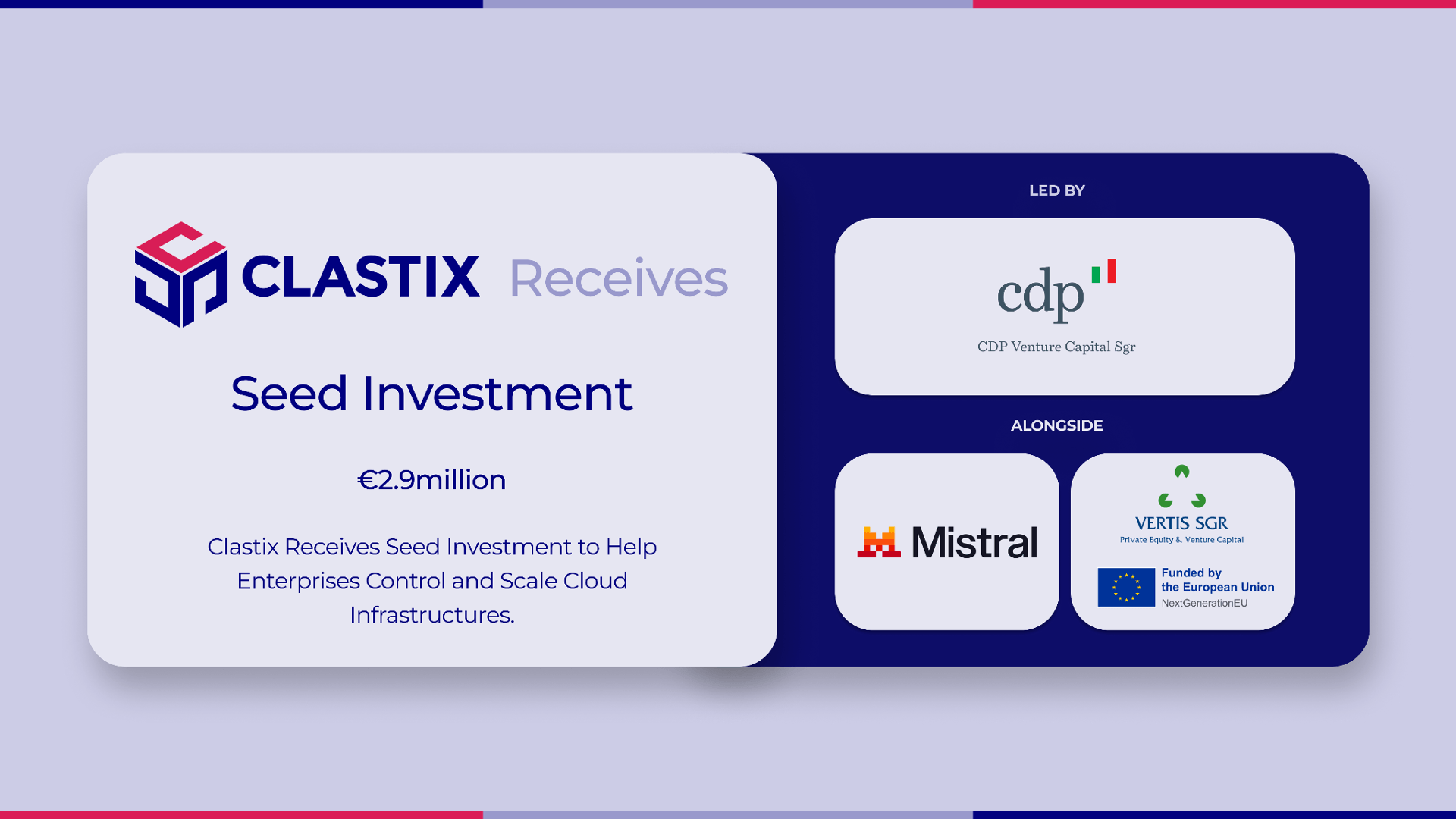
Italy-based Clastix, a company developing technology for managing Kubernetes operations at scale, has raised €2.9 million in seed funding to expand its team and accelerate the development of its platform. The round was led by CDP Venture Capital Sgr, with participation from Mistral and VERTIS SGR through its Vertis Venture 6 Digital Sud fund, which is partially financed by the European Union's Next-Generation EU programme.
Clastix develops infrastructure technology for organisations running Kubernetes across multiple teams, environments and workloads. The company is targeting the operational complexity that can arise as the number of Kubernetes clusters grows, including the dedicated machines and infrastructure traditionally required to operate a control plane for each cluster.
Its technology moves Kubernetes control planes onto shared infrastructure, allowing platform teams to reduce infrastructure overhead, simplify operations and manage deployments at a larger scale.
Clastix's technology includes Kamaji, its open-source Hosted Control Plane engine, and kMetal, its commercial platform for managing Kubernetes operations across fleets. Kamaji will remain open source under the Apache 2.0 licence, while kMetal will continue to be developed for fleet management, governance and production operations.
According to the company, its technology is already being used in production by infrastructure teams in Europe and North America across AI labs, telecommunications, cloud services and the public sector.
Adriano Pezzuto, co-founder and CEO of Clastix, said the infrastructure layer supporting AI workloads will become increasingly important as the technology develops.
The next phase of AI won't be decided by models alone but by who controls the infrastructure layer beneath them,” said Pezzuto. “This funding goes toward building that layer for what's coming: expanding our R&D to better support AI-scale workloads, and growing our team to bring it into new markets as they build their AI infrastructure.
Timothée Lacroix, co-founder and CTO of Mistral, said Clastix supports the company's Kubernetes infrastructure, with its work on multi-tenancy and managed control planes helping Mistral operate training and inference clusters at scale:
By backing Clastix, we're investing in Europe's AI stack. A sovereign AI ecosystem isn't just about models – it's about the infrastructure layer that makes them run.
Clastix will use the funding to support product development, customer success, solutions engineering and go-to-market expansion as it expands kMetal.
The company also plans to increase its R&D capabilities to support AI workloads and continue investing in Kamaji. Over the next three years, Clastix expects to grow its headcount as it responds to customer demand and builds out its capabilities for enterprise teams.


Would you like to write the first comment?
Login to post comments