

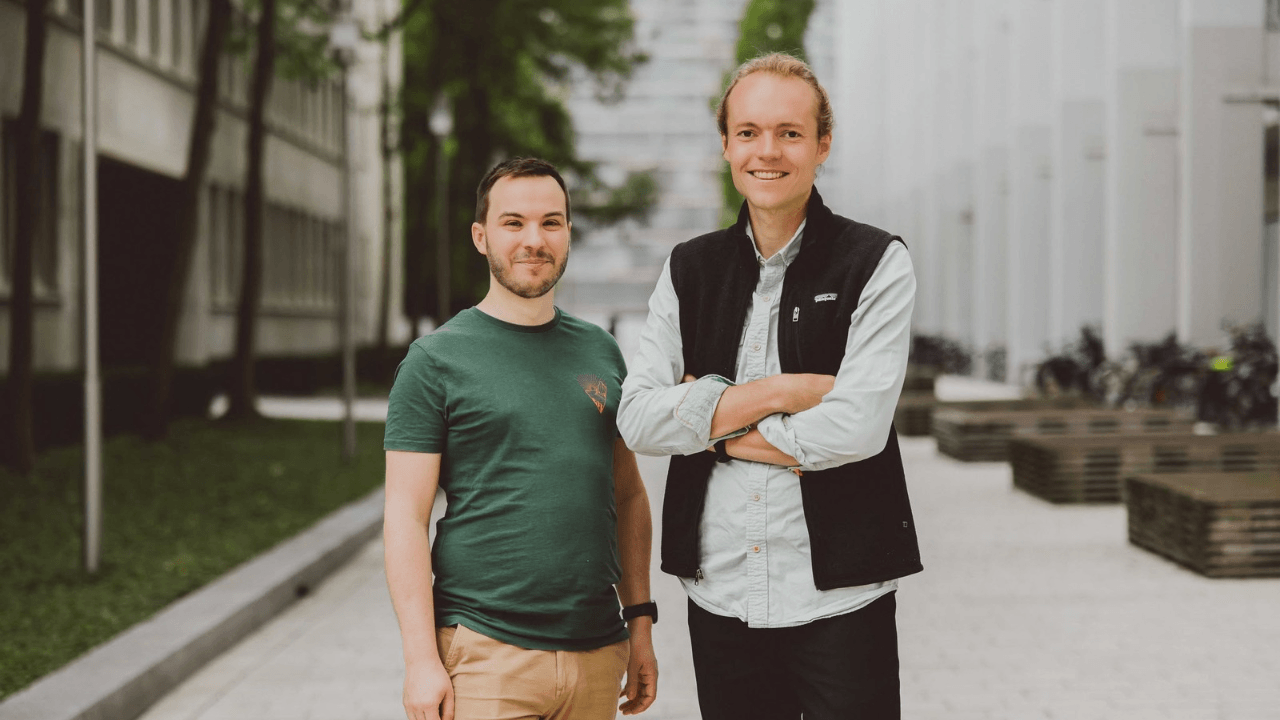
Swiss tech-bio firm Atlas Bio today launched from stealth with a $10 million Seed round led by Creandum, alongside a previously unannounced pre-Seed round led by First Momentum Ventures and LEA Partners, bringing its total funding to $12.5 million.
Atlas Bio is developing a foundational AI model to run in silico clinical trials. By simulating patient-level efficacy and safety signals before Phase II, Atlas Bio aims to de-risk clinical development, improve trial design, and support the industry’s shift toward more human-relevant evidence.
The company's first-of-a-kind AI foundation model is trained on roughly 2 million RNA readouts from human tissue, the molecular signals that show how genes switch on and off inside the body. By learning these patterns, the model can simulate how a drug will behave in each individual within a virtual cohort of patients, replacing both expensive Phase II trials and the animal studies that precede them.
Ending Phase II: drug development’s most expensive failure point:
Phase II trials cost drug companies $100 million+ and take two to three years, yet around 70 per cent of drugs fail at this stage.
Only 30 per cent of drugs show an effect on their selected disease in Phase II, yet among those that do eventually get approved, around 60 per cent turn out to treat a different (off-label) condition more effectively than existing treatments. In other words, the molecule often works, just not for the disease the trial was designed around.
Current clinical trials are not designed to identify these potential benefits early in drug development.
By running trials across all diseases simultaneously, Atlas Bio's platform identifies which patients actually benefit before sponsors commit to a narrow Phase II design, turning what is currently a 70 per cent failure rate into a discovery engine.
Atlas Bio’s in silico trials compress that timeline to a 12-week simulation project. Because the trial is virtual, multiple treatments can be tested on the same patient profile at the same disease state – something physically impossible in a live trial – enabling counterfactual analysis at scale.
Ending animal testing: human-relevant evidence at commercial scale:
Animal models are a poor proxy for human biology, and regulators are moving away from them. The FDA Modernization Act 2.0, passed in 2022, removed the legal requirement for animal testing before human trials for the first time in decades.
Atlas Bio is already working with a top 10 global pharma company and in talks with several other global pharma firms.
The company was founded in 2024 by Simon Romanski (ex-KIT, EPFL, Stanford and a long-distance runner) and Sebastian Bayer (led large language model (LLM) research at Google, early contributor to autonomous driving). Dominik Hartl, a former doctoral fellow of the Friedrich Miescher Institute for Biomedical Research, leads on scientific strategy and brings more than a decade of drug development experience.
According to Simon Romanski, CEO and co-founder of Atlas Bio, for sixty years, drug development has been built on two flawed assumptions: that mice predict humans, and that the only way to learn whether a drug works is to give it to thousands of patients and wait.
“Both are now becoming outdated. Human biology is finally legible to AI - and that changes the economics of this entire industry.
Many failed Phase II trials is a treatment that didn't reach a patient who needed it, and the cost of that failure has become impossible to defend when the technology to fix it exists. Atlas Bio is the end of Phase II as we know it, and the end of animal testing as the price of progress."
One Atlas Bio client – a Basel-based biotech – has already eliminated animal testing from a specific drug development workflow, proceeding directly to human trials on the basis of Atlas Bio’s simulation output. It is one of the first commercial uses of AI-driven simulation as a direct substitute for preclinical animal studies.
"Most biological effects are not caused by drugs. To predict unknown drug effects, we need to learn biology in an unbiased way," says Sebastian Bayer, CTO and co-founder of Atlas Bio.
"By training our foundation model on roughly 2 million human RNA readouts, we can generalise across indications and treatments, enabling simulations that aren't tied to one disease or one mechanism."
Creandum led the round, with Partner Katharina Wilhelm joining the board. In addition to this, Atlas Bio is also announcing a previously undisclosed $2.5 million pre-Seed round led by First Momentum Ventures and LEA Partners.
Katharina Wilhelm, Partner at Creandum, commented:
“The first wave of AI in drug development focused on drug design and is well underway. Now, we are entering the second wave: clinical development.
Today, clinical trials take years, cost hundreds of millions, and still fail 70 per cent of the time.
What excites us about Atlas is their ability to simulate trials without requiring sensitive treatment data. They are paving the way for a future where predictive models can replace steps of the clinical trial process entirely, allowing their customers to drive down both time and costs substantially."
Atlas Bio will use the funding to scale scientific and commercial teams, deepen platform validation, and onboard further enterprise clients through 2026.


Would you like to write the first comment?
Login to post comments