

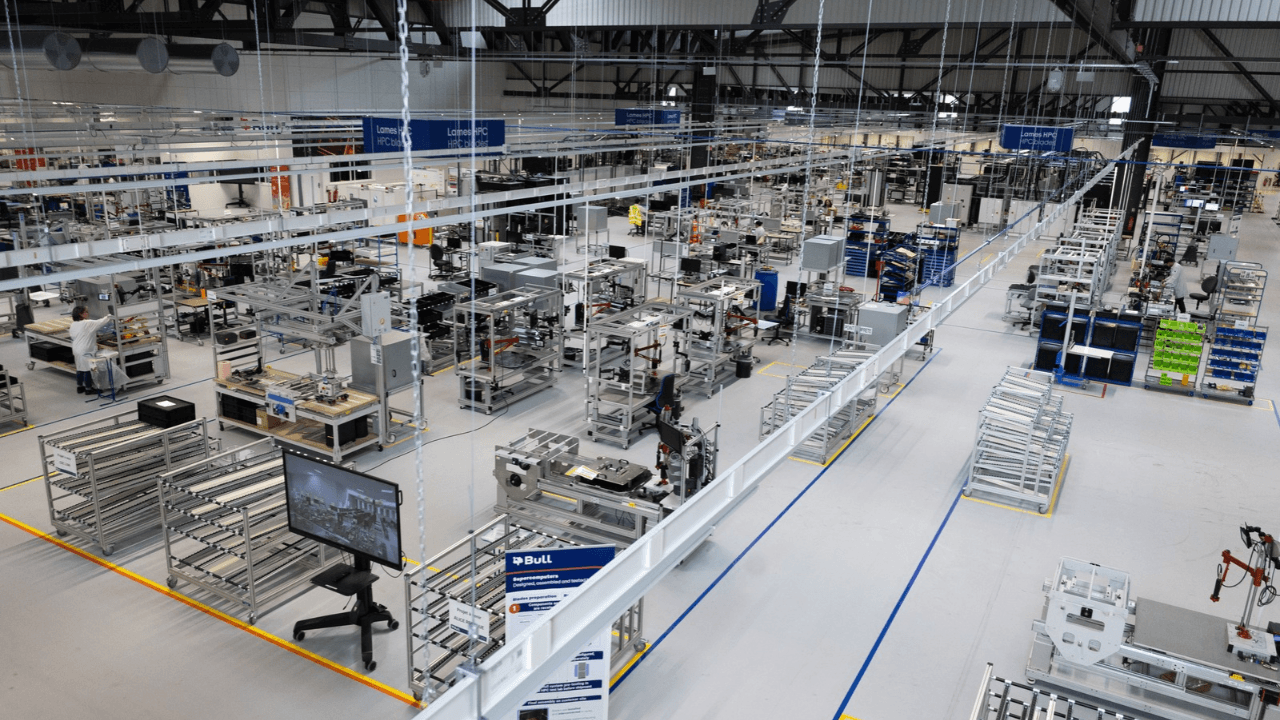
French computing company Bull has opened a new production building at its historic Angers site in France following an €80 million redevelopment.
Bull specialises in high-performance computing, AI and quantum technologies, developing hardware, software and related services for businesses, research institutions and governments.
The company generates approximately €720 million in annual revenue, employs 3,000 people across 32 countries and holds around 1,600 patents. Its technologies support scientific research, AI development and data-intensive applications, including those requiring greater control over computing infrastructure and sensitive data.
I visited Bull's newly expanded manufacturing facility to learn how the company is increasing European supercomputing production, reducing its reliance on overseas suppliers and opening its industrial infrastructure and engineering expertise to startups.
Inside Bull's new Angers manufacturing facility
Nearly 300 people work at the site, with another 50 to 100 expected to join as part of a wider recruitment plan targeting 500 hires. The factory can now assemble 12 computing racks a week, up from six, and Emmanuel Le Roux, Bull's CEO, said production could eventually increase to 24.
Walking through the factory, I was struck by how spacious and quiet it was. The production floor is divided into three areas: high-performance computing (HPC), AI infrastructure, and a central testing and validation section.
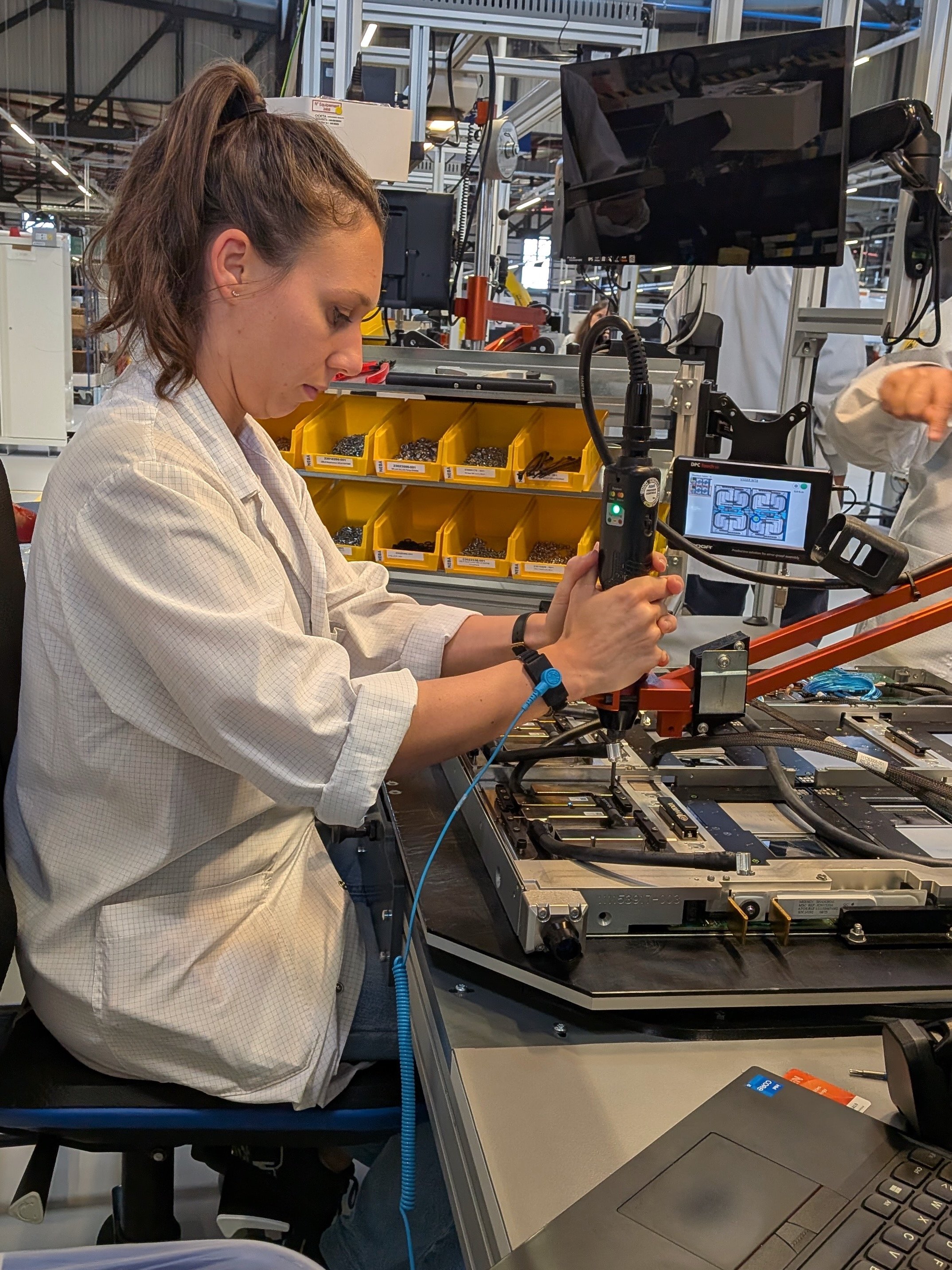
Rather than the traditional assembly lines I'd imagined, with workers and perhaps cobots standing shoulder to shoulder, technicians sat at individual workstations carrying out precision tasks.
Some used intelligent screwdrivers that automatically adjust torque settings and guide the assembly process, reducing the risk of loose, over-tightened or damaged screws.
The workforce brought together people with different academic and technical backgrounds, with some roles requiring dexterity and fine motor skills rather than formal qualifications.
Overall, the atmosphere reminded me more of a fashion house's bespoke atelier than a conventional line of shoulder-to-shoulder industrial assembly lines.
The modular layout also lets production lines adapt to different equipment in about ten minutes, while an entire line can be relocated in about three days.
According to a presentation by the Bull team, the expansion allows the company to assemble multiple large-scale supercomputers simultaneously, something that was previously impossible.
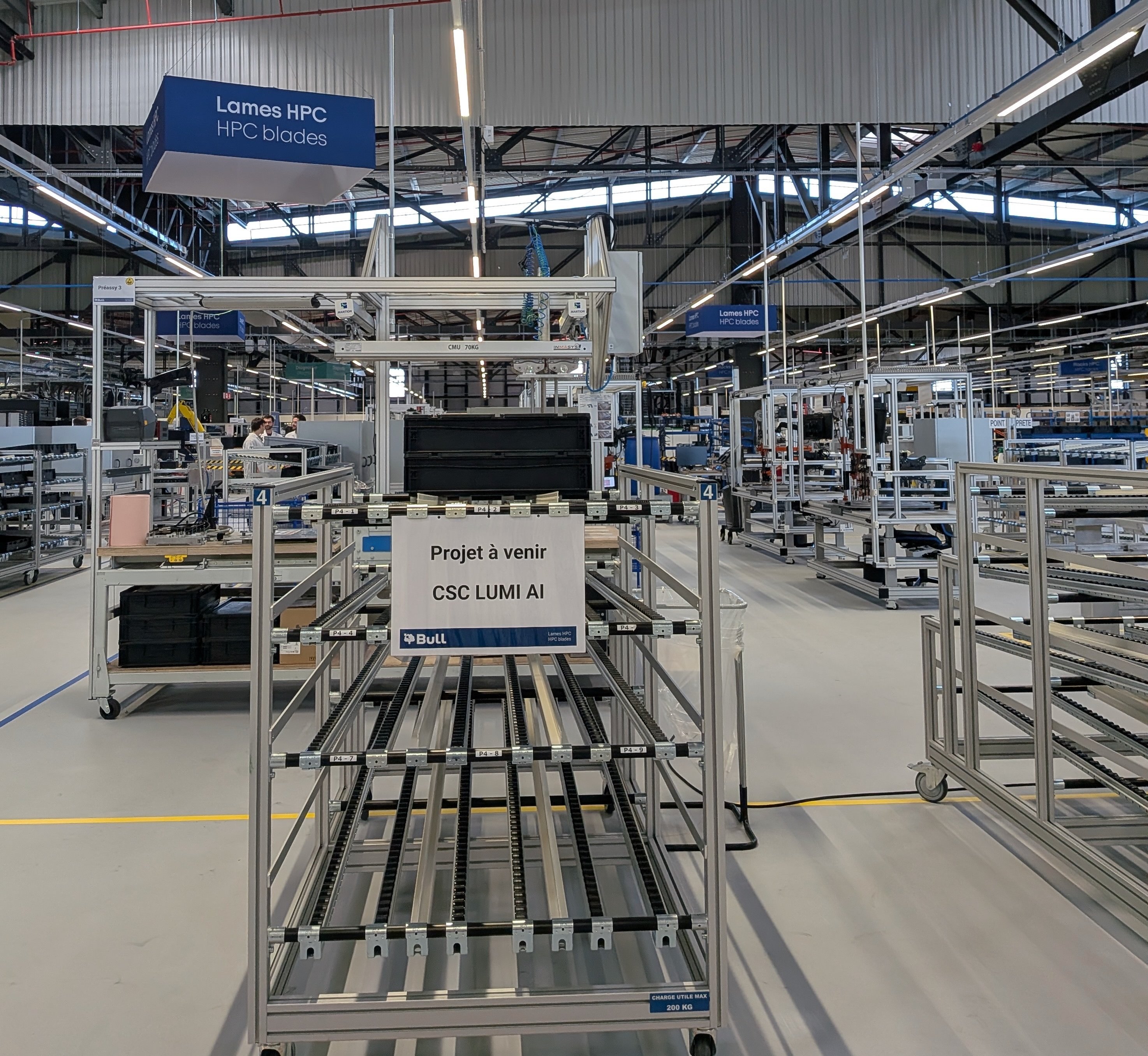
This includes France's 94-rack Alice Recoque supercomputer and Finland's €388 million LUMI-AI system, Bull's largest contract to date.
The redevelopment also includes more than 3,500 photovoltaic panels with 1,500 kWp of peak capacity and a heat-recovery system that Bull says could eventually capture enough energy to meet the equivalent needs of 600 households. Bull also plans to plant around 1,500 trees near the site. The project received €1.2 million from France's Green Fund, €213,000 from ADEME's Heat Fund and €1.5 million from the Pays de la Loire Regional Council.
One of Bull's key technologies is its patented Direct Liquid Cooling system, which circulates water through cooling plates attached to heat-generating components inside its supercomputers.
Unlike conventional air cooling, the system can use water at temperatures of up to 40°C, reducing the need for energy-intensive refrigeration and cooling fans. Bull's latest generation is entirely fanless, allowing more computing power in the same space while making it easier to capture waste heat for reuse in nearby buildings.
Building European sovereignty
Emmanuel Le Roux linked the investment to Europe's need for greater control over its computing infrastructure:
"Europe must have the industrial capabilities required to produce tomorrow's strategic digital infrastructures on its own territory."
Bull is also working to reduce its dependence on overseas suppliers. It has developed its own BXI high-performance interconnect technology, holds a stake in European chip designer SiPearl and now sources electronic boards manufactured in France.
According to Le Roux, those boards were made entirely outside Europe a decade ago. He also pointed to the Angers factory's continued operation during the COVID-19 pandemic as an example of the value of retaining local manufacturing capabilities.
Le Roux said European-made components now account for around 70 per cent of systems produced at Angers, up from 20–30 per cent five years ago.
He also claimed that the forthcoming LUMI-AI supercomputer will be 70 per cent European-made, compared with 40 per cent for its predecessor and approximately 5 per cent for competing systems. These figures have not been independently verified.
For Le Roux, technological autonomy is about having alternatives rather than eliminating international suppliers.
He gave the example of a shortage of a US-sourced electronic component costing less than €2 that threatened to halt supercomputer production. Bull's engineers redesigned the circuit board to accommodate an Infineon component, allowing manufacturing to resume.
The investment comes as European institutions seek to expand computing capacity.
The EU has committed approximately €7 billion to the European High Performance Computing Joint Undertaking (EuroHPC JU) over 2021–2027.
According to Le Roux, Bull has won 15 of 18 EuroHPC tenders.
An Open Factory for European startups
Alongside the inauguration, Bull announced an Open Factory initiative intended to make its industrial capabilities available to other technology businesses.
The programme aims to support European technology development and help companies move from laboratory research and prototypes to industrial-scale production.
I spoke to Petr Bednařík, founder of Czech AI company DataSentics and now Bull's AI Strategy Director, about what this could mean for startups.
For smaller companies developing AI hardware or high-performance computing technologies, Bednařík sees the Angers facility as a potential way around the substantial cost of building their own manufacturing infrastructure.
"The factory is a unique asset," he said.
But Bull's value to startups could extend beyond physical infrastructure. A specialist startup might build on Bull's software platforms or integrate its technology into an existing project for a large enterprise customer, gaining access to relationships that would otherwise be difficult to establish independently. Bednařík is also exploring ways to provide engineering resources as a form of investment.
"For example, we might assign three engineers to work with a company for two years, with that contribution forming part of our investment."
He stressed that Bull does not intend to become a conventional venture capital fund. For early-stage deeptech companies, technical expertise and engineering capacity can be as important as financial backing.
"Providing money isn't necessarily the most distinctive thing we can offer."
The investment model and factory-access arrangements are still being developed. Bednařík said Bull was working through business planning and board discussions, with the concept potentially defined by the end of 2026 and outreach to startups beginning in early 2027.
However, software startups interested in building applications on Bull's existing platforms can already approach the company.
Why DataSentics turned Bull away five times
Bednařík's approach to working with startups is informed by his own experience of building and selling DataSentics.
Founded in Prague in 2016, DataSentics develops AI and machine learning solutions for enterprise customers. French IT group Atos acquired the company in 2021, and it subsequently operated under the Eviden brand before becoming part of Bull in 2026.
Before founding DataSentics, Bednařík spent a decade at Deloitte. He wanted to build a more agile company, but scaling as a relatively small Czech technology supplier proved difficult, particularly when selling to major banks. Bull and Atos approached the company several times about an acquisition
. "To be honest, we turned them away five times," he recalled.
Eventually, Bednařík concluded that joining a larger organisation could give DataSentics access to customers it struggled to reach independently. However, he was concerned about losing the company's culture and independence.
"As a startup founder, you hear all the horror stories about acquisitions. A company gets bought, and within a year or two, the original team has disappeared, and much of the value has been lost."
According to Bednařík, Bull largely left DataSentics' team and working practices intact, focusing integration on sales, enterprise relationships and aligning technology roadmaps.
He acknowledged that operating with relative independence can complicate financial reporting and administration, but believes it helped the company retain its people and entrepreneurial culture.
"Even today, my team operates much as it did when we were an independent startup."
The experience convinced him that startups could benefit from access to corporate resources without necessarily being acquired. He points to the startup programmes of hyperscalers and Databricks as examples of companies supporting businesses that build on their technologies, and sees an opportunity to develop a similar model around European industrial infrastructure.
Why Europe's AI factories need more than GPUs
At the factory inauguration, Sebastian von Alfthan, Director of CSC – IT Centre for Science, discussed the shortage of computing capacity available to European researchers and businesses, and the importance of making advanced infrastructure accessible beyond large technology companies. CSC operates Finland's research computing infrastructure and hosts LUMI, the EuroHPC supercomputer inaugurated in 2022.
"What we lack is sufficient computing capacity to support their ambitions," he said of Europe's researchers, startups and technology companies.
LUMI ranked third globally when it launched. Although originally developed primarily for high-performance computing, its GPU resources have also been used for AI workloads. Its successor, LUMI-AI, is among the systems planned for production at Angers.
Von Alfthan explained that an AI factory is more than a data centre filled with GPUs. It brings together computing resources, datasets, storage, technical assistance, regulatory guidance and business development support. This is particularly important for smaller companies that may lack the staff or expertise to use advanced computing systems effectively.
He also discussed the potential to combine conventional simulation with AI in scientific research and, in the longer term, quantum computing. Examples included using AI to analyse agricultural data and assess wood quality in industrial production, demonstrating how advanced computing can support established industries as well as emerging technologies.
From French state ownership to new European contracts
The French government completed its acquisition of Bull from Atos in March 2026, giving the company a long-term public shareholder as France seeks to strengthen its domestic computing industry.
Bull has since announced several commercial agreements in Europe. In November, it signed a memorandum of understanding with Schwarz Digits, the digital division of Schwarz Group, to explore developing European AI and cloud infrastructure. The proposed collaboration includes Bull-manufactured servers, direct liquid cooling and making the Bull Sequana AI platform available through the STACKIT Marketplace.
In October, Germany's Climate Computing Centre (DKRZ) awarded Bull a €40 million contract, including five years of support, for its next-generation HLRE-5 climate supercomputer.
Scheduled to enter service in early 2028, the BullSequana XH3500-based system is designed to run two global climate simulations simultaneously at 5 km resolution while reducing energy consumption per simulated year by approximately 75 per cent compared with DKRZ's current Levante system. The supercomputer will use Bull's direct liquid cooling technology.
DKRZ already supplies some recovered heat to the University of Hamburg's neighbouring chemistry department, and plans to make more waste heat available to university buildings when HLRE-5 is installed.
Bull's expanded Angers factory and proposed Open Factory programme could open up valuable opportunities for European deeptech startups, particularly those facing the high costs of moving from prototype to production. The next step is turning those ambitions into practical support that startups can actually use.


Would you like to write the first comment?
Login to post comments