

Digital learning has made educational resources more widely available, but access remains a challenge for many students, particularly those with disabilities or limited budgets.
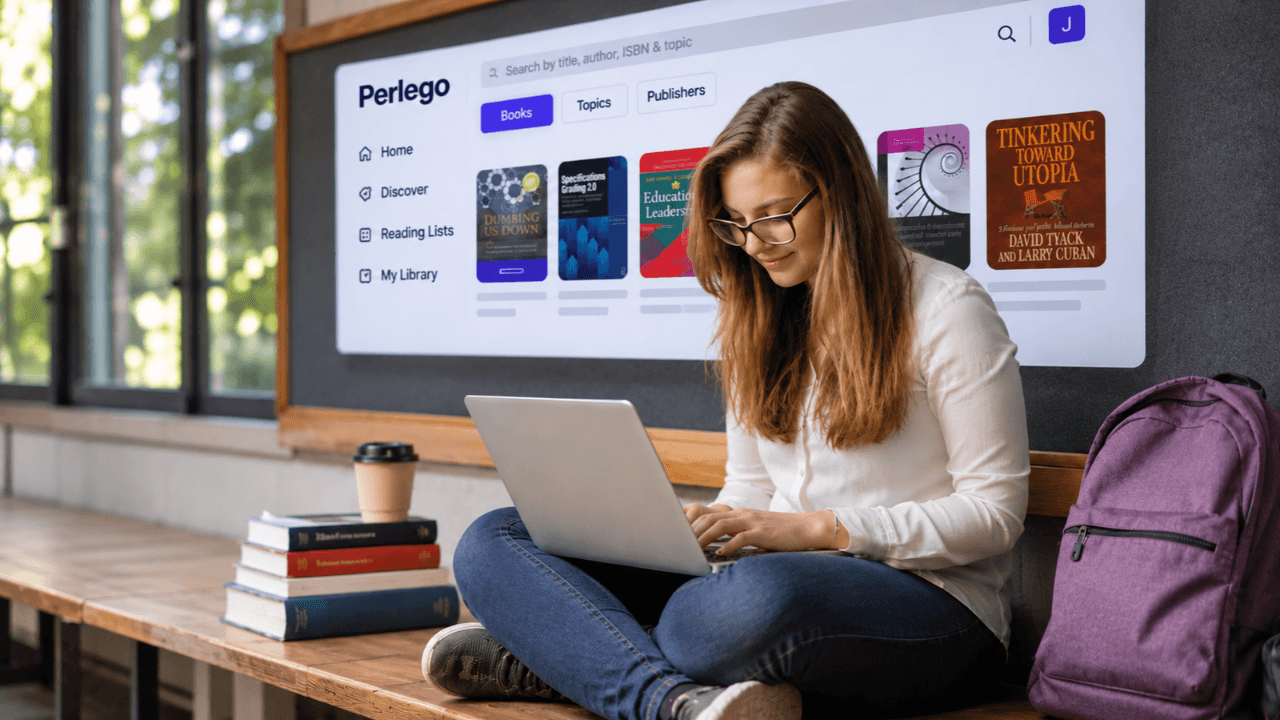
London-based edtech company Perlego is tackling these barriers through a subscription-based digital library with access to more than 1.5 million books, alongside accessibility features, such as text-to-speech, adjustable fonts and reading tools. The company has raised over €70 million in funding.
I spoke to Gauthier Van Malderen, founder and CEO of Perlego, to learn more.
From expensive textbooks to digital subscriptions
I'm sure I'm not the only one who remembers university textbooks being heinously expensive. When I studied in Australia, textbooks — including those written by my lecturers — were compulsory, and I remember spending around €400 per semester at a minimum.
Worse, books were frequently updated, making it difficult to buy second-hand copies.
Van Malderen had a similar experience studying in Italy and the UK. At the same time, he noticed publishers were losing revenue through piracy and the second-hand book market.
“Students were sharing books or turning to illegal websites because they couldn't afford to buy them.
I started thinking about how people were already subscribing to music and films, and wondered why the same model couldn't exist for educational books.
That's where Perlego came from.”
Making digital books genuinely accessible
Accessibility is often treated as an additional feature rather than something fundamental to learning. Digital technology, however, offers opportunities to improve the reading experience, particularly for people who struggle with printed materials.
Perlego allows users to adjust fonts, text sizes and colour settings. It also offers a dyslexia-friendly reading mode and BeeLine Reader, which uses colour gradients to guide readers through text.
According to Van Malderen, one of Perlego's most important features is Read Aloud, its text-to-speech tool, which uses AI-generated voices with adjustable reading speeds. Traditional audiobooks cover only a small proportion of the publishing market, largely bestselling fiction and some nonfiction.
“For academic textbooks, research papers and other specialist materials, producing conventional audiobooks often doesn't make economic sense.
With text-to-speech, we can make that content available in audio format without needing to produce a separate audiobook.”
The feature is now available across more than 95 per cent of Perlego's catalogue.
Perlego pays publishers royalties based on consumption, treating listening and reading equally. It also shares usage data, helping publishers identify opportunities for audio versions of content that might otherwise be commercially unviable.
AI that supports learning rather than replacing it
Perlego has also introduced AI-powered research tools that draw on its catalogue of licensed educational content to help students and academics find relevant sources. Van Malderen explained:
“Our research tool uses semantic search and retrieval-augmented generation (RAG), which means it draws on content from our catalogue rather than simply generating an answer.
For example, you might ask about the impact of interest rates on debt markets. The system generates an answer with the relevant source information and takes you directly to the book.”
Unlike general-purpose generative AI tools, which can produce fabricated references, Perlego's approach is designed to connect users with identifiable source material they can examine themselves. However, there's considerable debate about AI in education, particularly around students relying on generated answers rather than developing their own understanding.
Van Malderen says Perlego must balance the interests of three groups: publishers concerned about how copyrighted material is used in AI systems, academics worried about the impact on learning, and students who want to find information quickly.
“One of the biggest concerns we hear from professors is that students are increasingly using generative AI to produce essays without necessarily learning the underlying material.”
Perlego has developed AI principles intended to ensure its tools support learning rather than replace it. Rather than generating complete essays for students to submit, the company focuses on helping users discover sources and engage with the underlying material.
Van Malderen believes universities need to work with AI technologies rather than ignore them, particularly as students already have access to tools that may lack educational safeguards.
Beyond the reading list: How Perlego is improving access at Leeds
The University of Leeds, one of the UK's largest universities, began using Perlego around two years ago. According to Isabel Archer, Access & Acquisitions Manager (Acquisitions & Reading Lists) at the University of Leeds, the platform helped address longstanding gaps in access to reading-list materials.
“One of the things that initially drew us to Perlego was the coverage of reading list titles that we couldn't provide electronically through other providers, and in some cases couldn't obtain in print either.”
Further, the university previously couldn't provide electronic access to 60 per cent of reading-list citations.
Since the partnership began, students have used Perlego's Read Aloud feature 40,871 times, activated dyslexia-friendly font settings 2,532 times and adjusted text sizes 11,391 times.
The partnership has also eliminated licensing-related “turnaways” during peak exam periods — instances where students are denied access to a text because the maximum number of permitted users has been reached.
Students have opened an average of more than 18 books each from Perlego's catalogue.
Van Malderen says the data also reveals that students are exploring material beyond their prescribed reading lists.
“For us, that's an important part of accessibility too. It's not simply about changing the way someone reads a book, but giving them access to a much broader range of resources.”
The economics of a subscription-based library
Textbook demand is seasonal, peaking at the start of semesters and during exams. I asked Van Malderen how Perlego manages subscriber churn during quieter periods.
“We have both direct-to-consumer and institutional businesses. Universities often sign multi-year contracts, which helps offset seasonality, while consumer demand peaks around the start of the academic year and exam periods.”
Perlego also targets markets where academic calendars differ, and has expanded beyond textbooks into fiction, nonfiction and travel guides.
“Imagine you're a student travelling over the summer. You might want access to Lonely Planet guides. You've already got your highlights and annotations saved in Perlego, so there's an incentive to stay.”
A global library for a changing generation of learners
International expansion remains a major priority for Perlego, which is active in more than 180 countries. North America accounts for more than 55 per cent of its revenue, with Europe its second-largest market. South Africa has also been growing particularly quickly. In parts of Africa and Southeast Asia, distributing physical books can be expensive or logistically difficult, creating opportunities for digital platforms.
Perlego is also benefiting from growing interest in lifelong learning, with its audience extending beyond traditional university students to professionals looking to retrain or develop new skills.
“People often assume our typical users are university students aged 18 to 24. But in the US, we're seeing an older audience, with an average age somewhere around the mid-30s.
These are people who might be retraining, developing new skills or studying alongside work and family responsibilities.”
The company also plans to develop more interactive learning experiences, including elements of gamification, while expanding its relationships with academic and trade publishers.
Academic journals could be another area of expansion. Ithaka, the nonprofit organisation behind JSTOR, participated in Perlego's last funding round, and Van Malderen sees potential for collaboration to make academic books and journals easier to discover together.
He has also noticed how closely people's reading interests follow what's happening in the news.
“When there's a major geopolitical event, conflict or economic development, we can see changes in what people search for.
They might suddenly become interested in the history of a particular country or want to understand an economic issue in more detail.
People are continually looking for ways to understand the world around them, and our role is to make that knowledge easier to access.”


Would you like to write the first comment?
Login to post comments