

Paris-based quantum computing startup Qluster has raised €4.7 million in a pre-seed funding round led by Quantonation, an investment fund specialising in quantum technologies and physics-based innovations, with support from Quantum Launchpad and Bpifrance.
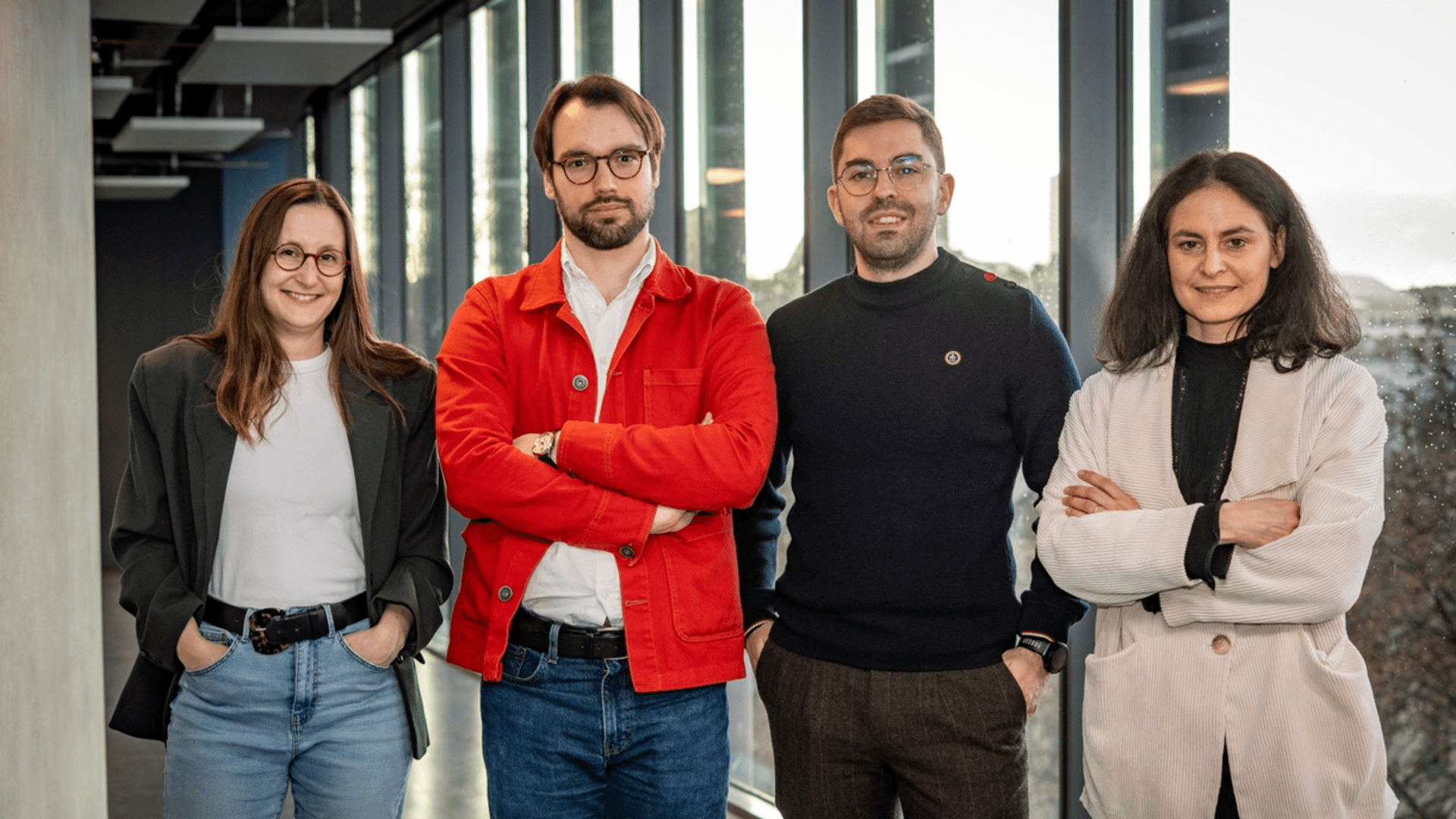
A spin-off from Laboratoire Kastler Brossel, a research laboratory associated with three Nobel Prizes in Physics, Qluster was founded by David Fainsin (CEO), Ambroise Boyer (CTO), Clarisse Thibault (COO) and Valentina Parigi (CSO), a physicist and professor at Sorbonne University. The company builds on decades of fundamental research in quantum optics to develop a new generation of quantum computers.
Qluster aims to develop a universal, fault-tolerant quantum computer capable of addressing complex industrial challenges. Its approach combines continuous-variable photonic quantum computing with an "Architecture First" strategy, which prioritises the computational requirements of industrial applications rather than the limitations of a predefined qubit technology.
Qluster's technology uses light to process quantum information, enabling architectures designed for greater scalability and stability. It builds on a patented miniature photonic source developed by Parigi and Fainsin at Laboratoire Kastler Brossel, whose underlying principle has already been experimentally validated and published in a scientific journal.
Alongside its photonic technology, Qluster is adopting an "Architecture First" approach that begins with the computational problems businesses need to solve. The company translates these challenges into quantum circuits to determine the necessary resources, including the number of qubits, circuit depth, execution speed and energy consumption. It then designs the computer architecture around these requirements.
For several years, the race to build quantum computers has largely focused on developing increasingly powerful qubits. But the challenge today is to ensure that the computing architecture can meet the needs of industry. This is the approach Qluster has adopted from day one, with the goal of developing an intermediate-scale quantum computer by 2032,
explains David Fainsin, co-founder and CEO of Qluster.
Founded just a few months ago, Qluster has already received the 2026 i-Lab Grand Prize, supported by France 2030. The startup has also benefited from the support of Quantum Launchpad and Agoranov since its inception.
By 2036, Qluster aims to develop a large-scale, fault-tolerant universal quantum computer capable of performing complex industrial computations while maintaining commercially viable size, energy consumption and operating costs.
Qluster plans to establish its own R&D laboratory to further improve the performance of its photonic technology. The company also intends to expand its team by recruiting experimental physicists and specialists in quantum computing theory and architecture, enabling it to advance hardware development and the design of its future quantum computing architecture in parallel.


Would you like to write the first comment?
Login to post comments