
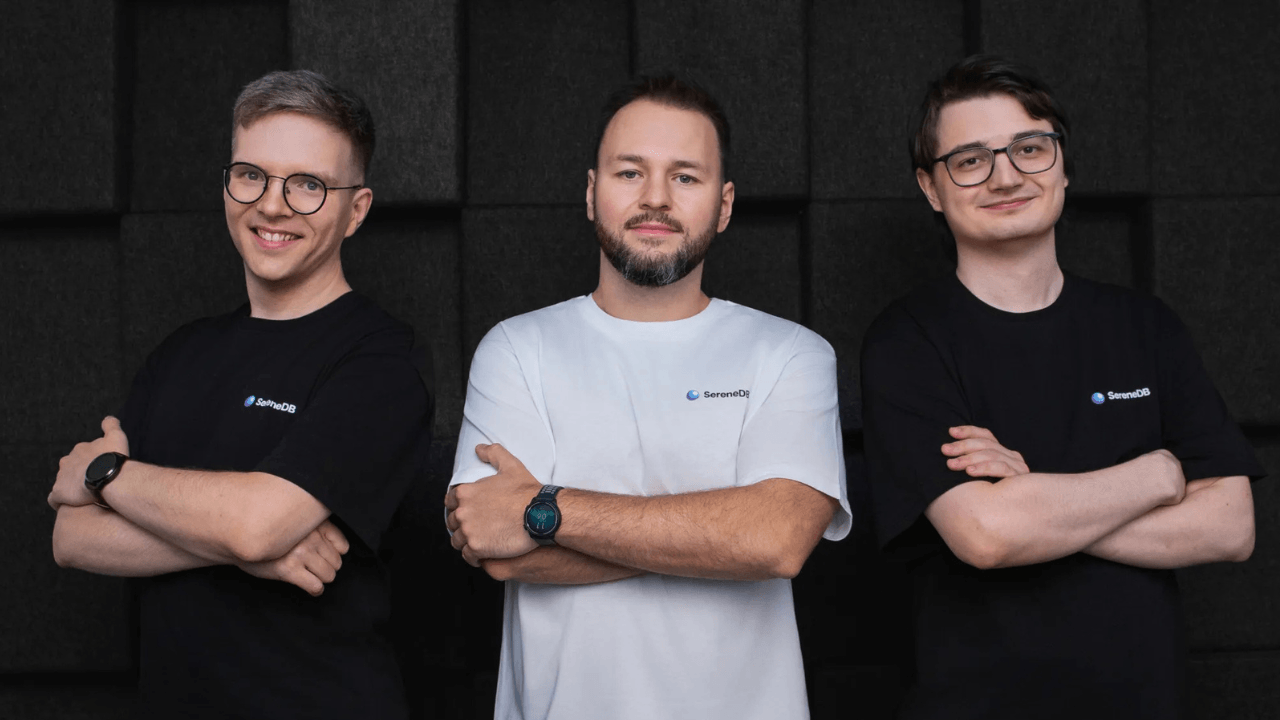
Berlin database startup SereneDB has closed its Pre-Seed funding round, raising $2.1 million. The round was led by venture funds Entourage and High-Tech Gründerfonds (HTGF).
Most search and analytics tools were built to find single, static items, not to analyse fast-changing, complex data. They struggle with real-time updates and deletions, and they force teams to stitch together searches, caches and dashboards.
The result is slow answers, brittle pipelines and insights that arrive out of date.
The team is leveraging its expertise from creating the world’s fastest enterprise-grade C++ search library to build the engine for next-generation data applications.
I spoke to CEO Alexander Malandin to learn more.
SereneDB brings live data and deep analysis into one system. It fuses a powerful and versatile search engine with modern OLAP execution under the standard PostgreSQL umbrella, handles real-time ingestion with correct updates and deletes, and returns complex results in milliseconds.
While people and AI agents can ask better questions on of the most recent data, companies reduce tooling, cost costs, and operational risk by using simple and , standardised SQL tools and APIs.
According to Malandin, there are three core pillars to SereneDB:
“First: we’re written in an efficient stack. C++ lets us do things faster or with far fewer resources.
Second: we bring functionality to the market that hasn’t existed before — search tools couldn’t work with real-time changing data.
Third: we’re doing it all in open source. Because we believe in value creation through communities. We believe that since we are given the chance to stand on the shoulders of very tall men, we can give others an option to lean against us in the process. This creates a better community, a better industry.”
Why two industry veterans walked away to reinvent search and databases
SereneDB is led by CEO Alexander Malandin, a chemical technologist turned IT evangelist with deep experience in enterprise storage, servers, and databases at EMC and Dell, and ArangoDB.
He is joined by CTO Andrey Abramov, a 15-year information-retrieval expert who built a C++ alternative to Lucene and became the first to properly integrate it with a database — a recognised visionary in search-driven database design.
Principal Software Engineer Valery Mironov, a self-taught developer who left college to focus on coding, is an open-source enthusiast and author of YACLib.
Malandin and Abramov bring a 16-year working partnership across family IT businesses, startups, and large enterprises, including ArangoDB.
Malandin admits he was always the presales engineer — selling hardware at first, then moving into databases.
“I love infrastructure because it’s tangible. It’s slow, yes — deal cycles are six to twelve months — but it’s also the layer everything else is built on. That’s where you can make a real impact.”
He explains that the real turning point came at ArangoDB, working with Abramov:
“We reached a moment where we simply couldn’t get attention for the ideas we wanted to build. We knew the market needed what we were thinking about, but we couldn’t pursue it inside the company. So we left to build it ourselves.”
Why Search deserves a rethink
Search quietly powers nearly every digital action we take, yet in the enterprise world it remains underserved, under-innovated, and dominated by decades-old foundations.
“It’s ironic. Search is one of the biggest technologies of our lives — we use it dozens, if not hundreds, of times a day. But enterprise search is tiny. Almost everything relies on Lucene. It’s in ElasticSearch, OpenSearch, SingleStore, Neo4j — it’s everywhere,” shared Malandin.
Alternative search libraries have existed, but his co-founder built one of the only independent ones:
He explained:
“Abramov started what is now called iResearch back in 2014. It’s written in C++, and today it’s one of the only independent search libraries left; the rest are developed internally for the needs of specific companies.”
However, according to Malandin:
“Honestly, no one has tried to integrate a search library with a database the way we’re doing it. Historically, companies put a search library next to a database. They exchanged data, but they didn’t understand each other. There was no consistency.”
SereneDB takes a different architectural stance.
“We’re building something tightly fused — not two systems passing messages, but a unified engine where search understands the database and the database understands search. We started exploring this in a past project and learned a lot.
SereneDB packages that knowledge properly for the first time.”
In other words, instead of having separate systems for “live data writes / transactions”, “full-text / search queries”, and “analytics / aggregation queries”, SereneDB aims to handle all of that in one system.
Real-time data is critical
By collapsing search and analytics into a unified engine, SereneDB positions itself as an infrastructure layer built precisely for the real-time era. For Malandin, real-time data processing is the difference between meaningful analytics and missed opportunities.
He recalls a customer from a previous role — a large logistics company whose business depended on the insights generated from its operational pipelines.
“Real time matters enormously,” Malandin says.
“The customer’s core value was analytics. But they could only update data every two days because the dataset was too large. The freshest data has the most value, but it was basically unavailable to them.”
The company aims to eliminate the trade-off between fast-changing data and the ability to run sophisticated queries over it.
“If you can analyse data the moment it’s produced, you unlock value. And if you can analyse aggregates from even five or ten minutes ago, that’s another layer of value. We’re designed to handle both,” he explains.
“‘When Can I Try It?’
The response from the developer community has been overwhelmingly positive. “I haven’t heard a single negative reaction,” admits Malandin.
“Whenever we explain that we’re building something with the functionality of ElasticSearch and ClickHouse, with a Postgres front end people already know, everyone says, ‘When can I try it?’”
However, the company only started publishing code on GitHub yesterday — and that’s the biggest challenge, according to Malandin, in terms of next steps with devs.
“People want a demo immediately because they already know exactly where this would fit into their stack.” SereneDB is expected to gain initial traction with two core user groups:
Startups:
Malandin contends that while Postgres is the world’s default database, it’s a transactional system.
“The moment a startup becomes successful and needs real analytics, Postgres isn’t enough. They’re forced to bolt on ElasticSearch or ClickHouse — neither of which gives them consistency.”
With this in mind, SereneDB wants to be 100 per cent Postgres-compatible — this means a startup could keep transactional Postgres and use SereneDB as analytical Postgres. “
That’s a huge improvement, ” according to Malandin.
Existing search users:
The team already sees use cases where it's 10× faster than ElasticSearch. “And we offer a complete analytical layer on top of that. So anyone using ElasticSearch or OpenSearch is a natural fit,” asserts Malandin.
This funding advances SereneDB’s commitment to open-source development, giving the data community a voice in shaping the technology while benefiting fairly from its progress.
By enabling trustworthy, real-time insights at any point in the data life cycle, SereneDB aims to set a new practical standard for modern analytics.
According to Pieterjan Bouten, Founder and Managing Partner at Entourage:
“SereneDB’s team has spent years in the trenches of information retrieval, where breakthroughs are rare.
They’ve earned their position with core search technology addressing a critical layer of tech that is often overlooked. Unlocking this data foundation paves the way for a wave of new applications. SereneDB is building that infrastructure, and they have the grit to see it through.”
Hendryk Hosemann, Senior Investment Manager at HTGF, says:
“As AI becomes central to every software product, engineering teams need the ability to query, analyse, and understand live data in real time at scale. SereneDB is redefining AI-memory infrastructure with search and analytics accessible to everyone through PostgreSQL.
It’s incredibly rare to find a team that is both able and daring enough to build at this depth, and we’re proud to back them as they redefine what modern databases can deliver.”
The company will use the investment to expand its team.


Would you like to write the first comment?
Login to post comments