
Spacetech company UNIVITY today announced it has raised €27 million backed by Blast, Expansion, and the Deeptech 2030 fund, managed by Bpifrance on behalf of the French state as part of the France 2030 programme, alongside two family offices.
It brings the company's total funding to over €67 million and funds its aim to build a high-speed, space-based internet infrastructure for telecom operators.
I spoke to Charles Delfieux, founder and CEO of UNIVITY, to learn more.
When space starts competing with fibre
For the first time, space-based connectivity is reaching performance and cost levels that can compete directly with terrestrial networks.
“Because of advances driven by players like Starlink — industrialisation, lower launch costs, optimised satellite production — we’ve reached a point where space is a viable alternative,” says Delfieux.
For telecom operators, this represents a structural shift. Rather than investing billions into fibre rollouts, they can access space-based infrastructure with significantly lower capital requirements, sometimes even without CapEx.
At the same time, companies like SpaceX and Amazon are moving up the stack, selling connectivity directly to end users.
UNIVITY is taking a different approach by positioning itself as a wholesale space infrastructure provider. According to Delfieux, this was unthinkable just a few years ago.
“Because of advances driven by players like Starlink — industrialisation, lower launch costs, optimised satellite production — we’ve reached a point where space is a viable alternative.”
Not another satellite operator — an infrastructure layer
UNIVITY develops a wholesale space infrastructure enabling telecom operators to provide high-speed, low-latency internet access from space directly to their customers, complementing terrestrial networks.
UNIVITY’s strategy is built on two core technological pillars.
First, its positioning in Very Low Earth Orbit (VLEO) enables significantly lower latency, improved performance—including for smartphones and connected vehicles—and rapid natural atmospheric disintegration at the end of satellites’ lives, contributing to orbital sustainability.
Second, UNIVITY’S commercial strategy is to leverage the strengths of telecom operators worldwide. The use of telecom operators’ 5G spectrum, enabling them to leverage existing 5G components, which are already mass-produced, helping reduce costs.
It ensures native integration with existing mobile networks and enables seamless 5G NTN service continuity, without relying on frequency bands already saturated or pre-empted by new entrants.
Together, these choices position UNIVITY as a key player in the convergence of terrestrial and space networks, rather than just another satellite operator.
“The telecom industry is one of the most powerful globally, with strong assets at the national level: spectrum, regulatory access, distribution networks, and brand,” asserts Delfieux.
“By building shared infrastructure that these operators can access independently, we tap into those assets. That’s how we aim to compete.
Just like in terrestrial networks, where you have wholesale telecom operators, we aim to deploy and operate shared space infrastructure that others can use.”
The reason is that telecom operators already have strong assets — regulatory access, spectrum rights, established brands, and distribution networks.
“We don’t want to challenge those. Instead, we provide the missing piece that enables them to deliver competitive internet services from space. That effectively makes them competitors to the telecom operators we serve.”
A sovereign alternative to vertically integrated space networks
At a moment when technological sovereignty is becoming a strategic priority, this model offers a clear alternative—allowing operators to retain control over their space-based connectivity rather than relying on external platforms. UNIVITY aims to position Europe as a key player in global hybrid connectivity.
According to Delfieux:
“Our ambition is to enable operators to leverage space as a natural extension of their terrestrial 5G networks, combining performance, competitiveness, and sovereignty.”
The company gives telecom operators full control over operating and commercialising space-based connectivity on their own terms — establishing genuine sovereignty over both infrastructure and services.
“We believe that enabling that independence is key to the future of satellite constellations,” says Delfieux.
Further, through this funding round and with the support of CNES, UNIVITY is accelerating the development of a competitive space infrastructure designed to complement fibre and cellular networks, extend connectivity to rural and remote areas, strengthen the resilience of critical networks, and restore operators’ control over their space-based expansion.
uniShape moves VLEO 5G from concept to reality
This Series A will support the execution of the uniShape program, the first VLEO-based 5G NTN demonstrator, developed with the support of CNES. It will demonstrate full interoperability between terrestrial and space networks within a controlled convergence framework.
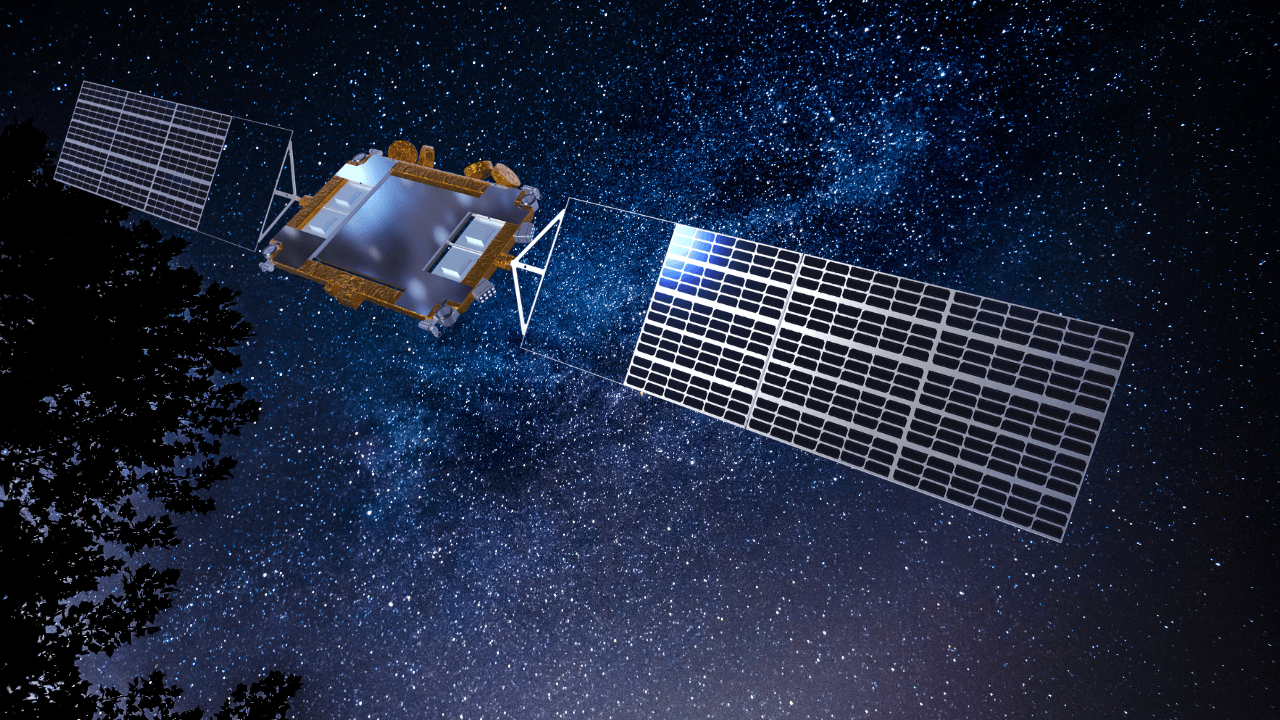
Two VLEO 5G satellites will be assembled, integrated, tested, and operated in orbit to validate an end-to-end high-throughput 5G NTN service, as well as Direct-to-Cell smartphone connectivity — from ground gateways to end-user devices.
UniShape is the company’s second demonstrator. Last year, it launched its first payload of around 20 kilograms. UniShape is a significant step up, involving two satellites of over 250 kilograms and a second-generation ground segment.
As operators test their options, UNIVITY moves quickly
UNIVITY stands out as a company that has moved at speed from idea to iteration to funding and expansion. Delfieux attributes this to several factors:
“First, a lot of hard work.
Second, a willingness to take risks: we don’t wait for one phase to be fully complete before preparing the next. It’s also about managing all aspects of the company in parallel: technology, commercial traction, partnerships, IP, HR, investor relations, and institutional relationships.
Finally, timing plays a role. The demand for global connectivity is strong and growing, and we’re entering the market at the right moment.”
Delfieux characterises the telecommunications industry as fast-moving and space-centred.
“Many operators are currently testing different solutions --- Starlink, Amazon, and others, including ours — to better understand their options.
We expect that over the next one to two years, many operators will begin making concrete commercial commitments.”
The company has signed 17 letters of intent and MOUs across four continents, with strong demand not only in Europe but also in Southeast Asia and the Gulf region.
The company is strengthening its teams in engineering, industrialisation, and business development. From here, the next steps are industrialisation and mass production.
“We’re already preparing for this, including plans for a manufacturing facility near Toulouse to produce two satellites per day and 1,000 user terminals per day,” explained Delfieux.
Beyond that, the key priority is commercial — converting expressions of interest from telecom operators into firm contracts. That includes both capacity agreements and potential investments,
According to Charles Beigbeder, co-founder of Expansion, UNIVITY represents an exceptional opportunity to support a breakthrough innovation that is rethinking space connectivity infrastructure.
“With this Series A, we are strengthening our commitment to enabling telecom operators to capture this strategic market while addressing the challenges of sustainable space usage.”
Stéphane Lefevre-Sauli, Senior Investment Director at , adds:
“We are delighted to continue supporting UNIVITY, whose globally impactful innovations in VLEO and 5G NTN spectrum are critical to enabling telecom operators to remain competitive and independent in the space connectivity market.
This investment fully addresses national and European sovereignty challenges in connectivity, which are at the core of our investment thesis.”
Anthony Bourbon, Founder of Blast Club, states:
“UNIVITY is not just innovating, it is redefining the architecture of global communications. By positioning space as the natural extension of terrestrial networks, the company is already establishing itself as a pivotal player in the sector.”


Would you like to write the first comment?
Login to post comments