

Driverless car startup Bliq.ai this week announced that it has received approval to operate its vehicles on public roads in Estonia without a driver behind the wheel.
The approval marks the first authorisation of its kind in an EU member state and enables Bliq to begin fully driverless road operations under remote supervision.
With a dozen vehicles already in operation and further expansion underway, Bliq currently operates what the company believes to be the largest completely driverless vehicle fleet in Europe. The approval follows an extensive validation process, including rigorous test-track sessions and real-world testing in Tallinn city traffic with a safety driver onboard.
“Europe has now crossed a major threshold for driverless mobility,” said Julian Glaab, CEO and Co-Founder of Bliq.
“This approval shows that fully driverless vehicles can be developed, validated, and deployed in Europe today. Our goal is to bring this technology to consumers and businesses across the continent as quickly and safely as possible.”
Bliq is building driverless cars for private and business use, starting in Europe. Rather than manufacturing purpose-built autonomous vehicles, the company upgrades existing software-defined vehicles with a fast-to-integrate sensor and compute stack, turning them into fully driverless cars.
Its current product generation combines an AI-based Level 2 driving system with remote human supervision, enabling rapid deployment while maintaining robust safety oversight.
The company’s platform has been developed with a strong focus on safety and regulatory compliance. According to Bliq, its system has undergone extensive real-world driving validation and has been assessed with involvement from technical services and Estonian authorities.
The Estonian approval is also a key step in Bliq’s broader European expansion. The company says it is actively pursuing regulatory processes in several countries and plans to bring its driverless technology to multiple EU markets in the near future, with Germany positioned as an important next market.
“Driverless cars should not be limited to robotaxi fleets,” said Torgen Hauschild, CTO and Co-Founder of Bliq.
“We believe the biggest opportunity is making autonomous mobility available in the vehicles people and businesses use every day. Our retrofit model, remote-supervised architecture, and shipping-focused engineering approach are designed to make that possible.”
Bliq is backed by investors including NEA and Atlantic, and operates from Berlin, Germany, and Tallinn, Estonia. The company’s team combines experience across autonomous driving, automotive engineering, regulation, functional safety, and transportation operations.
In April, autonomous vehicle startup Verne announced the launch of Europe’s first commercial robotaxi service, starting in Zagreb, Croatia, enabling members of the public to book and pay for a Pony.ai-powered autonomous ride through the Verne app.
The initial commercial deployment uses electric vehicles equipped with Pony.ai’s seventh-generation autonomous driving system. These vehicles operate autonomously, with trained autonomous vehicle operators onboard during the early phase of the rollout, covering key districts of the Croatian capital, with plans to expand coverage across the city.
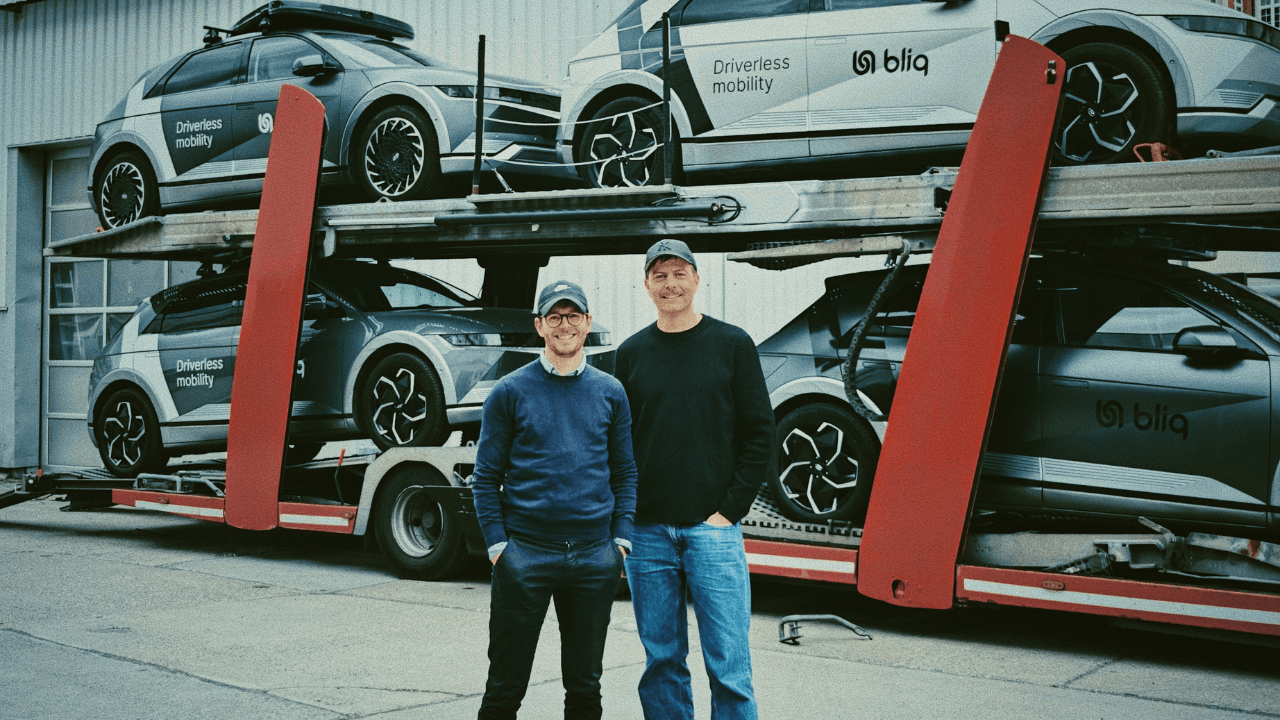
Lead image: Bliq founders Julian Glaab and Torgen Hauschild (left to right).


Would you like to write the first comment?
Login to post comments