

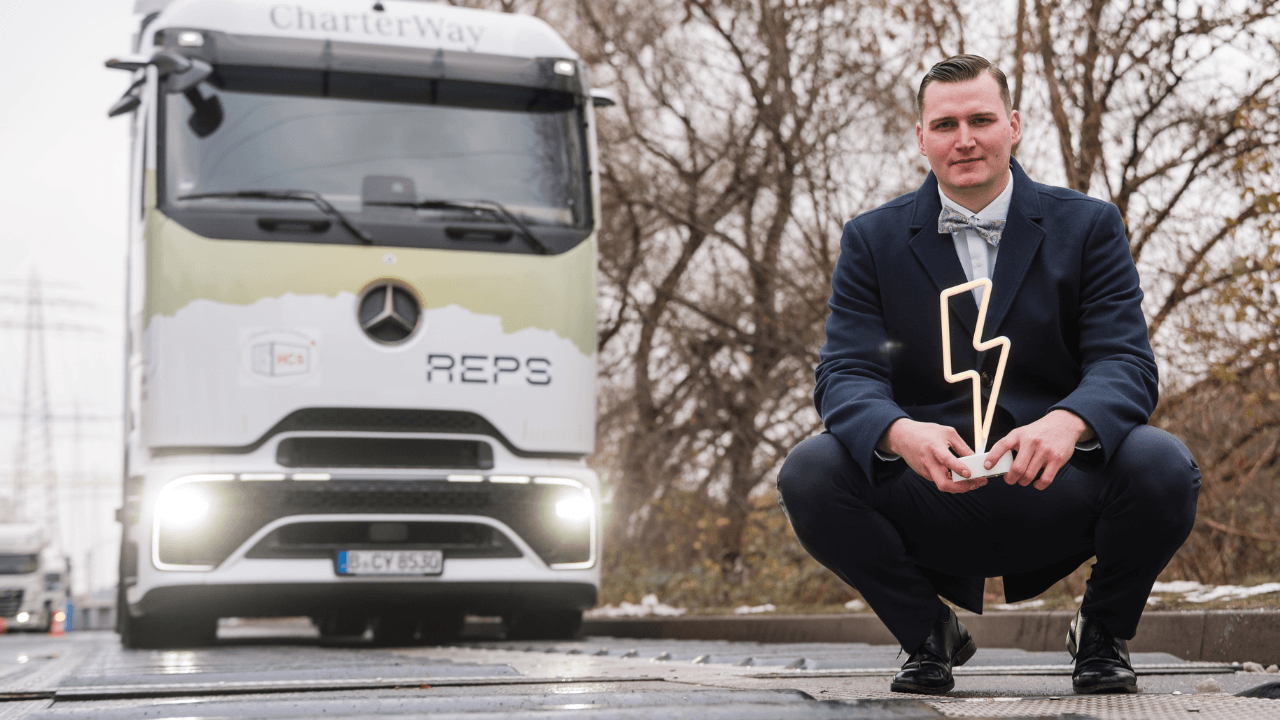
Tyrol energy generation startup REPS today announced a $23.6 million equity financing round to scale its Road Energy Production System, a patented “road power plant” that converts vehicle traffic into electrical energy.
Its core product is a patented road power plant that installs directly into existing road infrastructure and harvests energy from trucks and cars driving over it, without disrupting traffic flow or logistics operations.
Every day, enormous amounts of energy are lost through motion, pressure, and vibration.
On roads, that loss is constant, predictable, and concentrated in the same places over and over again: entrances, exits, curves, speed-limited zones, loading areas, and any point where heavy vehicles naturally slow down.
REPS was built to recover wasted mechanical energy and convert it into clean electricity at scale, using existing infrastructure.
The technology is particularly effective where vehicles naturally slow down or brake, or where slopes create additional force. REPS is initially targeting ports, logistics hubs, cities, industrial sites, and other high-traffic infrastructure operators that want to reduce energy costs while improving sustainability.
“Roads are everywhere. Traffic is everywhere. What was previously wasted energy can now be transformed into clean electricity through REPS,” said Alfons Huber, Founder and CEO of REPS.
Most renewable energy has focused on generating new power through solar and wind. REPS takes a different approach by recovering energy that’s already being wasted. The company’s first application is roads, where the energy lost through traffic alone could theoretically cover around 5 per cent of global electricity demand.
REPS says its converter delivers 254x higher efficiency than the next-best alternative currently on the market, and unlike weather-dependent renewables, the system operates independently of time of day and weather conditions.
The broader opportunity sits inside a category called energy harvesting, converting lost mechanical impulses into usable electricity. REPS believes the reason energy harvesting hasn’t become a major force in the energy transition is straightforward: existing mechanical converters have historically failed on efficiency and durability, which makes the economics fall apart.
REPS had to reinvent the energy converter itself to unlock a system that can operate under heavy traffic conditions for more than 20 years and amortise within years.
The first commercial REPS system has been operating at the Port of Hamburg since November 2025. Since then, more than 115,000 trucks have crossed the system, generating over 6,700 kWh of electricity from real traffic conditions. The Hamburg deployment has translated into strong international demand.
Following the launch, the company is engaged with over 90 parties from the port industry alone, spanning Europe, the Middle East, Asia, and North America, and it says interest has now expanded beyond ports to logistics hubs and cities.
A rollout of around 230 systems across the Port of Hamburg’s public roads, excluding terminals, could generate approximately 10 GWh of electricity per year, enough to power around 2,800 households, and offset roughly 9.81 per cent of the CO₂ emissions caused by port traffic. The return on investment in that scenario would be below four years.
On a city scale, the company estimates that deploying around 64,000 systems in a city the size of Dubai could recover approximately 3.2 TWh of electricity annually, equivalent to about 10.8% of the city’s total energy consumption today.
Justin Karnbach, CEO of Hamburger Container Service GmbH, said:
"The installation at our facility demonstrates the potential of REPS: where vehicles have to brake anyway, clean energy is recovered and can be used directly where we need it. Without any interference with traffic and without additional space."
“We spent six years developing the technology. Now the scaling phase begins. The strong demand from ports and logistics operators worldwide confirms the need for our solution, and with this financing round we can now scale at the speed required by the energy transition,” added Alfons Huber.
Longer term, REPS sees roads as the first proof point for a broader energy-harvesting platform. The ambition is to turn high-traffic infrastructure into decentralised power assets, capturing energy that’s already being wasted and making it economically meaningful at scale wherever large masses move frequently.


Would you like to write the first comment?
Login to post comments