

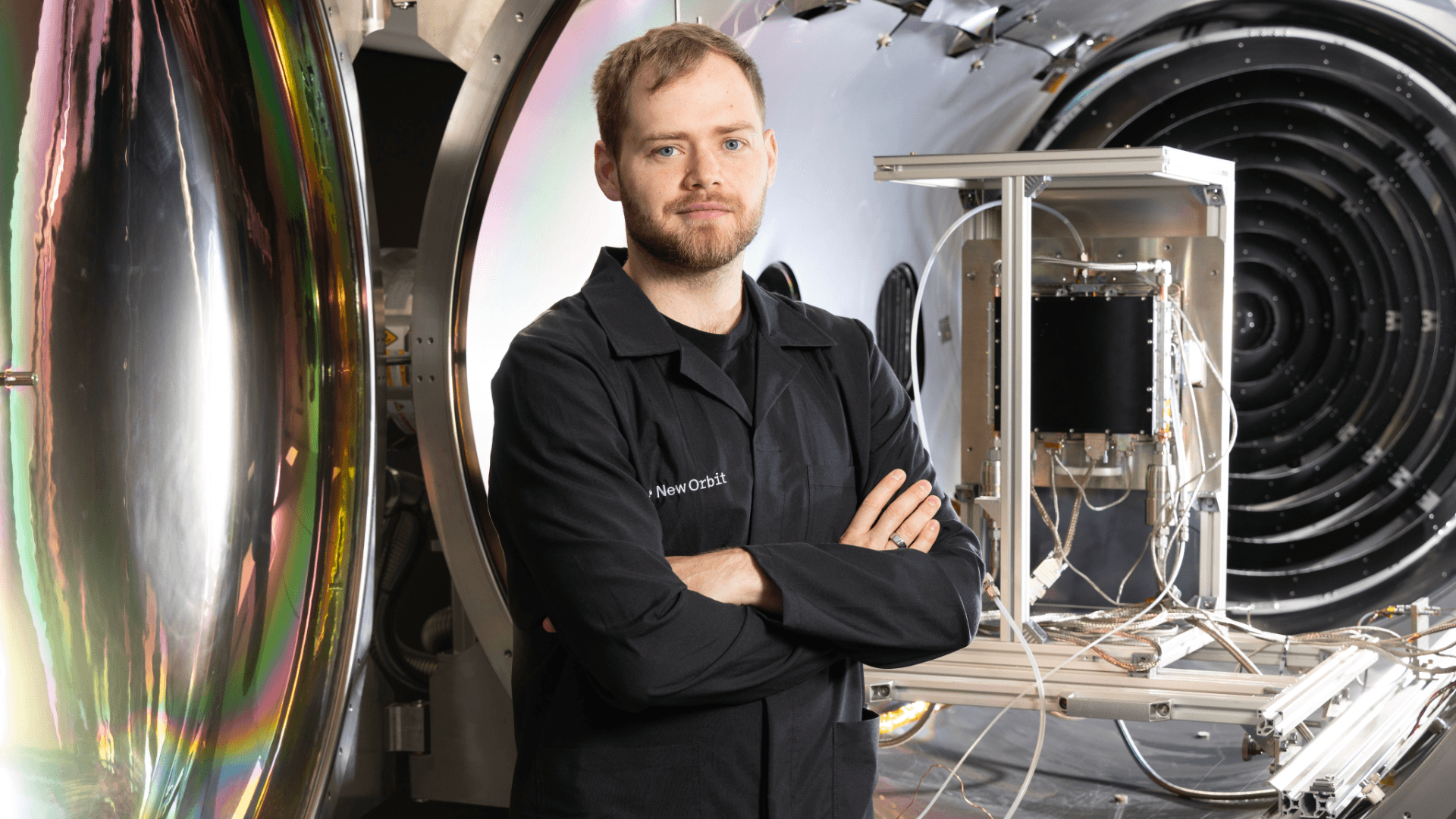
UK-based satellite manufacturer NewOrbit has raised $18.5 million in Series A funding to advance the commercialisation of Very Low Earth Orbit (VLEO), a region of near-Earth space between 200 and 300 kilometres above the planet that has historically remained inaccessible for commercial satellite operations.
The oversubscribed round was led by Voyager Ventures, with participation from angel investors including David Kirk, former Chief Scientist at NVIDIA, Lawrence Leuschner, co-founder and former CEO of TIER Mobility, and family office Custos. Existing investors Atlantic.vc, Lifeline Ventures, LGF and Illusian also participated in the round.
Founded in 2021 and headquartered in Reading, NewOrbit is developing satellites designed to operate in this orbital band, which has historically been used primarily for government and scientific missions, including spy satellites and the International Space Station.
Operating closer to Earth allows satellites to capture higher-resolution imagery and provide lower-latency communications than conventional satellites in higher orbits. The company says its approach could enable drone-level imaging quality and direct-to-device connectivity at significantly lower cost than existing satellite constellations.
Despite its advantages, VLEO has remained commercially challenging due to extreme environmental conditions. Atmospheric drag, atomic oxygen, and aerodynamic forces have historically made long-term operations difficult. To address these challenges, the company has developed purpose-built satellites equipped with proprietary propulsion technology designed to operate for up to five years in these conditions.
Anatolii Papulov, CEO and co-founder of NewOrbit, said the company views very low Earth orbit as a largely untapped opportunity within the space economy:
For decades, very low Earth orbit has been considered too challenging for commercial satellite operations. We believe it represents a significant opportunity for new services and applications that are not possible with existing orbital infrastructure.
The funding will support the construction of NewOrbit's NEO Production Complex, a manufacturing facility planned for 2027. The site is expected to produce the company's first commercial satellite ahead of a planned launch in 2028 and increase production capacity as operations scale.
The company is targeting applications including Earth observation and satellite-based connectivity, areas where operating closer to Earth could offer performance advantages over conventional orbital deployments.


Would you like to write the first comment?
Login to post comments