

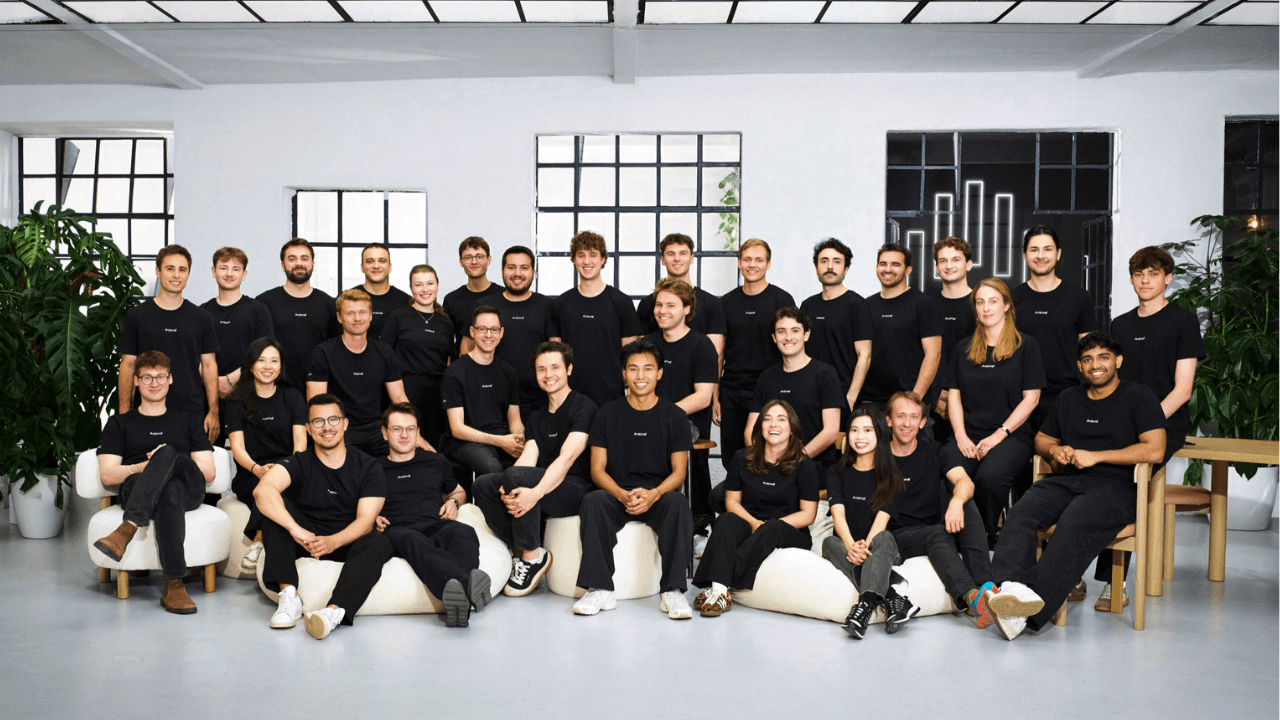
Robotics deployment company microagi today announced a collaboration with Google Cloud to accelerate the development of models and robotics capable of understanding and interacting with physical environments.
As part of the collaboration, microagi will use Google Cloud’s advanced AI stack and the NVIDIA Blackwell platform to scale its model training workloads.
microagi's Atlas platform fine-tunes AI models using each customer's operational data, creating robotics systems tailored to specific industrial tasks. The hardware- and model-agnostic platform sits between customers' infrastructure and frontier AI models, avoiding vendor lock-in.
Founded in 2025, the company is headquartered in Munich, with a research hub in Zurich and offices in London and New York.
Its business model aims to accelerate robotics AI development by training task-specific models for individual robotic platforms. The company operates a unique business model designed to accelerate robotics AI development, including training task-specific models for robotic platforms.
I spoke to Bercan Kilic, CEO and co-founder of Microagi to learn more.
Five days of fundraising, months of investor interest
The news comes a week after the company announced it had raised $55 million in seed funding, the largest seed round in German history. The round was led by Hummingbird, with participation from Northzone, LocalGlobe, Village Global and redalpine
Unusually, the company says it has spent only five days fundraising — two days for the pre-seed and three for the seed round.
“That's unusual, but it reflects the fact that investors had been tracking our progress long before we formally opened a round,” said Kilic.
“We were demonstrating our technology to research labs, customers and robotics partners, showing progress across data collection, compute infrastructure and robot training."
Hummingbird Ventures had been tracking the company's progress for several months before reaching out and visiting the team. Following the visit, the firm moved quickly to invest. While other investors also expressed interest, Hummingbird was already providing strategic support and making introductions even before the fundraising round had officially begun. The parties signed a term sheet within just three days.
Europe faces an embodied AI crossroads
Kilic believes that if Europe doesn't act quickly, the technology gap with the US and China could become larger than Europe's current gap with developing economies.
"AI is advancing so rapidly that governments are increasingly likely to treat advanced models and compute as strategic national assets. If export restrictions become commonplace, countries without sufficient domestic compute infrastructure will struggle to compete.
That's why we believe the next 18 months are critical. Europe needs to invest in energy, data centres and advanced compute now — not simply for startups like microagi, but for the entire European innovation ecosystem.”
The former Formula 1 engineer from Red Bull Racing was inspired to build the company after concern for Europe’s future. He contends that every year, AI models were improving exponentially, while Europe wasn't making the same progress.
“The moment that really hit me was seeing open-source Vision-Language-Action (VLA) models emerge. As a mechanical engineer, robotics has always been close to my heart, and I realised the next frontier had arrived, yet almost nobody in Europe was building for it.”
Initially, he didn't even plan to start a company. But the more he explored the space, the clearer it became that Europe was missing three essential ingredients: large-scale robotics data, massive compute capacity, and the infrastructure to train and deploy embodied AI systems.
“Without all three, Europe risks becoming irrelevant over the next 20 to 30 years.”
Building productivity, not replacing workers
Long-term, the company’s ambition isn't simply to improve margins for individual companies. It's to increase productivity enough that European manufacturers can compete on both quality and price.
“China offers an interesting example. Rather than replacing workers, successful manufacturers often expand capacity by opening new factories that produce more goods at lower cost. Greater productivity drives prices down while increasing competitiveness.
Over time, that creates abundance. As robotics improves, costs should continue falling. Some robots can already operate 24 hours a day. They're currently slower than humans in many tasks, but we expect that to change.”
Kilic shared that the partnership is important because both companies recognise that Europe needs strong leaders in embodied AI.
“NVIDIA provides the compute platform, while Google Cloud provides the cloud infrastructure and engineering support. We'd already been working with Google Cloud, but this partnership significantly deepens that relationship.”
One of the biggest benefits has been efficiency.
“Google's engineers have helped us optimise our clusters so we're effectively achieving roughly twice the computational efficiency while using substantially less energy per unit of work. That optimisation work is ongoing,” said Kilic.
How Google Cloud and NVIDIA accelerate training
The new partnership announced today will ensure microagi has access to highly optimised, NVIDIA RTX PRO 6000 Blackwell Server Edition GPUs (G4 VMs) and NVIDIA GB300 NVL72 rack-scale systems (A4X Max instances) to power its model training and inference workloads.
This infrastructure will support microagi’s efforts to offer customisable software packages for enterprise robotics. For example, hospitality or industrial businesses will be able to procure robots pre-configured with microagi models tailored for specific operational roles.
Working closely with both Google Cloud and NVIDIA engineering teams, microagi can streamline its workflows on Google Cloud's platform and bring new products to customers more quickly.
“Robotics is becoming one of the most demanding frontiers for AI, requiring massive physical-world datasets, accelerated compute and a full-stack platform to turn models into intelligent machines,” said Tobias Halloran, Director of EMEAI Startups at NVIDIA.
“By running on NVIDIA Blackwell-powered instances on Google Cloud, microagi can scale the training and deployment of embodied AI systems for commercial and industrial environments.”
An end-to-end robotics AI platform
In a sector where many companies are developing the software intelligence layer for physical AI, Kilic believes microagi's competitive advantage lies in offering an end-to-end ecosystem.
“Robotics doesn't have an internet-scale dataset like language models do, so collecting high-quality data is one of the industry's biggest challenges.
We collect diverse robotics data, train foundation models on large-scale compute infrastructure, and then fine-tune those models using each customer's own operational data. That process transforms a capable general model into one that's highly effective in a specific industrial environment.”
Importantly, microagi customers always retain ownership of their data and models: “Unlike some approaches where customer data ultimately improves shared foundation models, we ensure each customer's intellectual property remains protected.
Why European compute matters
Equally important is microagi’s commitment to European compute infrastructure.
“Whenever possible, we want our workloads to run on European-based infrastructure,” asserts Kilic.
“There are two reasons. First, our customers are European manufacturers with valuable intellectual property. Even if they trust us, they may not want sensitive production data processed outside Europe. Keeping workloads within Europe under GDPR provides additional confidence"
Second, he believes Europe must build its own long-term AI infrastructure.
“If advanced chips become subject to export restrictions or geopolitical tensions increase, the only compute Europe can rely on will be the infrastructure already located here.
Creating demand today encourages companies to continue investing in European AI infrastructure.”
From here on, the company’s focus is execution.
“We have customers, data and compute. Now it's about scaling deployments. Alongside that, one of our biggest priorities is expanding European compute capacity.
We believe Europe needs significantly more AI infrastructure if it wants to remain competitive over the next decade.


Would you like to write the first comment?
Login to post comments