

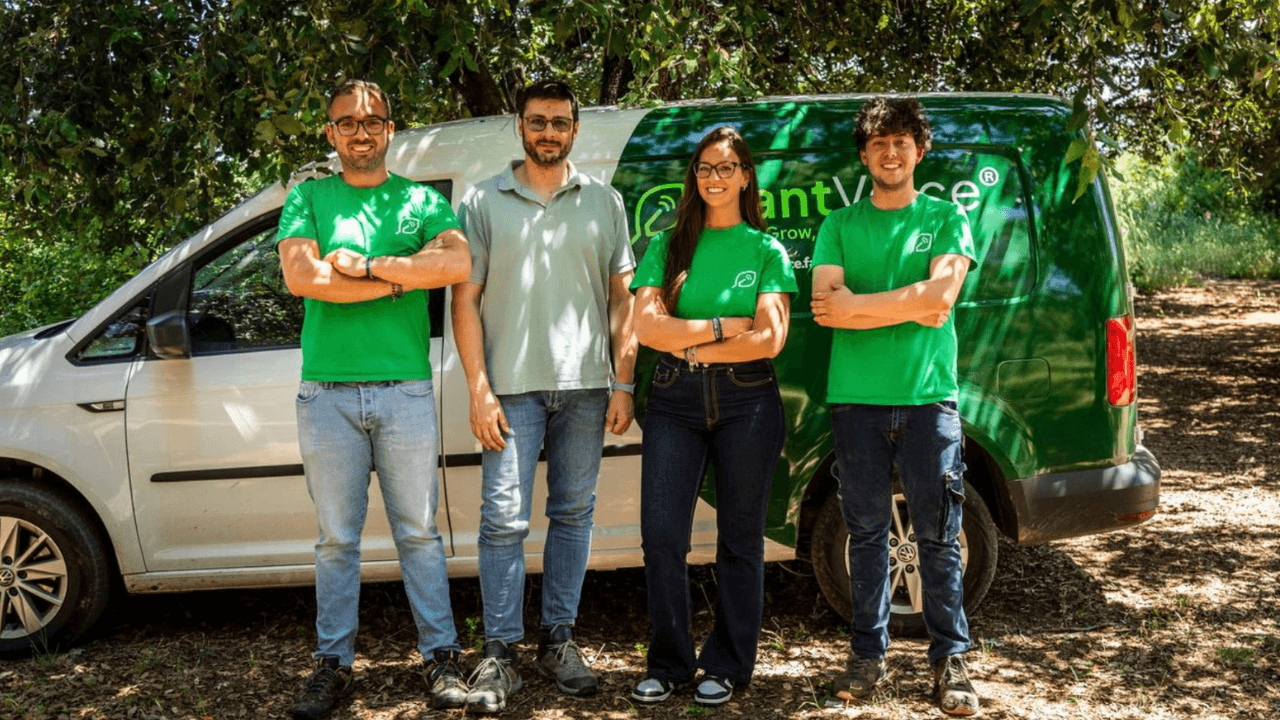
Traditionally, farmers make decisions based on weather forecasts, soil moisture measurements, visual observations, and their own experience in the field. These are valuable sources of information, but they only provide part of the picture. Italian startup PlantVoice, however, believes that the plant is the most reliable indicator of its own needs. PlantVoice has developed an agronomic platform specifically designed for food production, integrating real-time plant physiological data with weather and soil data. It aims to make "plant intelligence", a standard layer within modern agriculture — a future where every important agronomic decision is supported not only by environmental data, but by direct feedback from the plant itself.
I spoke to the COO, Giorgia Ferrari, to learn more.
Listening to the plant, not just the environment
PlantVoice was founded in 2023 by Matteo Beccatellia, a chemist who studied biosensors in Parma and the US, and Tommaso Beccatellia, who has a background in manufacturing and 3D-printed objects.
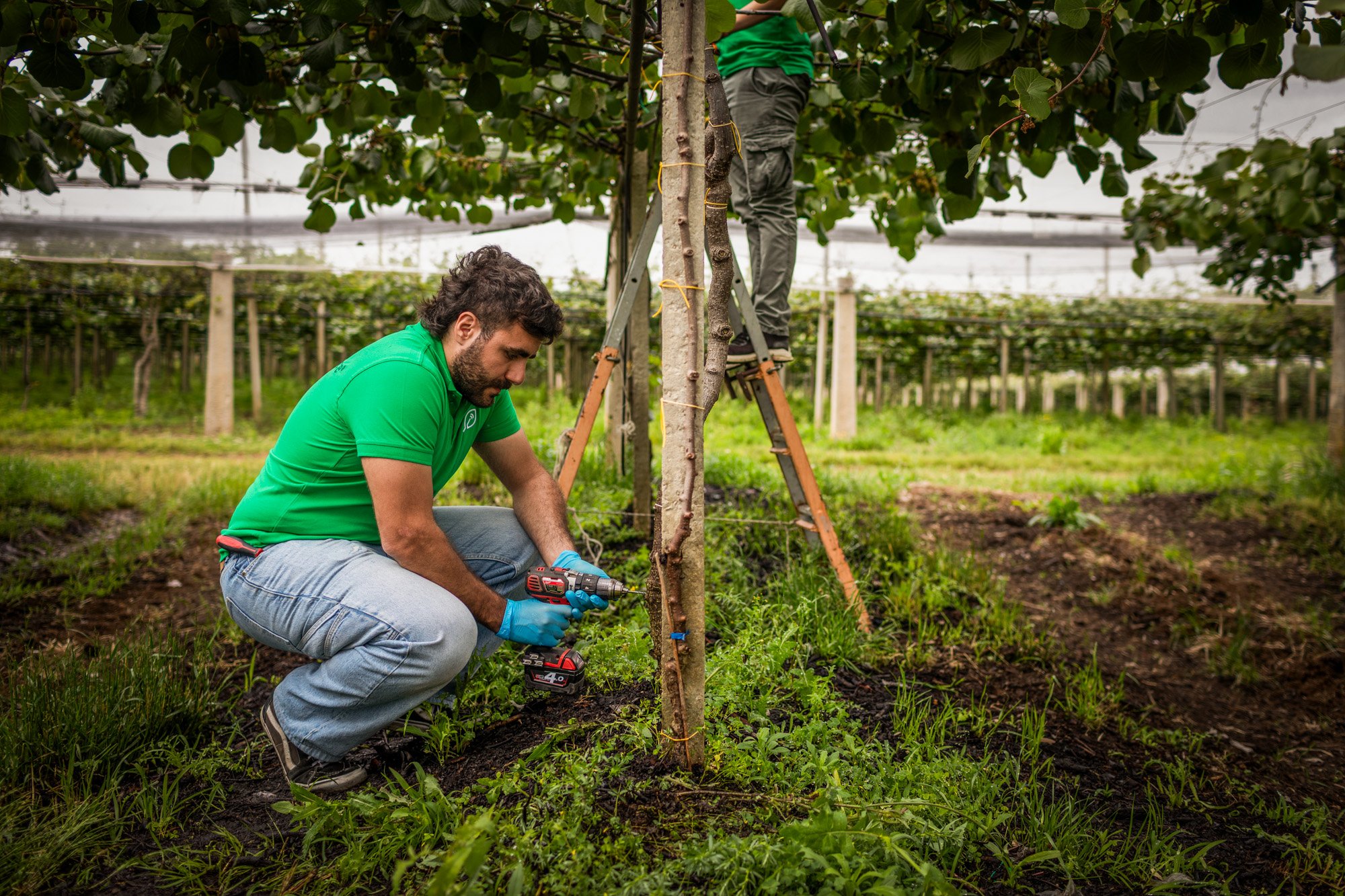
PlantVoice has developed a biocompatible sensor head made from a specific wood fibre to match the plant's components.
“The plant doesn't recognise it as an obstacle,” explained Ferrari.
“We make a hole, insert the probe, and the material adapts to the hole, closing it off from external conditions.”
Many existing agricultural technologies focus on conditions around the plant, such as weather, soil, and satellite imagery. While these provide important information, they do not necessarily show how the crop itself is responding. PlantVoice aims to close that gap by incorporating physiological data directly from the plant.
From biosensor to AI-powered recommendations
Today, agriculture generates huge amounts of data, but farmers do not necessarily need more dashboards or additional complexity. “Farmers need clear recommendations that help them make better decisions,” Ferrari said.
“We’re continuously listening to customers, and they tell us they have one app for weather conditions, one for soil sensors, and another for drones, for example.”
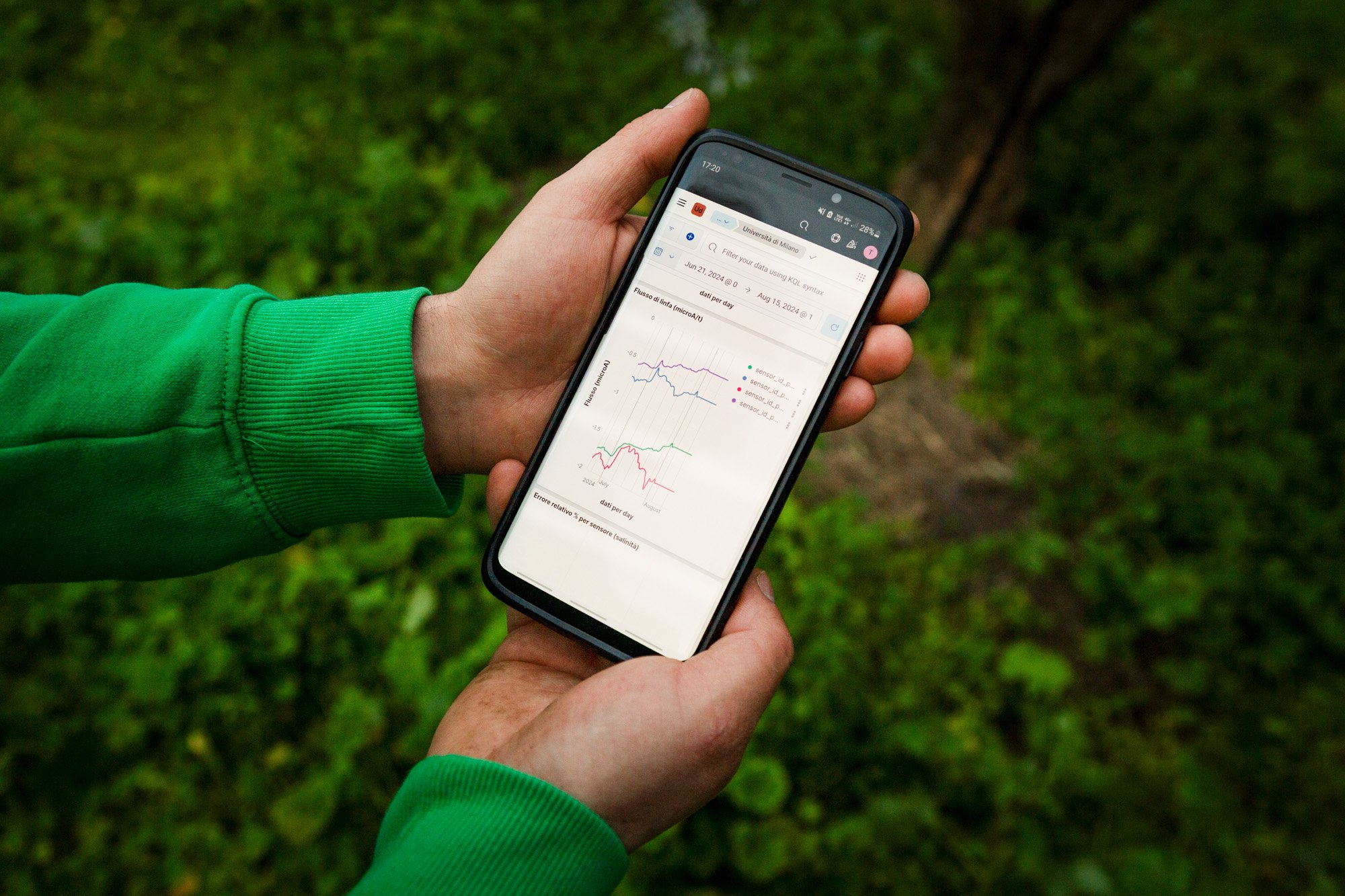
The PlantVoice platform combines plant data with information from across the field, including weather forecasts, soil conditions, irrigation data, and agronomic models. This creates a digital representation of the crop’s condition, enabling PlantVoice to provide recommendations based on the relationship between what is happening inside the plant and external environmental conditions. Rather than analysing individual parameters in isolation, the platform tracks patterns and trends over time.
“For example, a physiological response may indicate that a plant is beginning to experience water stress. By combining that signal with weather forecasts and soil moisture data, growers can understand what is happening to the plant, identify the likely cause, and anticipate how conditions may develop over the coming days,” explained Ferrari.
Through PlantVoice, farmers use the information to make daily operational decisions.
“For example, they can decide when to irrigate, how much water to apply, whether a crop is experiencing stress, or whether a particular agronomic strategy is working — for example, treatments involving pesticides.”
PlantVoice can also integrate existing tools and devices, including other sap probes, through APIs and other connections, combining their data with physiological information collected directly from plants.
“With our platform, we’re trying to avoid that fragmentation. We can integrate those devices into our platform through APIs and other connections, and then we add the physiological data from inside the plant,” Ferrari explained.
From plant data to agronomic intelligence
PlantVoice trains its models through fine-tuning, combining data generated by its patented biosensors with information from other devices in the field, open-source datasets, and scientific research.
“We have engineers collecting all the data, and we also use machine-learning models to analyse it because our monitoring system generates a large amount of data,”
Ferrari explained. Its AI engineers then identify correlations between these different data sources and the plant’s physiological response.
“We also draw on scientific literature and papers that correlate specific plant responses with factors such as temperature, soil moisture, solar radiation, and the plant’s phenological stage."
PlantVoice’s agronomists then help align these established relationships and open-source information with data collected from the company’s own devices.
Bringing precision agriculture to fruit growers
The company primarily targets high-value perennial crops, particularly fruit production, where crop quality, sustainability, and production efficiency can significantly impact growers’ returns. The company currently works with crops including apples, olives, cherries, kiwifruit, citrus, and other fruit trees.
“A typical customer might have five or ten hectares upwards, because the investment needs to be supported by sufficient production,” Ferrari explained.
PlantVoice works with large agricultural businesses including Italian fruit producers Salvi Group and Rivoira, as well as Zespri. But its customers are not necessarily large agribusinesses.
“The technology can also be installed on a farm where a single farmer has only five hectares.”
Ferrari has also observed that generational change within family farms can help drive adoption of new agricultural technologies, with younger generations often more willing to introduce digital tools into established farming practices.
“The traditional perspective is always there, and we don't want to minimise the importance of farmers' experience in the field. We want to be a companion — something that helps them with their work.
People who are now beginning to work in agriculture and are already comfortable with technology can be key to adopting this kind of technology.”
The company designed the system to be as simple and practical as possible for growers. Installation can be managed by third parties or installed by the user. Its also testing a go-to-market strategy involving agronomists and larger agronomy practices here in Italy.
Taking PlantVoice beyond Italy
PlantVoice is active across Italy and has installations in France, Austria, Spain, and Germany. Further afield, it has installations in South Africa and South Korea, as well as a dragon fruit pilot in Angola.
“That's a pilot and our first time working with dragon fruit, so we're trying to understand how the technology works with that crop.”
It's also beginning conversations in New Zealand because there's significant kiwifruit production there.
“There are millions of hectares of orchards worldwide."
As well as expanding commercially, PlantVoice is strengthening its AI capabilities and predictive models by continuously expanding its datasets across different crops, environments, and growing conditions. It's also entering partnerships with agricultural companies, technology providers, and researchers that share its vision for data-driven agriculture.
“The more plant data we collect, the more accurate and valuable our recommendations become. That's one of our main priorities,” said Ferrari.
Lead image and all featured images: Le Voci Delle Piante.


Would you like to write the first comment?
Login to post comments