

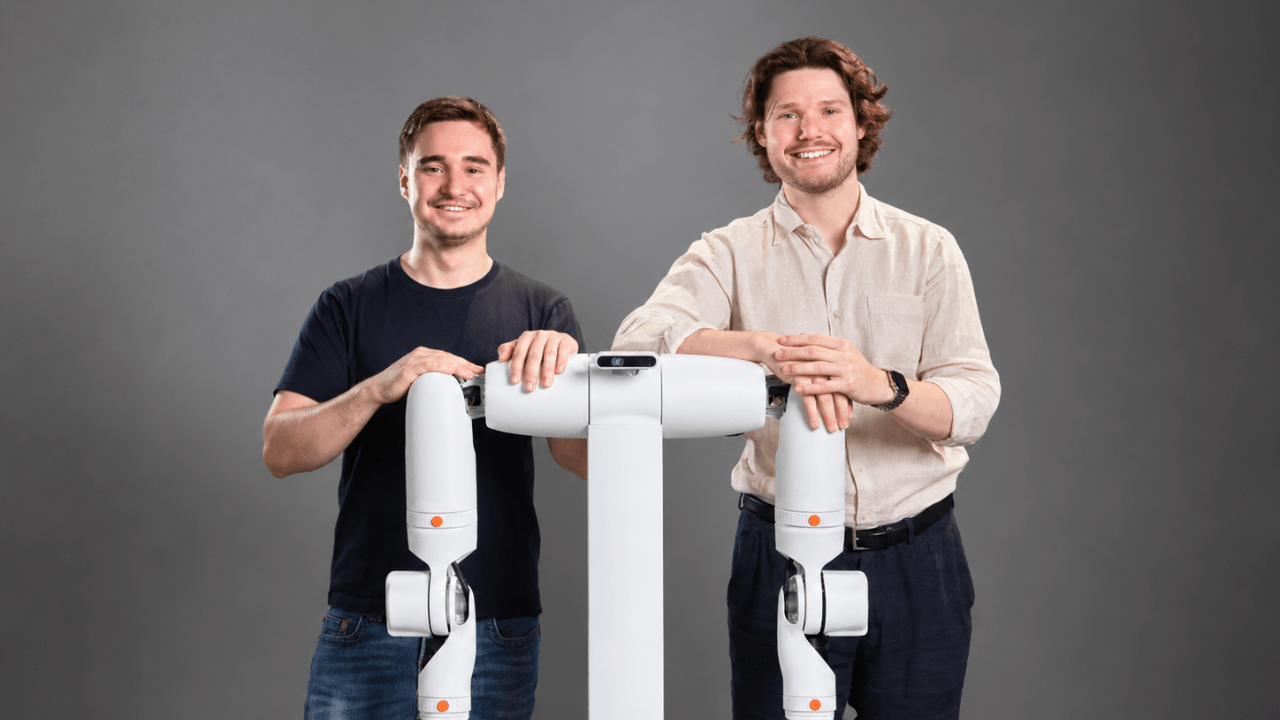
O-ID, a Tokyo-based company founded by two Europeans building one of the world’s first fully modular humanoid robots for industrial manufacturing and logistics, has raised $1.2 million in pre-seed funding.
Chicago-based TAWANI Ventures led the round, with participation from Hustle Fund, Techstars, and angel investors — including the founders of Humanoid Guide, who were early investors in robotics company 1X.
Building robots in Japan for the world
O-iD was founded in Tokyo in 2025 by Norwegian CEO Stian Jakobsen and Dutch CTO Simon Gormuzov, who met at Waseda University. Jakobsen previously worked in cyber defence, while Gormuzov, a mechanical robotics engineer, spent years in industrial robotics before the pair decided to build O-ID together.
I spoke with Stian Jakobsen, Co-Founder and CEO of O-ID, to learn more about the technology, the company's decision to build in Japan, and its aims for modular humanoid robotics.
According to Jakobsen, the duo came to Japan for different reasons but stayed because they saw an opportunity to build something that matters.
“Simon came for robotics; I came to study cybersecurity. We became friends, and we kept talking about how much more these machines could do.
We both love this country, and living here makes the workforce challenges very real. At the same time, Japan has incredible engineers and manufacturers, some of whom could both make components for our robots and use them in their factories.
We want to bring those things together and build robots here for the world.”
Japan’s $65B physical AI push meets an 11 million-worker shortfall
As its population ages, Japan’s workforce is projected to shrink, leading to a shortage of more than 11 million workers by 2040, with factory workers retiring and going unreplaced.
At the same time, robotics is a national priority. Japan announced in June 2026 that it is targeting ¥10.5 trillion ($65.1 billion) in public and private investment in "physical AI" — AI that controls robots and machinery — aiming to deploy 10 million AI-equipped robots by 2040.
Existing industrial robots are rigid, and retooling a factory around them requires significant capital investment and time. General-purpose humanoids are more flexible, but a single failed component can put the whole robot out of commission for months.
For large automotive plants, for instance, the stakes are high: an hour of downtime now costs $2.3 million.
O-ID brings modular humanoids to Japan’s factory floors
O-ID's robots are designed with a cybersecurity-first approach to fit into existing factory layouts without requiring facilities to be rebuilt around them. The company is betting that a modular architecture will also make humanoids easier and cheaper to maintain at scale.
Onboard AI sensors continuously monitor component wear and flag parts approaching failure, allowing O-ID to ship a replacement before downtime.
On whether Japan has fallen behind in humanoid robotics, Jakobsen believes the country has some catching up to do in commercialising the technology, but argues its manufacturing base could give it an advantage.
“We’re talking to manufacturers that have spent decades producing precision components for the automotive industry. The factories, equipment, and expertise already exist.
We don’t need to build all of that from scratch. “Our opportunity is to bring that manufacturing strength into robotics and move quickly. We’re not building this just to make a few impressive machines.
We want to build one of the world’s leading robotics companies, and we believe Japan is the place to do it.”
Jakobsen said the company's broader motivation is tied directly to Japan's labour shortage:
“When enough factory roles go unfilled at once, entire supply chains are at risk.
O-ID's robots are built to work alongside the people still on the floor, closing those gaps before they become a crisis for a single factory and for the industries Japan depends on.”
Why a humanoid rather than conventional automation?
For O-ID, the case for humanoid robots is less about replicating the human form and more about fitting into factories and processes originally designed around people.
Across the hundreds of thousands of manufacturing sites in Japan, Jakobsen noted, much of the work has been designed around the human body: “the height of a table, where the tools are, how someone reaches into a machine.”
He explained:
“Conventional automation can work extremely well, but fitting it into an existing process can mean redesigning workstations, moving equipment, and changing how the line runs. That takes time and money.
We want robots that can work in those existing spaces, use the equipment already there, and work alongside people.
The point isn’t to make something look human. It’s to supplement a workforce that’s increasingly difficult to fill, without asking a factory to rebuild around the robot.”
From prototype to the factory floor
O-ID’s first prototype is a fully assembled, stationary, dual-arm robot that the company is using for integration testing and to develop the manipulation capabilities needed for its first customer applications. Its next version is already in development and will add mobility and greater strength.
O-ID plans to unveil it at CES 2027, while its first factory pilots are targeted for early 2027. According to Jakobsen, the work now is focused on getting those customer tasks running consistently, validating safety and reliability, and making sure the robot can be manufactured and serviced at scale.
The company is starting with repetitive factory tasks that remain difficult to automate, particularly jobs involving loading, unloading, and moving components between different stages of production.
Jakobsen explained:
“Imagine components arriving at a factory in packaging. Someone has to open that packaging, take the parts out, and put them onto a conveyor.
Or a machine finishes a part, and someone has to remove it and load the next one.
Those are the kinds of jobs we’re starting with."
They’re repetitive, but the factory depends on them getting done.
“Our ambition goes far beyond those first tasks. But the way to get there is to solve a real problem, get robots working with customers, and build from there."
Designing a robot around modularity
Full modularity is central to O-ID's approach. Jakobsen compares it to something as routine as replacing a car tyre.
“Imagine you’re driving and your tyre pops. What do you do? You replace the tyre and keep going. Now imagine having to send the entire car back to the factory.
That would be crazy, right?”
Yet in robotics, he says, a failed component can still mean taking the whole machine away for specialist repairs.
“That’s the problem we’re solving. We’re designing O-ID so staff can swap the affected module on-site, whether it’s a shoulder, an elbow, or a compute unit.”
Achieving that means designing the mechanical connections, power, data, and software around modularity from the beginning. Powered hot-swapping also requires the system to manage disconnection and reconnection safely.
However, O-ID doesn't see this as a trade-off between durability and modularity. Jakobsen explained:
“Robots need service. It might be a finger joint that wears out, or an actuator in the shoulder or elbow. It depends on the work they’re doing and which parts are carrying the load.
Now imagine hundreds of thousands of robots in operation. Sending specialists out for every component replacement simply won’t scale.”
The harder part is on O-ID's side: it has to design the entire robot around modularity while maintaining strength and precision.
“We take responsibility for that complexity so the customer gets a machine that’s straightforward to maintain.”
Predicting failures before they cause downtime
Predictive maintenance is another part of O-ID’s modular approach, with the company aiming to monitor how individual components perform over time and identify potential failures before they disrupt operations.
Jakobsen explained:
“The idea is to understand how each module is being used and how its behaviour changes over time. Our architecture allows us to improve accuracy as deployments scale.
“If a joint starts drawing more current or running hotter under the same conditions, that can tell us something needs attention.
The goal is to identify a problem early enough to get a replacement to the customer before it interrupts their work. And when something does fail unexpectedly, they should still be able to swap the module on-site.”
The economics of modular humanoids
O-ID is not publishing its manufacturing costs or customer pricing yet, but as it moves towards mass-production volumes, it expects to be highly competitive on price. The bigger difference, according to Jakobsen, is what the robot costs to run over its lifetime.
“A worn joint shouldn’t mean shipping an entire robot away, and a better hand or computer shouldn’t mean buying a whole new machine.
Replacing and refurbishing individual modules is how we’re designing for lower costs, both for us and the customer.”
And if the robot can help a factory run a shift it otherwise couldn't staff, its value goes well beyond the purchase price.
Building in Japan, scaling to the US
Many of O-ID’s components already come from Japan, and the company is working towards a fully domestic supply chain. It is partnering with Japanese manufacturers, including automotive Tier 1 suppliers, while working with US and European component developers to bring their technologies into production locally.
O-ID has signed a letter of intent with Sumitomo Electric Industries, Ltd. to explore the potential application of its technologies to wire harnesses for humanoid robots.
While its initial focus is automotive manufacturing and logistics in Japan, O-ID plans to expand into additional industries and, eventually, the US market.
The company has filed a provisional US patent for its modular connector technology, and says its Japan-built robots are being designed to meet US National Defense Authorization Act (NDAA) requirements.
The new funding will help move O-ID’s first robot from prototype to production as it prepares to place robots on Japanese factory floors.
William Pritzker, Partner at TAWANI Ventures, said:
“Japan and Chicago share a robust role and history as lynchpins of the global manufacturing ecosystem. Stian and Simon have impressed us with their ability to work and to innovate within this space.
Modular humanoids are a generational opportunity to expand industrial productivity just as labour force declines present unprecedented challenges.
O-ID will lead the transfer of decades of Japanese robotics expertise, learnings, and supply chain into an AI-native, adaptable platform.”
Yuki Shirato, Managing Director at Techstars, said:
“I originally selected Stian and Simon not simply because of their brilliant minds, but because they are building something truly unique.
O-ID humanoid robots will be modular, designed for mass production and repairs, and made entirely in Japan.
They have made tremendous progress since then, and this fundraise and joint research with Japanese manufacturers mark an important step forward in their mission of reshaping how we live.”


Would you like to write the first comment?
Login to post comments