
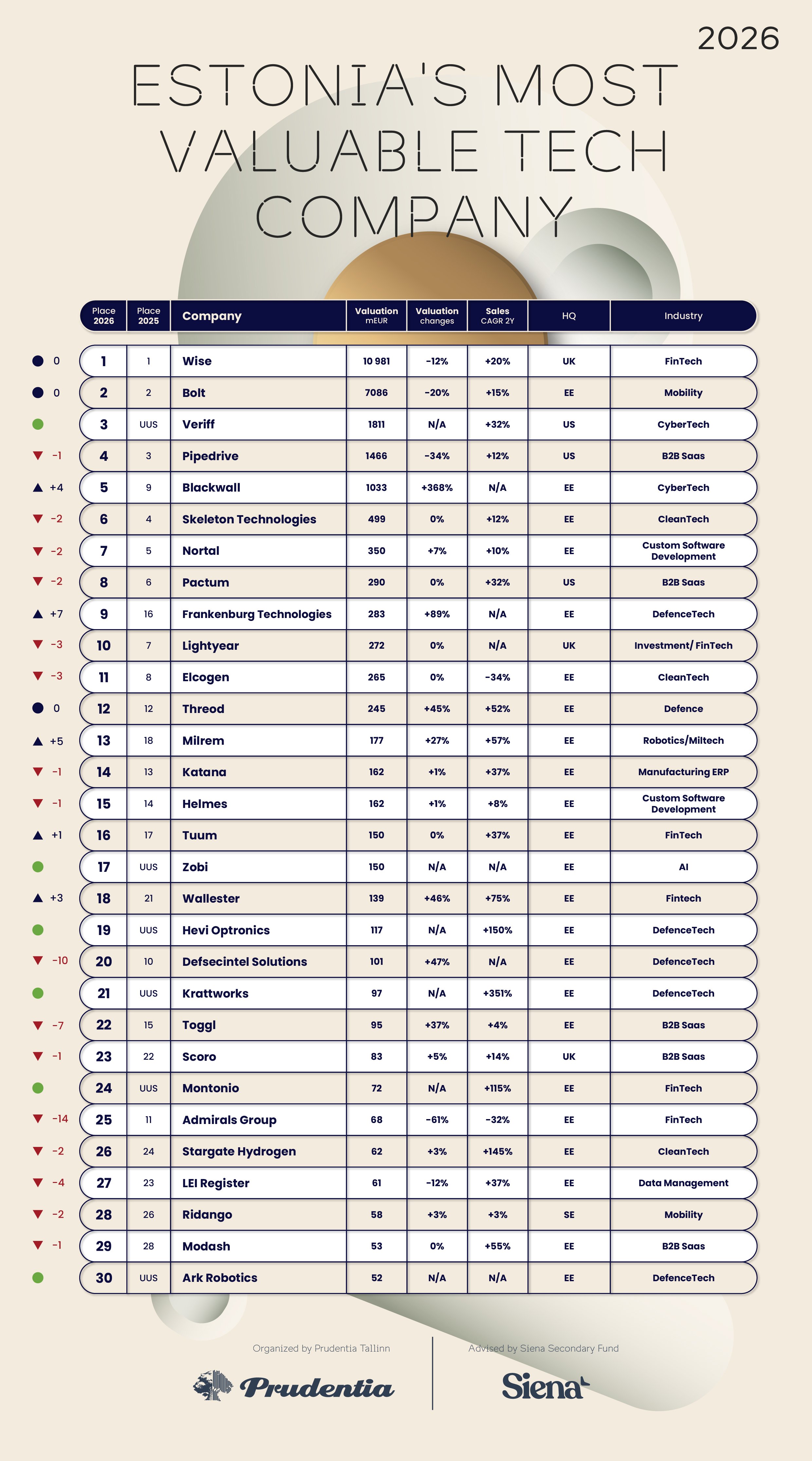
Cybersecurity company Blackwall has reached a €1 billion valuation and ranks fifth in TopTech 2026 , the annual ranking of Estonia's 30 most valuable tech companies. Wise tops the table at €11 billion, followed by Bolt (€7 billion) and Veriff (€1.8 billion).
TopTech is compiled by M&A advisory firm Prudentia Tallinn and Siena Secondary Fund, and is the only independent valuation of the Estonian tech scene. Its figures draw on market capitalisations, recent funding rounds, investor fair-value estimates and financial data that some companies share only with the compilers.
As a result, the list covers companies whose valuations rarely make the news.
I spoke to Rando Rannus, General Partner at Siena Secondary Fund and co-author of TopTech, and Tõnis Voitka, co-founder and CEO of featured defencetech company KrattWorks, to find out more.
Blackwall jumps 368 per cent to €1.03 billion
According to Indrek Uudeküll, Partner at Prudentia Tallinn, who led the compilation of the ranking, Blackwall also received this year's TopTech special award for the biggest riser. Its valuation grew from around €221 million to €1.03 billion in a year, an increase of 368 per cent, lifting it from ninth to fifth place.
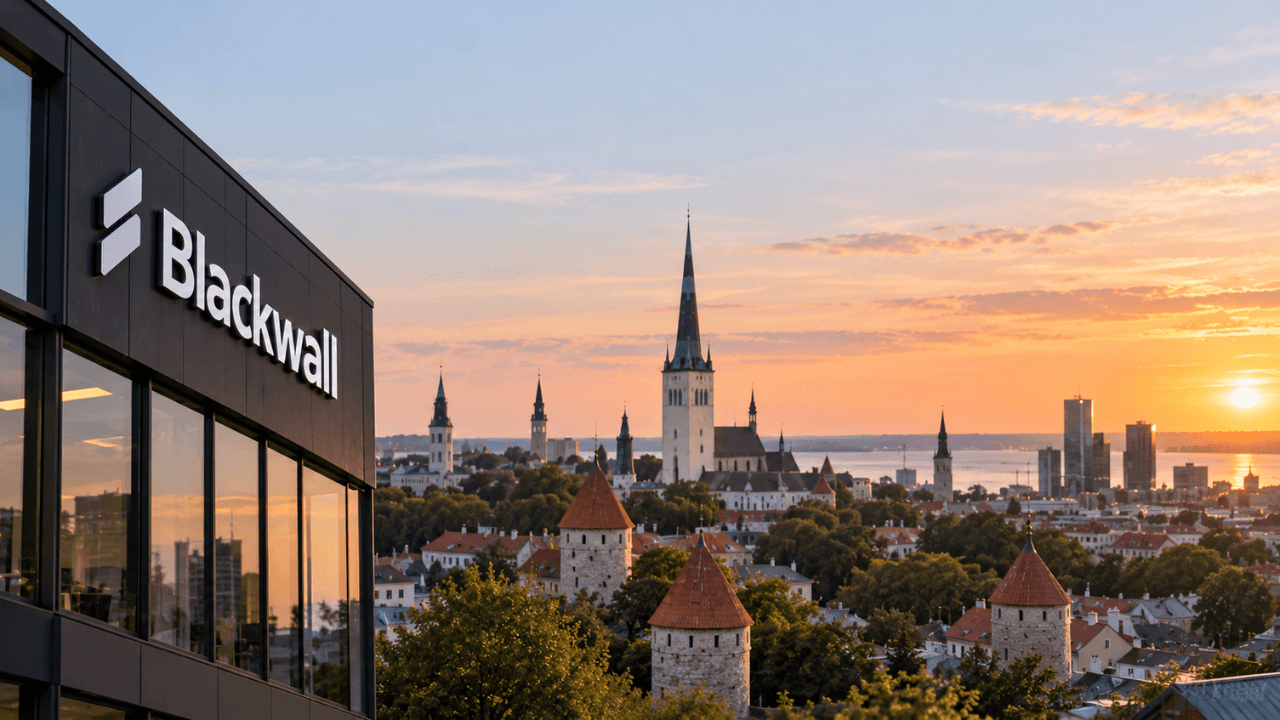
Blackwall provides security infrastructure: its GateKeeper solution filters out malicious traffic before it reaches customers' applications.
Uudeküll says Blackwall shows that valuing a technology company means looking at the product, the sales channel and the economic value it creates for customers, all at once.
Rando Rannus, General Partner at Siena Secondary Fund and co-author of TopTech, says Blackwall's growth and the valuations of comparable cybersecurity companies underpin the figure:
"Blackwall has grown its revenue very strongly, and valuations across its cybersecurity peer group are high. Together, those two factors are what support the higher valuation.
Our figure is an implied valuation: we apply a revenue-based multiple benchmarked against listed cybersecurity companies and peers that have raised funding in the past 12 months.
So it reflects real revenue, priced at the level the market currently pays for comparable businesses. We expect the €1B+ valuation to be confirmed soon by an independent party, through Blackwall's new funding round."
Wise and Bolt weigh on Estonia’s overall tech valuation
The combined value of Estonia's 30 most valuable tech companies fell slightly year on year, to €26.4 billion from €27.7 billion. Wise is valued at €10.98 billion this year and Bolt at €7.09 billion. Together they account for 68.3 per cent of the TOP 30's total value.
The top five hold 84.6 per cent of the table's value, so the revaluation of a few large companies has a strong effect on the overall result
. Rannus argues that the headline decline therefore does not tell the whole story:
"Wise and Bolt lost around 15 per cent of their combined value, and that alone outweighs the growth everywhere else in the table”
Below the very top, the picture is healthier than the headline – defence, cybersecurity and AI companies are growing, “many of them on far less capital than the previous generation needed."
Defencetech becomes TopTech’s largest sector by company count
Overall, AI, cybersecurity and defence set the tone in this year's ranking. Veriff and Montonio are marked as new entries in the 2026 table, although in practice their data was simply unavailable for a period. Defence technology is represented in the TOP 30 by seven companies with a combined value of €1.07 billion, making it the largest sector in the table by number of companies.
Frankenburg Technologies, Threod, Milrem and DefSecIntel have been joined by Hevi Optronics, KrattWorks and Ark Robotics.
Frankenburg's value rose 89 per cent (to €283 million), Threod's 45 per cent (€245 million) and Milrem's 27 per cent (€177 million). DefSecIntel's value, however, fell 47 per cent, to around €101 million.
KrattWorks co-founder and CEO Tõnis Voitka attributes the company's growth partly to having worked in defence drones since 2018 and to “persistence”:
"In this sector you have to show up. Anyone can build a cool prototype. Getting it into series production is where most companies stall.”
Structurally, he highlights the company’s ownership of its whole technology stack — cameras, radios, autopilot, ground control software — as a key point of difference:
“We design them ourselves. When a customer needs a specific frequency band or encryption standard, we build it. We don't call a supplier or wait for a re-export licence.”
Crucially, KrattWorks is one of the few European companies that combines this with a manufacturing model that allows it to assemble systems anywhere in allied Europe, including in the customer's own country.
“For a government that cannot buy from outside Europe, that is not a feature. It is what makes the purchase possible," asserts Voitka.
Voitka says KrattWorks' growth has also been driven by concentrating on its DART target drone family.
“DART replicates the Shahed-type drones Russia uses against Ukraine, down to the sound of the engine. Air defence units now train against it. Today we have 30 paying customers, including the defence ministries of eight NATO countries: Canada, Denmark, Estonia, France, Germany, the Netherlands, Norway and Sweden.
At home we have a seven-year, €15 million contract with the Estonian Defence Forces."
But rapid growth in defence technology also creates a problem of focus, according to Voitka:
"As we grow towards 100 people, the challenge is making sure everyone understands the bigger picture. As we say at KrattWorks, we don't just build drones. We build force multipliers.
One infantry unit with our systems can do the work of a mortar battery. Five operators instead of fifty. If a product doesn't do that, we shouldn't be building it."
He also argues that the backgrounds of KrattWorks' employees influence how the company develops its products:
“More than half of our team are veterans who still serve as reservists in the Estonian Defence Forces, some with combat experience from Afghanistan and Ukraine. They know the difference between a demo and the field.”
B2B SaaS falls while fintech and software show growth
The combined value of the four companies classified as B2B SaaS fell by 32.4 per cent.
Pipedrive had the largest impact, but Toggl also declined (by 37 per cent), while Scoro grew by 5 per cent. In fintech, Wallester stood out with a 46 per cent increase, reaching €139 million. Software development companies Nortal and Helmes grew by 7.4 per cent and 1.4 per cent respectively.
The first generation of founders who never built without AI
Rannus says founders now in their twenties have never known what it is like to build a company without AI.
"They don't ask how many people they need, but how few. A new hire only comes on board when the machine can no longer keep up. That is a very different mindset from the 'growth at all costs' of 2021," he said.
He cites early signs of Estonian companies achieving with five to fifteen people and a couple of million euros what once took fifty people and tens of millions.
Rannus also points to Creem as evidence of what is emerging below Estonia's biggest technology companies:
"The clearest evidence is at the young end: Zobi has already made the TopTech list, and Creem went from one person to fifteen and to millions of euros in recurring revenue in two years.
None of them will match Wise or Bolt tomorrow, but together with the defence companies – seven of them now in the TOP 30 – they are how that concentration starts to thin out."
These young founders are advised, and increasingly funded, by Estonia's previous generation of founders.
The people who built Bolt and Wise share their knowledge on how to scale and, where needed, write the next generation's first cheque. Another key success factor is that companies reach real business before they need significant capital at all.
"When every euro takes you further, founders keep larger stakes, investors get a simpler cap table, and the ecosystem gets more mature companies in the years ahead. Their first employees and angels, in turn, become the next ones to put their money back into circulation. Estonia's startup DNA is intact: substance, resilience and a refusal to give up," he said.
Secondaries could accelerate that recycling, according to Rannus:
"Much of the value in this table still sits on paper, and early employees, angels and first investors can wait a decade or more for an exit.
Secondaries let part of that money move earlier – and in Estonia, money that moves tends to go straight back into the next generation of founders."
How TopTech calculates its valuations
TopTech ranks fast-growing technology companies with at least one Estonian founder or registration in Estonia, provided they are headquartered there or have at least 20 per cent of their workforce in the country.
Company valuations are based on the most recent reliable data available, prioritising market capitalisation, recent funding rounds or acquisitions, and published investor valuations. Where these are unavailable, TopTech estimates equity value using revenue multiples from comparable companies
. TopTech may carry forward older valuations for up to two years, after which it no longer values companies without sufficient financial data.


Would you like to write the first comment?
Login to post comments