

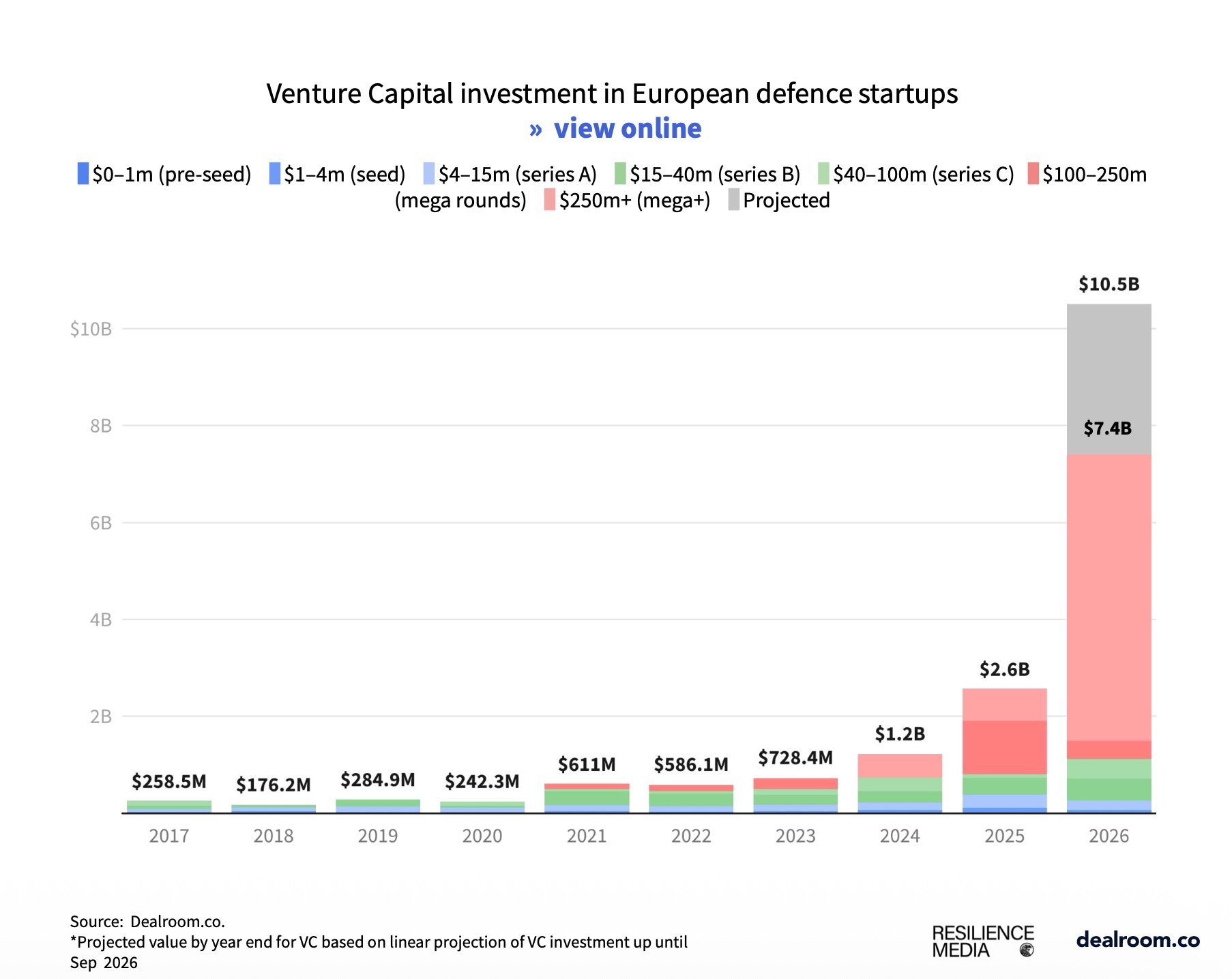
Venture capital investment in European defencetech startups has reached a record $7.4 billion in 2026 to date, nearly three times the $2.6 billion raised 2025, according to a new report from Dealroom and Resilience Media.
Mega-rounds, including seven $1B+ rounds: Anduril, Helsing, Saronic, Shield AI, Quantum Systems, ICEYE and Castelion, account for more than 85 per cent of funding this year.
Defencetech is now the fastest-growing major segment of European venture capital and accounts for 11.1 per cent of European VC investment, rising to 15 per cent within the EU27. Meanwhile, defencetech startups in NATO Alliance countries have raised $27.1B in VC funding in 2026, already 1.9x more than in all of 2025.
A rapidly expanding investor base
Dealroom has identified 310 investors participating in at least one European defence deal in 2026 to date and projects that the full-year total will reach 620, more than six times the 99 recorded in 2020 and up from 387 in 2025.
Specialist defence funds participated in 34 per cent of European defence rounds in 2025, nearly twice the previous year’s share, following a wave of dedicated fund launches. Private equity, project finance, debt and grants contributed a further $2.4 billion to NATO and allied defence companies in 2025.
Europe’s ten most active defence investors have recorded 52 round participations since 2024, led by the NATO Innovation Fund with nine and Project A with eight.
Record-breaking investment
Germany leads European defencetech funding, driven by Helsing, Quantum Systems, and Stark. German startups have raised $3.5 billion in 2026 and $5.9 billion since 2020, while Munich remains Europe’s leading defencetech hub. Munich in particular has become an extraordinary concentration of European defence capital.
The city hosts just 4.1 per cent of Europe’s VC-backed defence startups, but accounts for 39 per cent of their combined enterprise value and 40 per cent of European defence VC funding in 2026.
Helsing and Quantum Systems alone are valued at a combined $25.7 billion.
However, the growth is not confined to a handful of headline rounds. While mega-rounds account for more than 85 per cent of European defence funding this year, funding at the $15 million to $100 million “breakout” stage has already doubled compared with 2025 and reached a record level.
Early-stage investment, meanwhile, is projected to finish roughly in line with last year’s record. European defencetech funding is growing faster in relative terms than the broader NATO and allied market, reaching nearly three times its 2025 total, compared with an almost doubling across NATO and allied countries.
Defence startups in NATO Alliance countries have raised $27.1B in VC funding in 2026, already 1.9x more than in all of 2025.
US capital plays a growing role
US investors now account for 47 per cent of European defence tech funding, up from 12 per cent in 2020. The most active US investors in 2025-2026 into European defence tech have been Axon, Accel, Founders Fund, Y combinator, General Catalyst, and Lightspeed.
Autonomous systems attract the biggest share
Much of the capital is flowing into autonomous systems. European drone startups have raised $4.7 billion across 40 rounds this year, while anti-drone companies have attracted $1.2 billion and maritime autonomous systems $796 million — in both latter categories, more than in all previous years combined.
Europe’s strengths — and its capability gaps
Despite this growth, capability gaps remain. Europe is strong in quantum, photonics, space and drones, but trails global leaders in AI chips and processors, launch vehicles, humanoids and communications satellites: technologies critical to building resilient, sovereign systems.
Europe is now home to more than 160 VC-backed quantum startups, which attracted more than $1.6 billion in 2025.
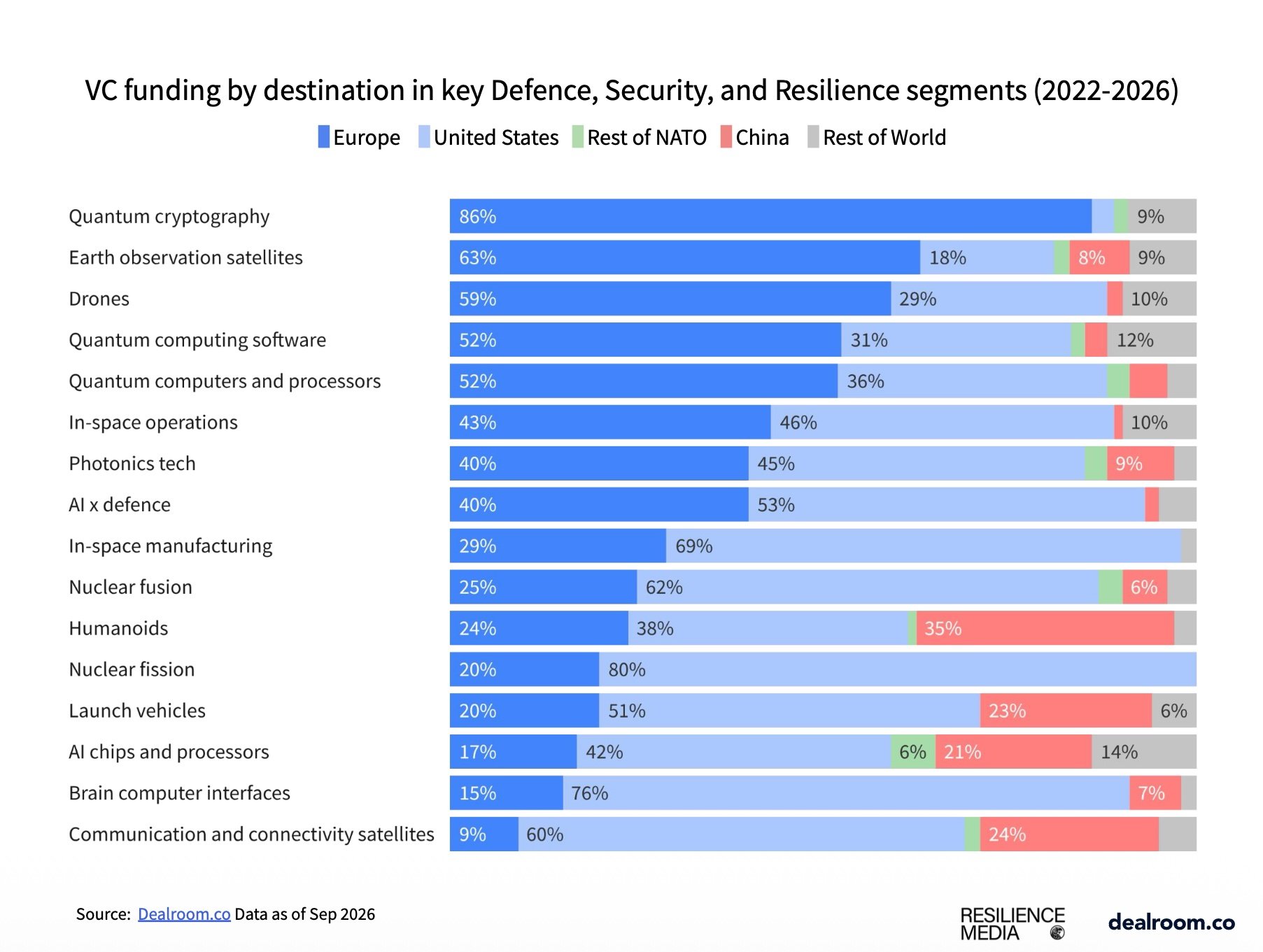
The picture is therefore uneven. Europe attracts more than half of global VC funding in quantum cryptography, earth-observation satellites, drones, and two quantum-computing segments, and is close to the US in photonics and in-space operations. But it remains well behind global leaders in areas including communications satellites, AI chips and processors, launch vehicles, and brain-computer interfaces.
Exit activity accelerates
Across NATO and allied countries, defencetech exit activity is projected to rise from an annual average of approximately eight exits between 2021 and 2024 to 28 in 2026.
Exit value reached a record $55.4 billion in 2025 but remained heavily concentrated in the US. European VC-backed defence startups are now worth a combined $44 billion, approximately twice as much as a year ago.
Companies founded since 2020 account for 77 per cent of that value.
Talent pipeline
Seventeen per cent of European defencetech founders have military or ministry of defence experience, most commonly in the UK, Germany and France. The same is true of 14.7 per cent of C-level executives.
Military experience is even more prevalent among specialist investors: 26 per cent of investors at defence-focused funds have military or ministry of defence backgrounds, compared with 12 per cent at generalist funds.
From investment to deployment
Leslie Hitchcock, co-founder and publisher, Resilience Media, said:
“National security, defence and technological innovation are now inseparable. Across NATO alliance countries, there is an urgent need to strengthen the infrastructure underpinning our collective security and resilience. For Europe, technological sovereignty must mean building together in the face of common threats.
This is both a strategic imperative and a major economic opportunity: to build companies that protect peace and democracy while transforming defence, cybersecurity, energy and other critical infrastructure.”
Gianni Cuozzo, co-founder and CEO of Exein, said:
“Defence is becoming increasingly software-defined, autonomous and connected, which creates a fundamentally different cybersecurity challenge.
As more critical systems use AI to make decisions and act in the physical world, security must operate at machine speed. That means autonomous defences trained on how machines actually behave, running on technology Europe owns and controls. That is the foundation of strategic autonomy."
Klaus Hommels, Founder and Chairman of Lakestar, said:
“Europe’s military leaders have been clear with us: if we want to build and retain critical defence capabilities in Europe, we also need sovereign European financing.
The demand for these technologies is there and now the capital must follow. This record investment shows that Europe is beginning to recognise defence technology as a strategic necessity, not a passing investment trend."


Would you like to write the first comment?
Login to post comments