

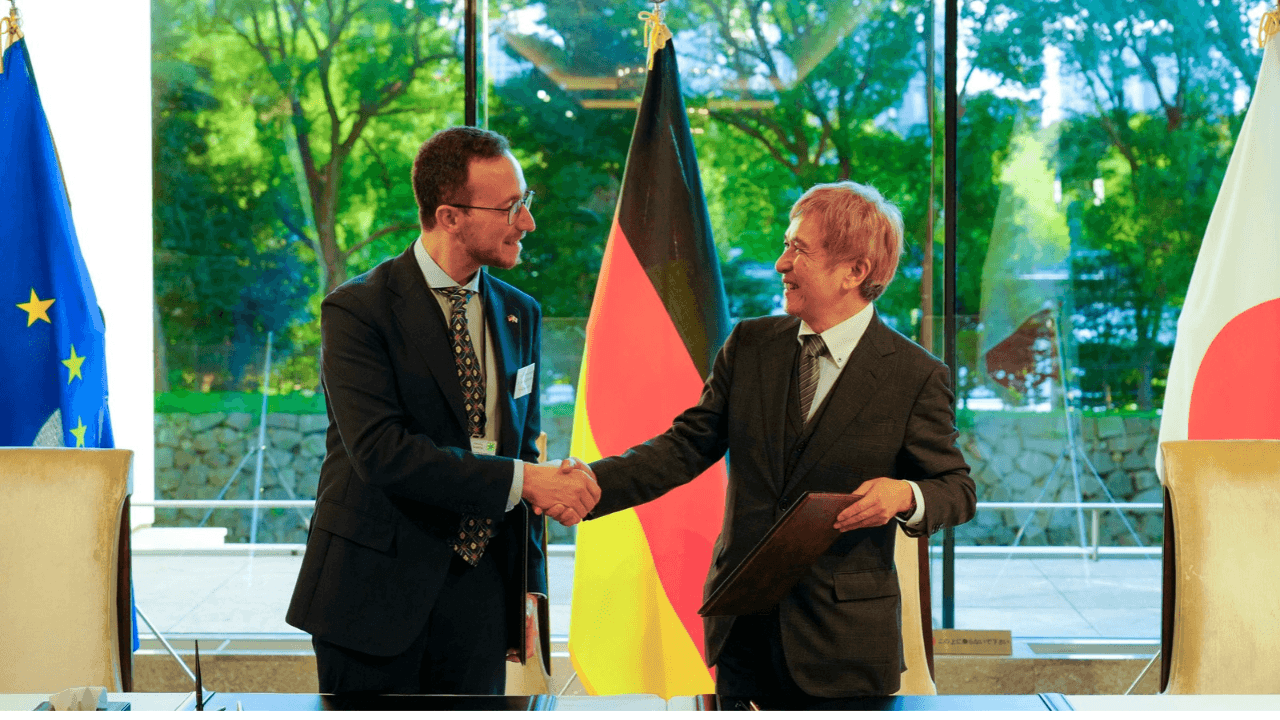
German fusion power company Proxima Fusion has signed Memoranda of Understanding (MoUs) with Japanese companies Fujikura and Kyoto Fusioneering to develop critical technologies and industrial supply chains needed for commercial fusion power. The agreements, signed in Tokyo during German Chancellor Friedrich Merz's visit to Japan, cover high-temperature superconducting (HTS) tape manufacturing, plasma heating and fusion fuel cycle technologies.
Together, the partnerships aim to strengthen Germany's industrial capabilities in fusion energy, bringing Japanese manufacturing and engineering expertise into Proxima's plans for its Alpha demonstrator and future Stellaris commercial power plants.
Germany's federal government has set a goal of building the world's first fusion power plant in the country. Achieving this will require industrial-scale supply chains for specialised components, many of which are not yet manufactured at the volumes needed for commercial fusion.
Fujikura partnership targets superconducting tape production in Germany
Under its agreement with Fujikura, Proxima Fusion will assess the technical, commercial and economic feasibility of establishing an HTS tape supply chain in Lower Saxony, Germany, including potential local manufacturing. HTS tape is a key material for compact, high-field fusion magnets used in stellarators.
Proxima anticipates requiring approximately 20,000 kilometres of HTS tape for its Alpha demonstrator and around 40,000 kilometres for each planned Stellaris power plant. As fusion moves towards commercialisation, growing demand for HTS tape will require significant investment in production capacity.
Greater visibility into long-term demand could help manufacturers scale production, reduce costs and establish more resilient supply chains. The partnership combines Fujikura's decades of superconducting materials expertise with Proxima's anticipated demand, while supporting the development of European manufacturing capabilities.
According to Dr Francesco Sciortino, CEO and co-founder of Proxima Fusion, Europe's fusion ambitions depend on building the necessary industrial capabilities today.
“A fusion power plant's supply chain has to be ready years before the plant itself. That is why we are working on HTS tape now, for our Alpha net-energy-gain stellarator and for the first stellarator-based fusion power plant, Stellaris. Fujikura is a clear leader in manufacturing high-temperature superconductors, and we are proud to work with them to build this capability in Germany.
This is how Europe builds its fusion supply chain: by connecting long-term demand with world-class manufacturing expertise.”
Naoki Okada, President and CEO of Fujikura, said the company has spent years developing HTS tape manufacturing technology and supplying products to fusion energy projects worldwide.
“Deploying fusion energy will require an industrial foundation capable of supplying high-performance HTS tape reliably and at scale. By working together, we aim to contribute to the practical deployment of fusion energy and the realisation of a sustainable energy future.”
Kyoto Fusioneering to advance plasma heating and fuel cycle technologies
Proxima's second agreement, with Kyoto Fusioneering, will expand existing cooperation on next-generation gyrotrons for plasma heating and fusion fuel cycle technologies. Gyrotrons generate high-power microwaves used to heat plasma to the extreme temperatures required for fusion reactions. Fuel cycle systems are responsible for managing and processing the fuel needed to sustain fusion operations.
Kyoto Fusioneering will contribute engineering expertise and technologies to support the commercial deployment of fusion energy in Germany, including through the national Fusion Hubs initiative of the German Federal Ministry of Research, Technology and Space (BMFTR).
The partnership builds on Japan's established fusion engineering capabilities and Germany's stellarator research expertise, including the Wendelstein 7-X programme at the Max Planck Institute for Plasma Physics, from which Proxima Fusion originated.
Kiyoshi Seko, Representative Director, President and COO of Kyoto Fusioneering, said Germany is approaching fusion as both a future energy source and an industrial opportunity.
“Germany is approaching fusion not only as a future source of energy, but as a pillar of its High-Tech Agenda to build national prosperity through advanced technology.
Manufacturing and engineering are at the heart of that vision, and they are also at the heart of what Kyoto Fusioneering does.”
He added that the collaboration would bring the company's plasma heating technologies to Proxima's stellarator programme and help establish fusion as an industry in Germany. During the Chancellor's visit, Kyoto Fusioneering also hosted Proxima Fusion at its Tokyo Research Centre.
Building the industrial foundations for commercial fusion
Both partnerships support Proxima's roadmap towards Alpha, its net-energy-gain stellarator demonstrator targeted for the early 2030s, and Stellaris, its first commercial fusion power plant planned for later that decade.
The Munich-headquartered company, which employs around 200 people, is developing fusion technology based on the QI-HTS stellarator concept. Its commercialisation plans are supported by the Alpha Alliance, a consortium of more than 50 industrial partners.
The agreements address different but complementary requirements for commercial fusion: superconducting magnets capable of confining plasma, technologies to heat that plasma, and systems to manage the fuel cycle. Sciortino said that building these capabilities would be central to determining which countries lead the emerging fusion industry.
“The global race to fusion will be won in factories and supply chains. Japan has spent decades building world-class fusion engineering capabilities;
Germany has the leading stellarator engineering in the world and knows how to industrialise. In working closely with Kyoto Fusioneering and Fujikura, we are building a new industry together, one that makes both our countries more secure.”
For Proxima, the partnerships represent another step towards translating Europe's fusion research capabilities into an industrial supply chain capable of supporting commercial power generation.
Lead image: Francesco Sciortino, CEO of Proxima Fusion, and Dr Satoshi Konishi, Co-Founder, Representative Director, CEO, and Chief Fusione from Kyoto Fusioneering.


Would you like to write the first comment?
Login to post comments