

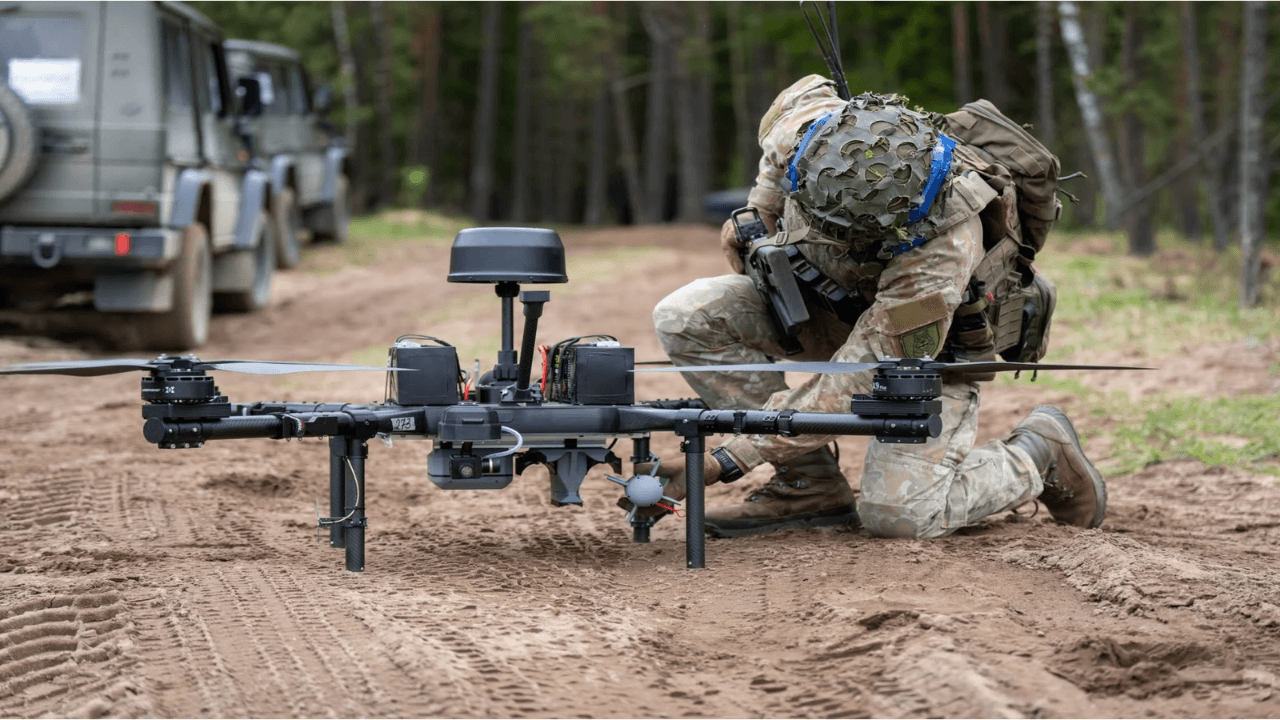
Following Russia’s full-scale invasion of Ukraine, former private equity fund manager Rapolas Markevičius decided to put his experience to work in a very different industry: defence technology. Today, he leads Lithuanian startup PDKINEMATICS, which develops precision-guidance systems to help drones operate more effectively in increasingly contested environments.
I spoke to Markevičius about the company’s origins, the changing nature of drone warfare, lessons from Ukraine’s battlefield and the challenges of building defence technology in Europe.
From private equity to precision-guided defence tech
Rapolas Markevičius, founder and CEO of PDKINEMATICS, is a former private equity fund manager who previously worked at 1 Asset Management. Following Russia’s full-scale invasion of Ukraine, he trained as a reserve officer at the Lithuanian Military Academy before founding the defence technology company.
PDKINEMATICS emerged from the geopolitical upheaval following the invasion, with Markevičius bringing together co-founders with engineering backgrounds in the space industry to develop technologies aimed at strengthening Europe’s defence capabilities.
“The situation became very personal as soon as Russia invaded Ukraine. I think it was a call to action for me as well,” he recalled.
What began as a project in late 2022 quickly developed into a company driven by a shared sense of urgency and a desire to contribute to European security.
“We decided that we could contribute to changing Europe’s geopolitical situation,” Markevičius explained.
“It was definitely political reasons that brought us into this industry.”
Today, PDKINEMATICS has a team of around 20 people. Markevičius admits that finding specialised talent is challenging. However, because the company is adapting established technologies to modern hardware, it can also recruit engineers with experience in newer technology sectors.
“I think this is a challenge for the entire Baltic region. You cannot scale a European technology business without expanding the geographical scope of your talent pool,” he said.
Bringing precision strikes to UAVs
According to Markevičius, limitations in current precision-guidance technologies trace back to the development of military doctrine after the Second World War.
“Major countries invested heavily in precision guidance technologies because they made military operations more effective while reducing collateral damage, which is particularly important within NATO doctrine,” he explained.
However, these technologies were primarily developed for large military platforms, including aircraft and helicopters.
“What we’re seeing on the battlefield in Ukraine is that these platforms cannot operate effectively near the contact line. That creates a fundamental problem for traditional NATO doctrine, which relies heavily on air support.”
First-person view (FPV) drones have helped fill this gap by providing a lower-cost precision-strike capability. However, Markevičius argues that their effectiveness remains constrained by operator skill and difficulties scaling their deployment. While Ukraine has become highly proficient in deploying FPV drones, European and NATO militaries have struggled to replicate that capability at scale.
Meanwhile, Ukrainian forces have increasingly deployed larger UAVs carrying unguided munitions, effectively supplementing traditional artillery capabilities.
However, these systems must generally operate at lower altitudes to achieve accuracy, increasing their exposure to ground-based threats. In Ukraine alone, approximately 300,000 drone-deployed munitions are reportedly dropped monthly, almost all unguided.
PDKINEMATICS aims to address these limitations with Gannet, its flagship precision-guidance system for unmanned aerial vehicles (UAVs). The low-SWaP-C (size, weight, power, cost) system is designed to enable UAVs to deploy precision-guided munitions from altitudes of up to 700 metres, according to the company, up to six times higher than with unguided munitions without sacrificing accuracy.
Already deployed in Ukraine and several other European countries, Gannet adds precision-strike capabilities to existing UAV fleets rather than requiring operators to acquire entirely new platforms.
The system is also jam-resistant, platform-agnostic and capable of operating in challenging weather conditions. PDKINEMATICS says it can integrate Gannet across different UAV types in under four weeks, from initial agreement to first flight.
Markevičius explained:
“Essentially, we’re taking established technologies and adapting them to modern hardware, making them smaller, lighter, more energy-efficient, less expensive and suitable for scalable manufacturing.”
Letting UAVs operate at higher altitudes without sacrificing accuracy offers significant operational advantages.
“Our systems allow UAVs to operate at much higher altitudes while maintaining precision, reducing their exposure to counter-air threats on the ground.
“This means the drone is more likely to return home safely, which is particularly important in the kind of conventional warfare we’re seeing in Ukraine.”
Although unwilling to disclose detailed technical information, Markevičius stressed that the system’s ability to operate in GPS-denied environments, particularly those affected by intensive electronic warfare, is central to its design.
“It’s one of the core capabilities of our technology.”
PDKINEMATICS is part of an emerging group of defence technology companies adapting precision-guidance capabilities.
Ukrainian startup M-FLY is developing laser-guidance systems designed to withstand electronic warfare, while Deftak is building computer-vision-guided munitions capable of operating without GPS. Swiss-US company Auterion is also developing autonomous terminal-guidance technology for smaller drones. Together, these companies reflect a broader shift towards making precision capabilities available beyond the large, expensive military platforms for which they were traditionally developed.
From battlefield testing to commercial contracts
Moving from battlefield testing to commercial contracts remains one of the biggest challenges for defence tech companies operating in Ukraine, particularly given the demanding technical and certification requirements. However, Ukraine’s defence technology ecosystem has matured considerably since the start of the full-scale invasion, with regulators adapting and procurement standards increasingly aligning with European standards.
“The Wild West of Ukrainian defence tech has been diminishing,” Markevičius explained.
“It’s now a lot more standardised and accountable.”
Markevičius sees this growing maturity as positive, even as it raises the bar for startups trying to move from successful pilots to commercial deployment.
Battlefield feedback drives faster development
For many early-stage defence tech companies, getting products in front of military end users is a significant challenge. Markevičius credits Lithuania’s close relationship with Ukraine for helping PDKINEMATICS establish direct connections with the personnel using its technology.
“Lithuania, both as a country and as a society, has done a great deal to support Ukraine, and Ukrainians recognise that. “
This has created strong relationships between the Baltic defence industry and Ukrainian end users.
“I think that’s one of the biggest advantages of our regional defence technology ecosystem. “We have very good connections with the people actually using these technologies, which allows us to maintain those rapid development and feedback cycles.”
Those relationships enable PDKINEMATICS to incorporate direct battlefield feedback into product development, often within weeks rather than months.
“We have a very tight iteration cycle that involves the end user. There is no other way to create an effective product without having customers or future customers involved from a very early stage.”
According to Markevičius, that speed is essential not only from a commercial perspective but also because battlefield conditions are constantly changing. Technologies must be continually adapted to developments on the ground, making close collaboration with existing and potential military customers an important part of the company’s development process.
Preparing for autonomous warfare
Beyond precision guidance, Markevičius believes the defence industry is approaching a more fundamental shift towards autonomous military operations. According to him, many technologies across the broader defence tech ecosystem are already technically capable of operating autonomously.
Ukrainian companies are already deploying varying degrees of autonomy on the battlefield. Kyiv-based The Fourth Law for example, develops AI-powered terminal-guidance systems that enable drones to track and approach targets autonomously, while working on more advanced capabilities including autonomous target selection and fully autonomous operation. This is not, however, to the point of a machine independently selecting and engaging a target without a human in the loop.
European and NATO countries have been cautious about deploying these capabilities at scale because of regulatory and accountability considerations. Ukraine is also experimenting with autonomous technologies, although questions of accountability remain central to how they are deployed. Markevičius contends:
“I would argue that autonomous warfare is no longer primarily a technical challenge. It’s a question of how and whether to deploy these capabilities. That puts us in a difficult position.
European countries and NATO allies need to prepare for the possibility of defending themselves against highly autonomous military operations.”
For European defence technology companies, this raises questions not only about what their systems can do, but also about how militaries and policymakers will decide to use them.
Ukraine first, then Europe and beyond
PDKINEMATICS’ immediate priority is to continue supporting Ukraine while expanding the adoption of its technology across Europe.
Longer term, Markevičius sees opportunities beyond the continent, although he says the company’s expansion plans remain deliberately gradual. “We do have ambitions beyond Europe, although our plans aren’t particularly specific at this stage.
"I like to think about our expansion as an onion, where we gradually move outwards.
That’s not just a commercial or management decision. It also reflects the company’s purpose.
We established PDKINEMATICS to build technologies that matter and that can materially improve our region’s ability to defend itself.
We have global ambitions, but our immediate focus remains Ukraine and Europe.”


Would you like to write the first comment?
Login to post comments