

Li-Fi is hardly new. I first started writing about the technology more than a decade ago, when the idea of transmitting data through light rather than radio waves promised to transform wireless connectivity. But despite the early excitement, Li-Fi never achieved mainstream adoption.
But now, the technology is finding renewed relevance in an unexpected place.
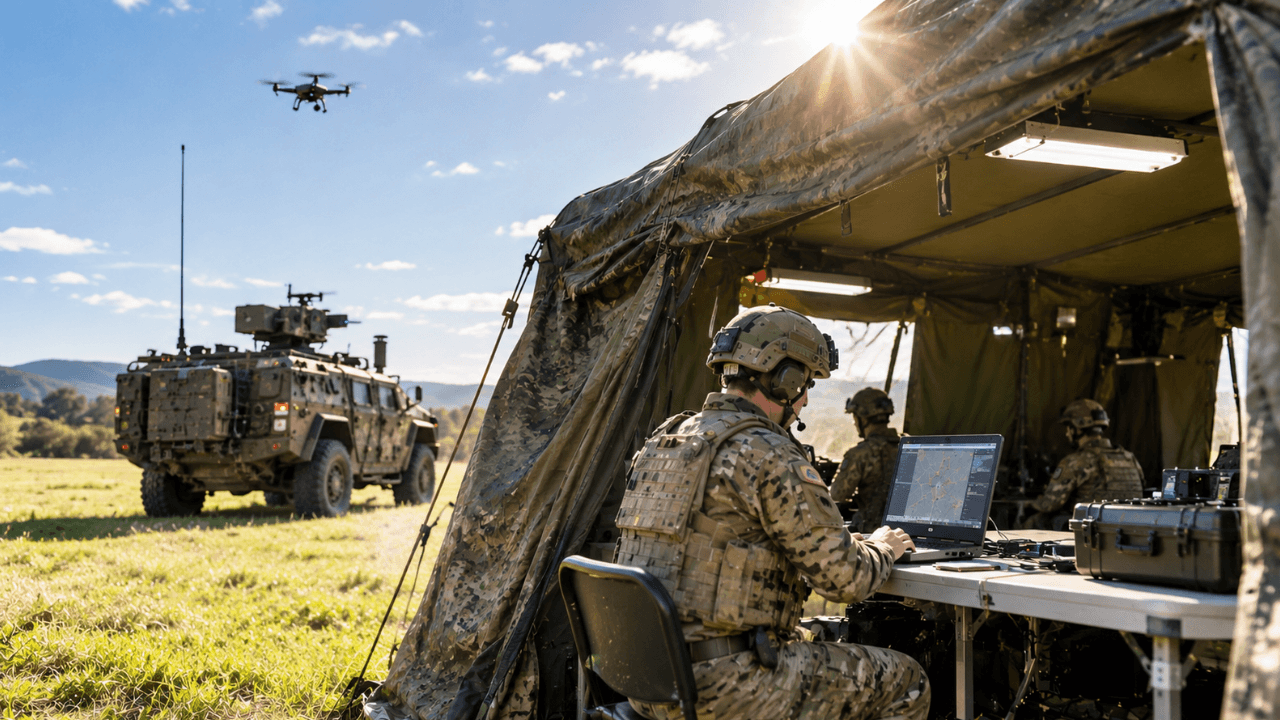
French optical wireless communications company Oledcomm is developing light-based communications systems designed to address the vulnerabilities of conventional radio-frequency communications, particularly in military environments where electronic warfare and jamming are increasingly prevalent.
Oledcomm has been selected for the Mission Track of NATO's Defence Innovation Accelerator for the North Atlantic (DIANA) after participating in the programme's initial Challenge phase.
I spoke with Benjamin Azoulay, President and CEO of Oledcomm to learn more.
What is Li-Fi?
Li-Fi, short for Light Fidelity, is an optical wireless communication technology that transmits data by rapidly modulating light, including infrared LEDs. An optical access point sends a modulated signal to a dedicated receiver, enabling wireless connectivity without conventional radio-frequency transmission.
The signal is largely confined to the illuminated area, which can be useful in sensitive environments. Oledcomm also uses laser-based optical links for longer-distance communications, including between vehicles, drones and satellites.
From consumer Li-Fi to defence
I remember there was a lot of excitement about Li-Fi in the 2010s, particularly around IoT, but it never really took off.
Azoulay said Oledcomm experienced the same trajectory. The company emerged from a university lab in Paris, where two professors had been working on Li-Fi.
"Everyone was talking about it. They created a lot of IP, and they created Oledcomm to bring it to market. The dream at that time was to bring Li-Fi to the mainstream and replace Wi-Fi."
As lighting shifted towards LEDs, the ambition was to turn light fittings into internet access points. "Everyone dreamed of every light on Earth having data communication capabilities and becoming an internet access point." But Wi-Fi advanced rapidly, while major chip and device manufacturers prioritised cellular technologies rather than Li-Fi. Azoulay concluded around 2020 or 2021 that mainstream adoption remained years away. Discussions with the French Ministry of Defence helped redirect towards defence and space. Electronic warfare, radio-frequency detection and jamming became increasingly prominent concerns following Russia's full-scale invasion of Ukraine in 2022. The ministry financed Oledcomm's first military-grade product.
Why light-based communications matter on the battlefield
On the battlefield, conventional radio-frequency communications can expose military personnel and equipment to detection and attack. Azoulay explained:
"When you emit on the radio, the enemy's electronic warfare systems take seconds to detect you, geolocate you and probably hit you with an FPV drone. So now everyone is looking for solutions to continue communicating, which is vital, but without being detected."
What we say at Oledcomm is that light is the new radio because it has zero electromagnetic radio-frequency footprint. It's undetectable. It's totally immune to jamming."
Optical communication avoids conventional radio-frequency emissions, although its performance depends on maintaining an unobstructed optical link.
Making the technology suitable for military use required more than repackaging civilian equipment. The hardware had to withstand shock, vibration, and extreme temperatures, while the software needed stronger security protections.
"We developed software called LiFi Manager with post-quantum-resistant encryption. Now, with DIANA's help, we're applying for NATO Secret accreditation for our products."
Beyond defence, Li-Fi has potential applications in secure offices, industrial settings, education, healthcare and transport, particularly where radio-frequency emissions or signal containment are concerns.
From orbit to soldier: Oledcomm's four products
Oledcomm's concept is a network connecting military personnel, vehicles, drones and command centres without conventional radio-frequency links.
"Our concept is a tactical bubble. We call it a one-kilometre bubble, a completely RF-silent tactical bubble," said Azoulay.
"Outdoors it's lasers, indoors it's Li-Fi."
The company has developed four optical communications products:
SOLARIS – Mobile command centres: An indoor Li-Fi system connecting up to 32 users in approximately ten minutes. It uses point-to-multipoint connectivity in military shelters and mobile command centres.
CLOVIS – Vehicle-to-vehicle communications: A mesh networking system connecting military vehicles over distances of up to one kilometre, with data transmission speeds of 1 Gbps. Azoulay said Oledcomm had secured a contract with the French Army, with delivery planned for the end of 2026.
LISA – Drone-to-vehicle communications: An optical communications system enabling drones to act as relays for military vehicles operating in radio-jammed environments or under radio-silence requirements. The drone can be positioned approximately 300 metres to one kilometre above the vehicle.
LUCI – Satellite-to-satellite communications: A laser communications system designed to maintain links between fast-moving satellites, with stated transmission speeds of up to 400 Gbps over distances of up to 8,000 kilometres.
"With those four products, we can deliver the promise that we always call 'from orbit to soldier, everything in light'," said Azoulay.
Lessons from military deployment
Oledcomm has deployed its technology with two brigades and one division of the French Army, according to Azoulay. It has also conducted tests with the UK Ministry of Defence, supported by its participation in NATO DIANA's UK accelerator.
One important lesson has been that practical usefulness to soldiers matters more than the technology alone. Optical communications require line of sight, which can be challenging in mobile environments.
"If there's an obstacle between the emitter and the receiver, you don't see each other, and you cannot communicate anymore," Azoulay explained.
During deployments with France's 7th Armoured Brigade, personnel changed the layout of tents and tables inside mobile command centres to preserve the optical link. Oledcomm also uses pointing, acquisition and tracking systems to maintain connections between moving vehicles, drones and satellites.
The company has revised its products three or four times in response to field feedback.
"So this field learning is absolutely critical for success."
Commercialising military communications
Oledcomm's business model combines hardware sales with annual service contracts covering cybersecurity, software updates, maintenance and training. Depending on customer requirements, the company can provide one-to-one replacement of faulty equipment, in some cases within 48 hours. It also offers annual training to account for personnel turnover within defence ministries, where staff typically rotate every three years.
Cybersecurity and encryption software are updated annually.
Azoulay sees accreditation as a significant barrier to entry for competitors. It can take years after a product is developed to secure the approvals required for defence deployment. Oledcomm is also pursuing partnerships with established defence contractors to integrate its technology into existing vehicles and drones, rather than developing complete military platforms itself.
"It's better to have someone who already has the contract, who already has the product, the vehicle or the drone, and we can add intelligence to it by embedding Li-Fi," explained Azoulay.
"This is our approach, which I think makes sense instead of trying to sell a full solution directly. For a small company, it's extremely complicated."
Revenue ambitions and the space opportunity
Oledcomm aims to double its turnover in 2026 and again in 2027, with a longer-term target of reaching €15 million in annual revenue by 2030.
"We're still small. We're talking about a few million, but moving towards €10 million in turnover to start with. My goal is to be a €15 million company in 2030," said Azoulay.
He sees different growth dynamics in defence and space. In space, the main limitation of radio-frequency communications is bandwidth, with growing demand from satellite constellations, AI applications and proposed space data centres.
"With lasers, and it's not exactly Li-Fi, it's lasers, it's light, we're able to reach 400 gigabits per second, terabit-per-second connectivity.
In space, there's huge demand. It's exploding now."
Azoulay pointed to Europe's IRIS² satellite constellation, which he said will comprise 330 satellites equipped with three laser communication terminals each, representing potential contracts worth €150 million to €200 million for the terminals alone.
He estimates that the space laser communications market will reach €9 billion by 2032, with around 30 per cent potentially accessible to smaller suppliers as major satellite operators develop their own terminals.
Defence presents a different challenge, with longer procurement cycles driven by operational testing and security accreditation.
"You need a minimum of two to three years to enter a new defence application because of accreditation and testing. Nobody will buy it before testing it in an operational exercise."
Military exercises involving brigades or divisions, field reports and accreditation can all be required before procurement decisions are made.
"So the time to market in Li-Fi is quite long, probably longer than in space."
Oledcomm is targeting expansion into the UK, Germany and the US. It already has a small US subsidiary and is beginning to increase investment there.
The value of NATO DIANA
Azoulay praised the support Oledcomm received through NATO's DIANA accelerator programme, particularly from the UK-based team, which helped the company access opportunities and prepare pitches.
"The key point is that we had a team who were really treating the innovators as stars, doing everything they could to open doors for us, to help us be brilliant in making our pitches."
Staff were highly engaged, even contacting participants at weekends to check their preparations for demonstrations and events.


Would you like to write the first comment?
Login to post comments