

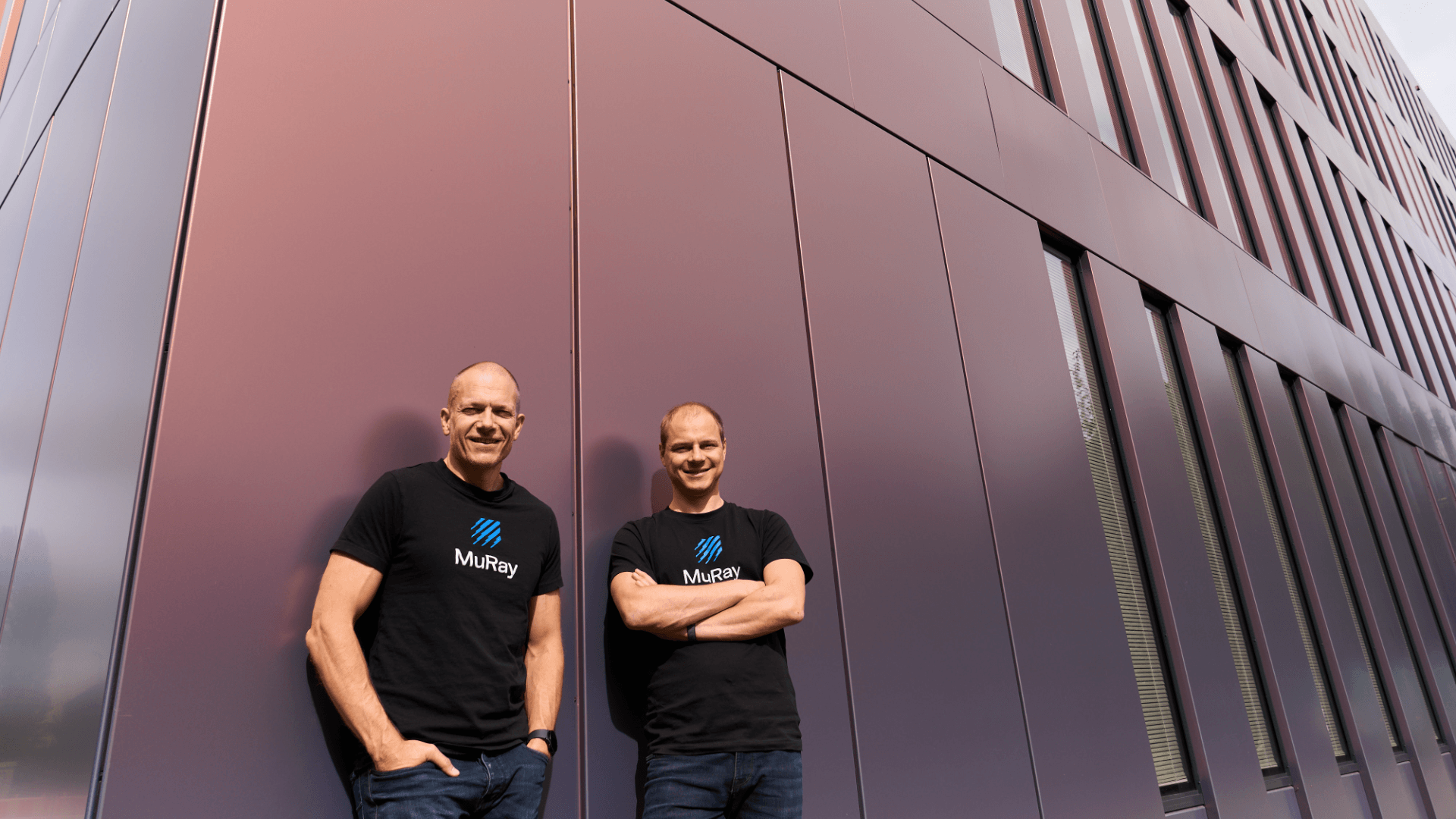
Hamburg-based deeptech company MuRay has raised €7.1 million in funding to further develop its Active Muon Imaging technology and bring it to industrial customers.
The financing includes a €3.5 million private investment round led by First Momentum Ventures and co-led by Caelora, a wholly owned subsidiary of Marvel Fusion. Other participants include Superangel, Mätch VC, Arcas VC and Tiny VC, alongside existing investor Nordic Science Investments. The company also received €3.6 million in non-dilutive public funding, including a grant from the EU's Horizon Europe programme.
Founded by Dr Andi Hektor and Dr Kristjan Põder, who serve as co-CEOs, MuRay is developing imaging technology that uses controlled muon beams to examine the internal structure of dense materials and components.
Quality assurance is the company’s initial focus, particularly for complex, safety-critical components such as 3D-printed rocket engines and gas turbine parts, where detecting internal defects remains a challenge.
Conventional X-rays struggle to penetrate dense materials, while MuRay's technology uses muons to produce high-resolution 3D images of components made from metals, ceramics and composites. The system can identify differences in material composition and density, enabling inspections within minutes rather than hours.
According to the company, the technology could allow manufacturers to detect defects directly on production lines while operating at a significantly lower radiation dose than conventional X-ray methods.
Dr Andi Hektor, co-founder and co-CEO of MuRay, said:
X-rays reach their limit at a few centimetres of steel, yet much of modern industry, from reusable rockets to gas turbines, is built from metal far thicker than that. Active muon imaging lets manufacturers see inside those large, dense components.
Beyond manufacturing quality assurance, MuRay is exploring applications across the space, aerospace, defence and energy industries, where more detailed inspections could help shorten maintenance cycles for components such as reusable rocket engines and jet engines.
In collaboration with the German Space Agency at DLR, MuRay has modelled the inspection of a rocket engine and plans its first real-world assessment in 2027. The project aims to demonstrate the technology's ability to detect internal defects in safety-critical components.
Dr Kristjan Põder, co-founder and co-CEO, added:
Defects that manufacturers can't see keep parts out of service for longer than they should be. Our technology helps them find those defects and get components back into service faster.
MuRay is also exploring applications in cargo and border security, where its technology could detect nuclear materials such as uranium within dense cargo. Longer-term possibilities include radioactive waste monitoring, the inspection of large structures such as bridges and buildings, and clinical diagnostics.
The new funding will support further technology development and MuRay's commercialisation plans, including a mobile imaging system approximately the size of a shipping container, designed to enable inspections directly at industrial sites.
The company plans to launch its first imaging service for industrial customers in 2027, combining DESY's existing electron beam in Hamburg with its own imaging system, followed by its first full-scale system incorporating a laser-driven accelerator in 2029.


Would you like to write the first comment?
Login to post comments