

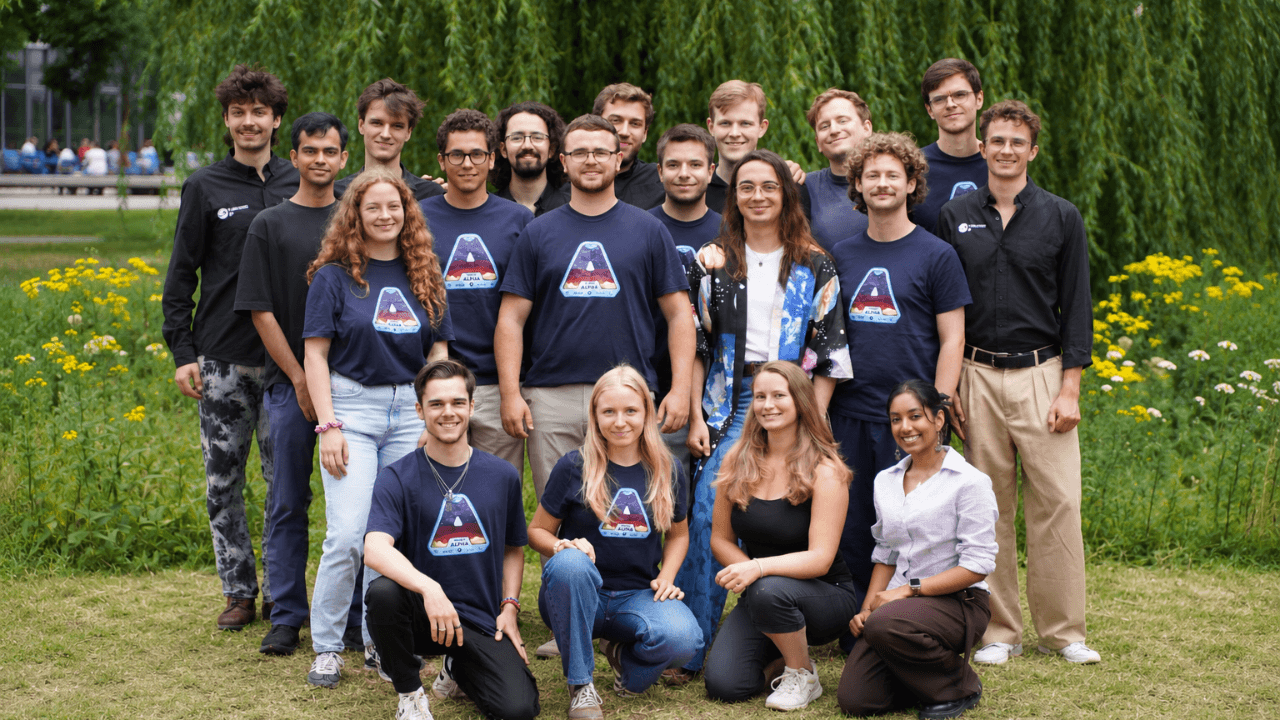
Austrian startup Tumbleweed has raised €6.9 million in the country's largest-ever spacetech seed round, just four months after launching Austria's first commercial satellite.
PactVC led the round, with participation from Vanagon Ventures, early backer Prototype Capital, EWOR, and international investors and angels.
I spoke to Julian Rothenbuchner, CEO and co-founder of Tumbleweed, to learn more.
Founded in 2024, Tumbleweed operates across Vienna and Delft, developing modular laboratory Pods hosted aboard its free-flying Oasis orbital platform. It makes microgravity accessible to researchers, manufacturers and R&D teams without requiring them to develop their own space infrastructure.
Tumbleweed's first mission, Oasis Alpha, launched aboard SpaceX Transporter-17 on 7 July 2026, carrying experiments for four customers, all first-time users of space. The mission was fully booked a year before launch and paid for upfront.
From building drones to rethinking Mars exploration
Rothenbuchner’s mother was a cello teacher, while his father trained as a classical violinist before becoming a cybersecurity entrepreneur.
“My dad was constantly working on his business, so entrepreneurship was just a normal part of life,” he recalled.
Rothenbuchner began building drones at around eight years old. Although he enjoyed physics, chemistry and mathematics, he was more interested in building things than competing in academic Olympiads.
At 16, he and two friends developed a concept for landing on Mars at approximately one-hundredth of the conventional cost. Inspired by the tumbleweeds seen rolling across landscapes in Western films, their wind-driven rover concept offered a potentially cheaper way to explore Mars and establish infrastructure. The idea won a space competition and secured funding from the European Space Agency (ESA).
With his school's support, Rothenbuchner pursued the project while completing his education. What began as a student project evolved into a volunteer research laboratory, supported by a network of hundreds of researchers at its peak.
However, by 2024, Rothenbuchner had grown frustrated with the pace of academic research and the increasing funding required to advance the Mars project.
“I loved the long-term vision of Mars exploration, but it wasn't particularly actionable,” he explained.
“The traditional funding routes were simply too slow for the pace at which I wanted to build.”
Thus, Rothenbuchner brought two colleagues from the research network into a new venture, laying the foundations for Tumbleweed's current focus.
Making microgravity accessible beyond the space industry
While a growing number of companies are developing infrastructure to transport payloads into space and return them to Earth, Rothenbuchner believes the bigger obstacle lies in making microgravity accessible:
“What we've realised is that the bigger challenge isn't necessarily the vehicle itself. It's the entire process of accessing microgravity.
For most pharmaceutical and biotechnology companies, the existing process is incredibly difficult.”
Preparing payloads, securing launch approval, demonstrating their safety and managing orbital operations require specialist expertise, often adding years of preparation to research projects. Tumbleweed aims to remove much of that complexity through its pre-certified, application-specific laboratory Pods. The fault-isolated containers provide power, data connectivity and the infrastructure needed to conduct experiments in orbit. Customers receive a laboratory in a box, install their equipment and test it in their own facilities before handing it over to Tumbleweed for launch.
Once in orbit, each Pod operates much like a remote server. Its built-in computer allows researchers to monitor and control experiments remotely, similar to accessing computing infrastructure through a cloud provider such as AWS.
Rothenbuchner asserts:
“There are significant scientific opportunities, but these applications will remain scientific curiosities unless researchers can access microgravity easily and affordably."
What Tumbleweed learned from Oasis Alpha
Built in nine months, which Tumbleweed says is five times faster than the industry standard, Oasis Alpha provided the company's first opportunity to test its service with paying customers.
The mission showed that organisations with no previous space experience could run experiments in three to four months for around €30,000. It also provided valuable lessons about designing the Pods around customers' actual requirements.
Rothenbuchner shared:
“When we signed our first customers, we didn't have a finalised hardware design. Instead, we told them we'd send successive prototypes and develop the system with them.
That allowed us to iterate several times based on their actual requirements.”
Customer feedback helped Tumbleweed identify and resolve challenges across hardware design, certification and operations, including requirements that might otherwise have emerged much later.
For Rothenbuchner, the key measures are the total cost and time required to complete an experiment. Launch and hardware are only part of the expense; certification, specialist engineering and mission operations can significantly increase costs.
Tumbleweed's pricing covers the entire process. Its €15,000 offering includes a Pod, development support, launch services and operational support, with customers able to access their experiments remotely and receive data during the mission. The company says it can offer lead times of approximately two to three months and is working to shorten them further.
Commercial demand has provided early validation of the model. Tumbleweed reports a customer conversion rate of approximately 40 per cent, with around two-thirds of its customers coming through inbound enquiries. The next challenge is expanding beyond early adopters.
“We're moving from universities and hospitals towards national research institutes, contract research organisations and eventually much broader industrial adoption,” Rothenbuchner said.
“Our philosophy is to integrate microgravity into existing supply chains. For microgravity to become a major commercial market, it needs to become as unremarkable as the internet is today."
Tumbleweed's three missions planned for 2027 are already attracting payloads from medical research, biotechnology and agritech laboratories. The company expects to carry more than ten customers across those missions.
What researchers are doing in microgravit
Tumbleweed's first mission supported materials science research, including experiments investigating recrystallisation and the underlying physics of how materials behave. It also carried experiments involving protein synthesis. Bacteria behave differently in microgravity, and researchers are investigating whether those conditions could help produce proteins that are otherwise difficult to manufacture.
For pharmaceutical R&D, microgravity can also act as a disease model and potentially accelerate the development of organoids and organs-on-chips. Organoids are small clusters of cells that mimic aspects of human organs. Often derived from stem cells, their cells can be relatively immature, meaning researchers may need to wait months for them to develop the characteristics they want to study.
Microgravity could potentially accelerate aspects of this maturation process, significantly shortening experimental timelines.
Beyond pharmaceutical research, Tumbleweed is working with researchers investigating how the immune system ages and testing potential interventions targeting inflammation for its next mission.
“One of the interesting things about microgravity is that it can accelerate certain biological changes associated with ageing,” explained Rothenbuchner.
The company is also collaborating with researchers studying the cardiovascular system, which undergoes significant deconditioning in microgravity, and exploring potential applications in wound healing research in space.
Securing launch access in a constrained market
The company is in discussions with providers across the US, Europe and Asia-Pacific, adapting spacecraft designs and mission requirements to secure reliable access to space as launch demand outpaces available capacity.
While their first launch was aboard SpaceX, Rothenbuchner asserts:
"We're not dependent on American launch providers, and we can't afford to be. We've even designed a spacecraft in a single day to take advantage of an opportunity.”
Tumbleweed can also use suborbital flights for early-stage microgravity experiments.
Although these provide shorter periods of microgravity and are unsuitable for some industrial applications, they allow researchers to test concepts and build confidence while orbital launch capacity expands.
Developing the capability to return experiments to Earth
Scheduled for 2028, Oasis Beta will introduce re-entry capability, allowing customers to retrieve physical samples for further analysis rather than relying solely on data transmitted from orbit. Rothenbuchner believes that the microgravity market won’t necessarily be dominated by whoever builds the best reentry vehicle.
“What really matters is the overall experience: how easy it is to access microgravity, how quickly experiments can be conducted, how flexible the service is and how much it costs.
We're developing our own reentry vehicle because controlling the entire process allows us to deliver the level of service we want. It reduces our dependence on external suppliers and gives us greater flexibility.”
Because a complete end-to-end re-entry test requires an expensive space mission, Tumbleweed is combining simulations with targeted physical testing to validate its engineering models ahead of an operational return mission.
For Rothenbuchner, however, the broader ambition remains making space research accessible to organisations that would never previously have considered it.
“I don't think we need to convince researchers that microgravity has interesting applications. We need to convince them that it's accessible.
We've demonstrated that organisations with little or no previous experience of space can conduct experiments for a low- to mid-five-figure sum.
I'm incredibly excited about making this capability available to more researchers and companies and seeing what they discover.”
More than one-third of Tumbleweed's 25 employees have invested their own money in the business, contributing a combined six-figure sum across its funding rounds.
“The team actually asked for this from their end - we didn't ask initially. But at this point the team has invested multi-6-figure amounts of their own money across every single round."
"This is a massive privilege, and I think it's indicative of a culture where we hire people who will consistently push for ownership,” Rothenbuchner said.
Daniel Dippold, CEO of EWOR, commented:
“Julian has done exactly what he told us he would do when we first met him, only faster. Now every lab and manufacturer can use space without becoming a space company first.”
Andreas Klinger, founder of Prototype Capital, added:
“Tumbleweed completely rethinks how R&D for industry and science in space should be done. This allows rapid iteration for the next generation of space technologies. It's hard to overestimate how important this can become.”
Austrian Federal Minister for Innovation, Mobility and Infrastructure Peter Hanke shared:
“Companies like these strengthen domestic value creation, create skilled jobs, and demonstrate that Austria is internationally competitive in demanding future technologies.”


Would you like to write the first comment?
Login to post comments