

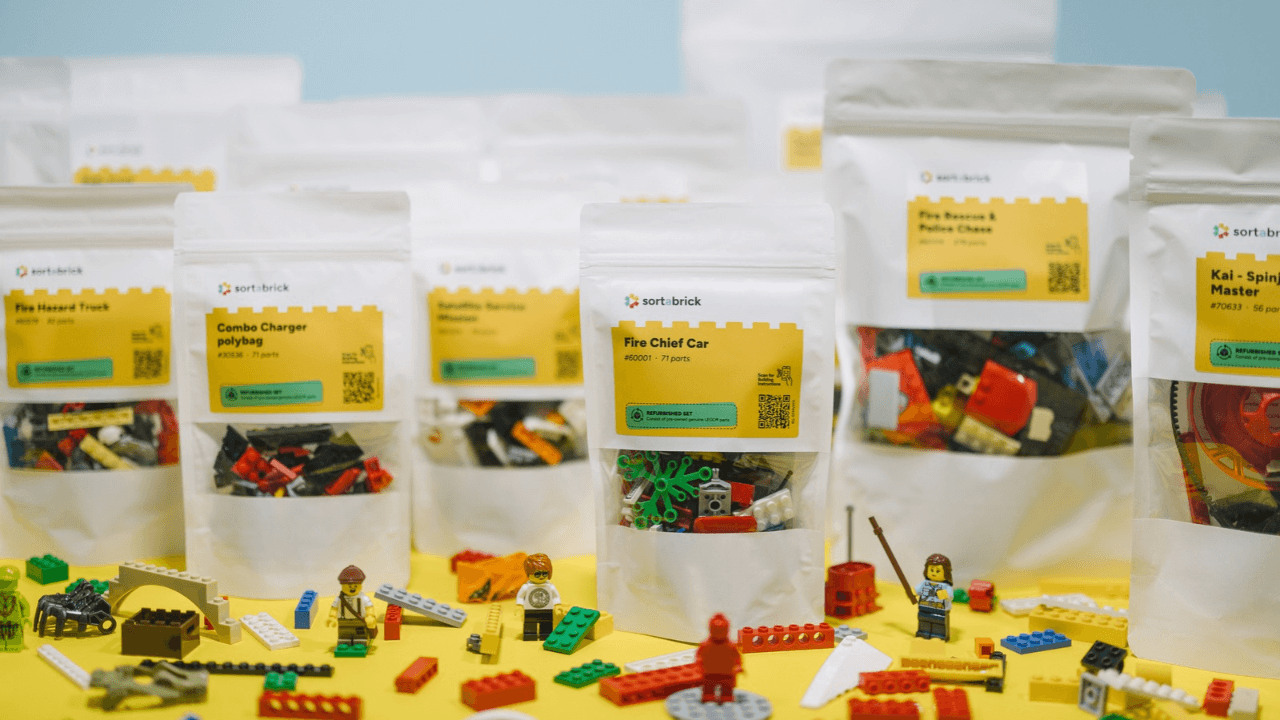
Billions of LEGO bricks are sitting unused in homes worldwide. While the bricks themselves can last for generations, rebuilding original sets from mixed collections can require hours of painstaking manual sorting.
Lithuanian startup Sort A Brick is developing automated technology to make that process commercially viable, turning collections of used bricks into complete, ready-to-build sets.
According to the company, the global secondary LEGO market is worth approximately €800 million, but only €80 million comes from sales of complete used sets. Sort A Brick estimates that a market for certified refurbished sets could grow to €4.7 billion by 2036 if automated sorting makes large-scale restoration commercially viable.
In October, Sort A Brick unveiled its second-generation automated sorting machine, capable of scanning and sorting up to 3,600 bricks an hour, four times faster than its predecessor. The launch coincides with the company's expansion into direct sales of refurbished sets.
More than 75 per cent of its listed inventory sold during the online store's first week, and the company reports that customers across 20 EU countries have purchased more than 1,100 sets.
Sort A Brick has also received nearly 2,000 restoration requests from 41 countries and processed more than 700 kilograms of mixed bricks, with Germany emerging as a key market.
I spoke to Ilya Malkin, CEO of Sort A Brick, to learn more.
From restoring childhood collections to selling refurbished sets
I've been following Sort A Brick's progress for several years. The company originally focused on restoring customers' existing LEGO collections, so I was curious about what prompted the move into selling refurbished sets.
According to Malkin, the company had always considered direct sales, but legal complexities and higher customer expectations meant it needed to improve its technology first.
“We decided to wait until our technology improved enough to deliver the quality and consistency we wanted.
We now have two business lines: restoring customers' existing collections and selling refurbished sets that we've assembled ourselves.”
The company is positioning its refurbished sets as a more reliable alternative to conventional second-hand purchases, where missing or incorrect pieces can be a problem.
“The sets are cleaned, checked for completeness and made entirely from genuine LEGO bricks. If a customer discovers a missing or non-genuine piece, we'll replace it. Customers can also scan a QR code to access the building instructions.”
Demand for restoration services has been strong, but processing capacity has been the biggest limitation. Malkin says some customers are willing to wait years to have their collections restored.
“The average order value is around €500, which is quite high. Customers often send us 14 or 15 kilograms of mixed bricks. “
Although the cost per restored set can be relatively low, paying €500 in one instalment is a significant barrier.”
Some customers find that the cost of restoring their entire collection exceeds what they are prepared to spend.
“That's one reason why selling individual refurbished sets makes sense. Instead of spending hundreds of euros restoring a collection, someone can buy a single set for €10 or €15, depending on the model.
We're targeting prices around half those of equivalent new sets, although older and rarer sets may be more expensive.”
Scaling LEGO sorting through computer vision and automation
The automated sorting system uses computer vision to identify LEGO bricks and match them against a database of sets. Software then determines which sets can potentially be reconstructed from the available pieces. The process begins with pre-sorting and cleaning. The second-generation machine scans bricks from all sides, while a redesigned distribution system and ten times more output containers allow hundreds of sets to be processed simultaneously.
Overall capacity has increased fivefold with approximately three times the physical footprint. Pieces the system cannot recognise are directed to a semi-manual sorting station, while completed sets undergo final inspection before delivery.
“We use computer vision to support that process, but we still have a human checking each set because we want to guarantee completeness,” Malkin explained.
The improvements extend beyond the sorting hardware to the software and supporting equipment.
“Our original machine was essentially a prototype. We were operating it in three shifts, running around 22 hours a day, but we were still limited in how much we could process,” Malkin recalled.
Improving recognition without chasing AI vanity metrics
The computer vision technology has evolved from identifying shapes to recognising colours and printed pieces, each introducing additional complexity.
“We're very pragmatic about what we invest in when it comes to AI. We don't want to chase vanity metrics. We introduce new capabilities when they significantly increase the proportion of bricks we can recognise,” Malkin said.
The system now automatically identifies more than 93 per cent of pieces, with the remaining seven per cent directed to manual sorting stations. Transferring those capabilities between machines presents another challenge, as even small hardware differences can affect recognition accuracy.
“When you build a machine and calibrate everything, the computer vision system works. But even if you replicate the machine, transferring those capabilities isn't straightforward,” Malkin explained.
The team is experimenting with using data from the original machine to train its successor, particularly for shape recognition. Colour recognition is more difficult because it requires machine-specific calibration.
“However, because we've already gone through that process once, it should be easier with the next generation.”
The challenge of making circularity commercially viable
Hardware-intensive businesses can be difficult to finance because companies must invest in machinery before they can properly test the market. For Malkin, another challenge is achieving sufficient scale to determine whether the business model is economically viable.
“At a very small scale, the results of an experiment can be misleading. The demand we've seen is encouraging, but we still need to demonstrate that the business works at scale.”
The second-generation machine is therefore a critical step towards making the operation commercially sustainable.
“We expect this new generation to make the operation profitable, which would allow us to start replicating the system. You can't scale something that's losing money every time you operate it.”
LEGO's durability makes it particularly suited to reuse, but reconstructing sets from thousands of mixed pieces is difficult without automation.
“So in a way, we're helping make that promise of reuse more practical.”
The legal complexities of refurbishing LEGO
Sort A Brick has been developing intellectual property around its sorting technology, filing a patent application in Sweden for its original machine.
“We received confirmation much faster than we expected, after around nine months,” Malkin explained.
However, the development of its second-generation machine, which incorporates additional innovations, has introduced challenges around patent protection.
“One unexpected challenge was coordinating the timing of the patent applications. If the first application becomes public before the second is filed, it can potentially create problems for protecting the newer technology.”
Protecting its own technology is only part of the legal challenge. Sort A Brick must also navigate intellectual property and resale rules surrounding LEGO products.
“We have to be careful about the images we use commercially,” Malkin explained.
“That's why we've organised building events where people come and build LEGO models, and we photograph those completed models ourselves.”
Establishing the provenance of second-hand bricks is another consideration, as resale rules can depend on where products were originally placed on the market.
"When we buy mixed bricks from individuals, we don't necessarily have the original receipts. So we identify the sets in their collections and ask sellers to confirm that they owned them.”
Malkin said the company is taking a cautious approach as it scales.
“Our lawyers have warned us that intellectual property disputes could arise as we grow, so it's something we take seriously.”
Beyond LEGO: Expanding automated sorting to other toys, Sort a Brick’s tech could eventually be adapted to other products, although their components would need to retain sufficient value to justify automated sorting.
“There are more than 100,000 different types of parts to identify,” Malkin shared.
“For our technology to make economic sense in another industry, there needs to be a large variety of parts, those parts need to retain enough value to justify sorting them, and there needs to be a way to identify and organise them.”
Other durable, modular toys could offer similar opportunities, including Playmobil and BRIO wooden railway sets. However, Malkin sees considerable room for growth in the company's existing market.
“There's so much LEGO in circulation that we could be working on this market for another decade.”
Scaling globally through sorting centres and partnerships
The company plans to open pilot sorting centres in Europe and the US in 2027, with ambitions to establish up to 40 sorting lines worldwide by 2030. Beyond processing second-hand LEGO, Malkin sees an opportunity to turn these facilities into educational spaces.
“We already have visits from schools and kindergartens because children find the technology fascinating,” said Malkin.
"When we open larger facilities, we'd like people to be able to see the machines working. It demonstrates recycling and reuse in a very tangible way.”


Would you like to write the first comment?
Login to post comments