
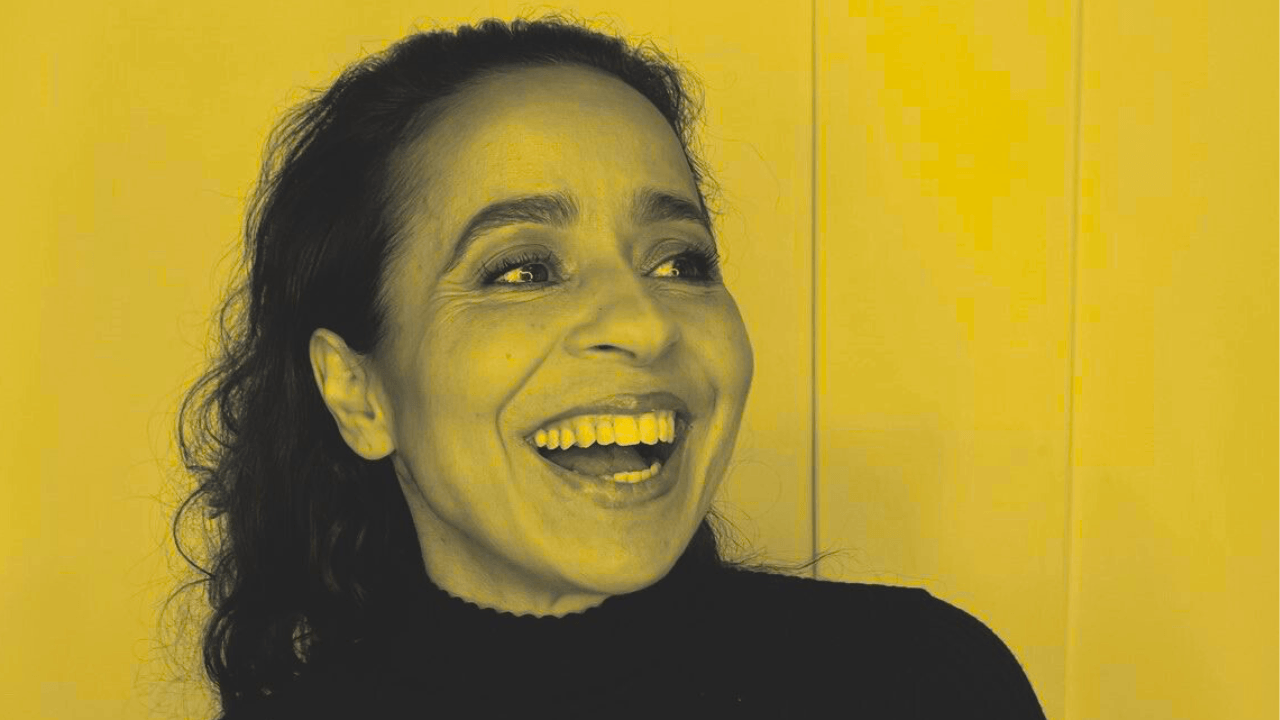
Growathon Ventures is launching as Europe's first women of colour (WOC) led VC fund, targeting €100 million to finance pattern-breaking founders who deliver excess returns, but receive only 0.02 per cent of European venture capital.
I spoke to Founder and General Partner, Esma Choho to learn all about it and discovered a legacy of female founders that offer a way forward.
“VCs aren’t risk-driven—they’re pattern-copying machines”
Choho doesn’t mince words. For her, the industry’s consistent underfunding of women isn’t a pipeline problem — it’s a fundamental mispricing of value.
Choho contends that “VCs aren't risk-driven, they're pattern-copying machines. “
She asserts that Europe has been copying American VC playbooks for 20 years, including their biases. That has left enormous alpha on the table.
"We're not founded to fix diversity. We're founded to capture returns that everyone else misses. And in doing so, we make Europe grow."
The data behind the arbitrage: outperformance vs underfunding
The data is unambiguous: 63 per cent valuation outperformance, 2.5x capital efficiency, yet all-female teams got 1 per cent of US VC in 2024. Further, top-quartile US funds had female decision-makers 69 per cent of the time
She contends that this isn't a risk, but rather it’s systematically mispriced alpha with superior fundamentals.
"European VCs are even worse: smaller market, more consensus-driven, more concentrated. They call pattern-breakers "risky" when they're actually the lowest-risk bet with the highest returns.”
Take Lisa Su, now celebrated for transforming AMD from a struggling $2 billion company into a $200 billion semiconductor powerhouse. As a woman, an immigrant, and a PhD electrical engineer stepping into a failing hardware business, she embodies the kind of founder traditional VC pattern-matching would have dismissed at the seed stage—“wrong profile, wrong sector, wrong timing.”
The same is true for Mira Murati, who followed a non-linear path from mechanical engineering to AI leadership. An Albanian immigrant with an unconventional trajectory, she became the Chief Technology Officer of OpenAI, one of the most influential technology organisations in the world.
These are the kinds of overlooked, pattern-breaking profiles that generate outsized returns — yet are routinely underestimated by traditional venture capital.
First-mover advantage in venture’s most overlooked segment
Growathon Ventures is the first European fund specifically designed to capture this arbitrage: financing founders who are systematically rejected by traditional VC pattern-matching, despite demonstrably superior performance. Women of colour founders get only 0.02 per cent of US venture capital, despite outperforming market returns. In Europe, the data is sparse — and the disparities are likely even worse.
The result is a completely untapped opportunity.
According to Choho, being first is important for the ecosystem, but what matters for our LPs is being first to capture a documented arbitrage:
“The data has been screaming about this opportunity for years. We're launching because the market inefficiency won't last forever.
Smart capital will follow. Our Founding LPs get a first-mover advantage.
This is a growth engine that has been in plain sight. And Europe left it on the table. First movers get exposure to documented arbitrage before market correction.”
Why pattern-breaking founders outperform on fundamentals
According to Choho, pattern-breaking founders possess three operational advantages:
Capital efficiency as a survival mechanism.
Raising 1/10th the capital means owning 3x more equity. Research indicates that women-led startups are more capital-efficient, generating 78 cents in revenue for every dollar invested, compared to 31 cents for male-founded startups. According to Choho, “this isn't luck, it’s necessity converted to discipline.”
Product obsession over capital gains
Rana el Kaliouby (Affectiva) pioneered emotion AI. Aileen Lee, co-founder of Cowboy Ventures, coined the team "unicorn." Both are founders who exemplify a founder archetype driven by product obsession rather than capital games.
As a result, deep domain expertise beats pattern-matching.
Choho asserts that “WOC founders prove worth through output, creating defensible moats.”
Resourcefulness from exclusion
Further, according to Choho, the 73 per cent survival rate for Black and Latina founders is operational reality, not inspiration.
“When excluded from networks, you build different problem-solving capabilities. This translates to resilience during downturns - exactly when most startups fail.”
Not an impact Fund — a returns engine LPs have overlooked
To be clear, Growathon Ventures is a WOC-led fund. It’s not an impact fund, a category where women in tech are often pigeon-holed. With this in mind I asked Choho how to reorient LPs from "impact investing" to returns-first thesis? Her advice: Show them their own portfolio construction logic.
“If European LPs saw data that founders with specific technical backgrounds delivered 35-78 per cent outperformance, they'd immediately source more of those profiles. The alpha is real. The demographic correlation is incidental.”
Reshaping Europe’s innovation ecosystem
Choho contends that every pattern-breaking founder who gets funded and succeeds strengthens Europe’s global competitiveness.
“This isn't about representation,” she says.
“It's about optimising for the best founders, regardless of whether they fit Silicon Valley’s pattern-matching. Europe wins when we stop leaving talent on the table.”
If Europe captured even 25 per cent of the alpha generated by overlooked founders, it would translate into tens of billions in additional value creation — resulting in more category-defining companies built and scaled in Europe rather than migrating to the US, and bolstering the continent’s position in AI, climate-tech, and B2B infrastructure.
For the broader ecosystem, this shift would validate pattern-breaking founders, create new proof points, attract more diverse entrepreneurial talent, and force traditional VCs to confront entrenched biases — ultimately generating exits and success stories with a powerful flywheel effect.
From a policy perspective, it would show that inclusive capital allocation isn’t charity but a superior investment strategy, provide a compelling blueprint for public-sector co-investment, and offer a path for Europe to build its own innovation advantage without simply mirroring the American model.
Growathon Ventures’ €100 million raise and the 100 Founding LP model
Growathon Ventures is raising €100 million, offering 100 European Founding LPs access at €7,920 each, closing this Christmas. According to Choho:
"Growathon Ventures' returns will not only validate our thesis. It will prove that Europe can lead by being more inclusive, not despite it. That is the story of the next decade of European innovation.”
The data has been screaming this for a decade. The 100 who move now own the correction.”
The architect behind the Fund
Esma Choho is a system architect, entrepreneur, and investor with decades of experience in strategy, technology, and organisational innovation. Her career began in 1991 with the founding of her own strategy and research firm, the first in Europe led by a female founder-strategist of colour who developed and applied her own models to guide public institutions, governments, and corporations through fundamental organisational and system transformations.
With the founding of this European VC fund, Choho expands her role as system architect to capital allocation and strategic investments. She positions herself not as a traditional VC player, but as an architect of systems: data-driven, directional, future-focused, driven by structural impact - not by superficial trends.
Why 100 founding LPs?
Aiming to secure 100 founding LPs at a time when many firms are struggling to raise capital is highly ambitious. But there's a strategy here. According to Choho, the model is built around three strategic mechanisms.
First, network-driven deal flow: one hundred LPs who are founders, operators, and angels create a hundred entry points into pattern-breaking founder networks that traditional VCs rarely reach. The result is a systematic information advantage.
Second, downstream validation: when portfolio companies raise Series A or B rounds, larger VCs routinely call these LPs for references. Having one hundred credible European operators in the cap table materially de-risks follow-on capital and drives higher valuations.
Third, the structure enables a multi-fund platform: once the thesis proves itself through exits, the 100 early believers gain reputational capital as the first to spot the opportunity. They anchor Fund II, attract co-investors, and receive priority access to co-investment opportunities.
As Choho frames it, €7,920 buys allocation rights in a platform designed to capture documented market mispricing before institutional capital corrects it.
"Europe has been copying American VC playbooks for 20 years, including their biases. That has left enormous alpha on the table. We're not founded to fix diversity.
We're founded to capture returns that everyone else misses. And in doing so, we make Europe grow."


Would you like to write the first comment?
Login to post comments