
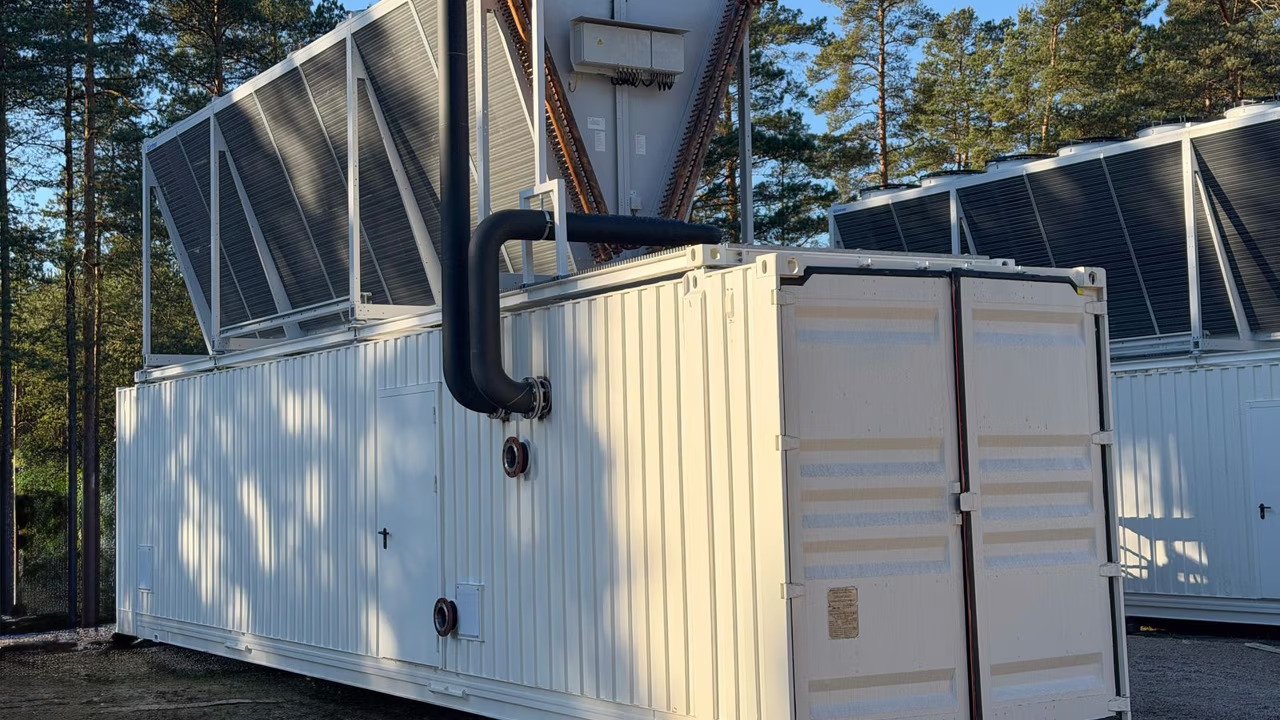
Personal Bitcoin mining device manufacturer Power Mining has developed a portable data centre that will heat towns using residual heat from Bitcoin mining.
Bitcoin mining consumes a significant amount of electricity globally eliciting significant greenhouse gas emissions and local air-pollution impacts.
In response, the sector is advocating for ways to not only reduce the energy consumption of mining but also capture waste heat from mining hardware and feed it into district heating networks or local building systems. While classical datacenters can collect heat at approximately.
At 27°C, Power Mining data centres can reach up to 65°C, providing cities with more efficient sources of heat. European data centres already make up more than 3 per cent of the continent’s total electricity consumption, which is expected to surpass 150 Tw/h annually – an equivalent of all of Poland’s electricity demands.
Up to 40 per cent of this energy is turned into heat, which most often is released into the atmosphere. If this energy were collected and redirected back to heating, it could ensure up to 10 million European households with heat.
Heat collection from data centres could become one of the most effective ways to combine digitalisation and climate goals.
In one year, one Power Mining datacenter can mine up to 9.7 Bitcoin, and heat up to 2000 homes. With 1.6MW/h in power, the datacenter achieves 95 per cent energy efficiency, thereby providing the municipality with 1.52MW/h. The data centres are built in Latvia and cost from €300,000.
Because they are assembled in a shipping container, they can be easily shipped around the world. Power Mining’s data centre is made up of eight server closets, each outfitted with 20 Whatsminer M63S++ servers that consume 10kW of electricity each, and create an equivalent amount of heat.
The servers can raise the incoming coolant temperature by 10-14°C, producing the equivalent amount of heat while mining Bitcoin.
Each server closet is equipped with warm and cool fluid collectors, which send the warmed liquid to a built-in heat pump station, where a 1.7 MW heat exchanger ensures the redistribution of heat from the data centre to the town’s heating grid.
If the heating grid does not require additional heat from the datacenter, the heated fluid is redirected to a built-in dry cooler, which adjusts the temperature to suit the servers' needs. This way, the data centre is able to cool itself, and also contributes to balancing the municipality’s heating grid.
The Latvian company’s first two datacenters, housed in shipping containers, will be shipped to a Scandinavian town, where they will be connected to the municipal heating system.
According to the Power Mining team:
“We’re truly grateful to our partners for trusting us with such an ambitious and technically demanding project.
We hope this is only the beginning — an opportunity to scale this model further and demonstrate how Bitcoin mining can strengthen a town’s heating system, reduce waste, and deliver real, tangible value for local communities.”
In addition to building over 100 Bitcoin data centres, Power Mining also builds personal- and industrial-scale Bitcoin mining hardware. Their desktop miner is one of the most widely used open-source Bitcoin mining devices globally, with over 20,000 devices shipped worldwide.


Would you like to write the first comment?
Login to post comments