

In March, Tech.eu reported on the story of “Rachel,” an AI voice agent created by AI engineer Matt Cortland to call more than 3,000 pubs across Ireland and ask a simple question: how much does a pint of Guinness cost? Using voice AI tools, Rachel successfully collected over 1,000 verified prices from pubs across all 32 counties, with most bartenders unaware they were speaking to an AI.
The story went viral, demonstrating the real-life impact of voice AI.
But beyond the price of Guiniess, voice technology is rapidly reshaping customer support infrastructure, replacing rigid phone menus and repetitive call centre workflows with conversational AI systems that can handle millions of interactions autonomously.
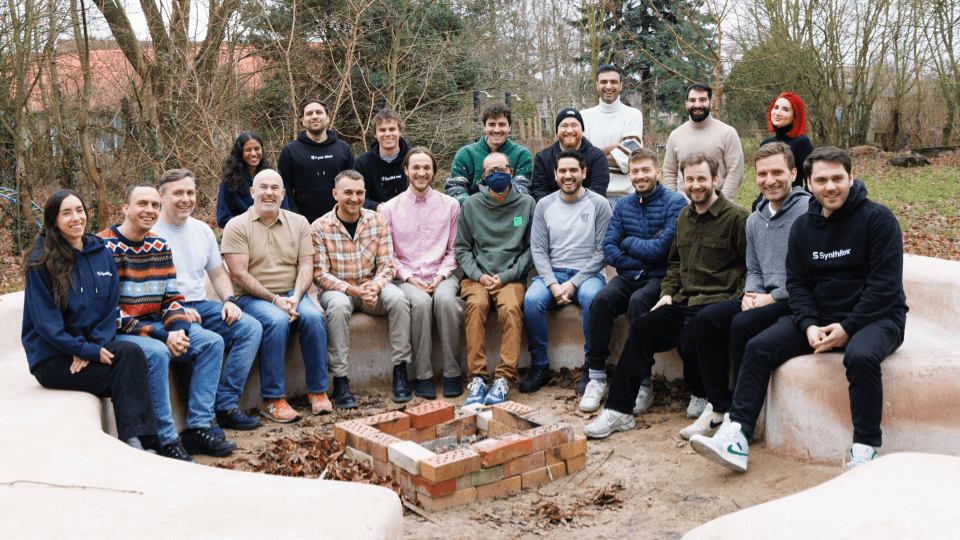
Berlin-based startup Synthflow AI is part of a new wave of companies building this infrastructure layer for enterprise communication.
Founded in 2023, Synthflow’s technology primarily automates high-volume customer phone interactions with AI voice agents that can hold natural conversations, route calls, schedule appointments, qualify leads, answer support questions, and update CRM systems in real time.
Companies deploy the system across customer support, BPO operations, healthcare scheduling, telecom, utilities, sales qualification, and public services — often replacing rigid IVR menus with conversational AI that can escalate to human agents when needed.
Its platform now handles more than 5 million calls per month for over 100+ enterprise customers globally, following a $20 million Series A led by Accel, bringing total funding to roughly $30 million.
I spoke to co-founder and CEO Hakob Astabatsyan to learn more.
The death of “Press 1 for support”
Traditional IVR systems are the familiar automated phone menus most people associate with prompts like:
“Press 1 for sales, press 2 for support.”
Modern AI-powered IVR systems replace rigid menu trees with natural, conversational interactions. Instead of navigating keypad options, callers can simply speak normally:
“I need to reschedule my appointment.” or “I’m calling about a payment issue.”
The system uses speech recognition, large language models, and workflow automation to understand intent, respond conversationally, route calls, retrieve information, and complete tasks automatically.
For example, in a healthcare clinic with multiple doctors, AI asks what you need and routes you to the right doctor.
That alone saves several minutes per call. Multiply that across thousands of calls, and you have an industry change.
Why AI voice agents are becoming the new front desk for business
According to Astabatsyan, the emergence of LLMs has fundamentally changed what these systems can do:
“With the emergence of LLMs, suddenly there’s an opportunity to make these conversations dynamic. You can interrupt the AI, change direction naturally, and flow through the conversation much more like you would with a person."
The goal isn’t to trick people into thinking they’re speaking to a human. Quite the opposite — you should clearly disclose that it’s AI. The real objective is simply to create a better experience. For many simple tasks, people actually prefer speaking to AI. If it’s something straightforward — checking a number, rescheduling an appointment for Thursday at 2 pm, or resolving a basic support issue — it’s much faster and more efficient.
"People are busy. They don’t want to wait through endless menus.
The technology is now smart enough to handle appointment scheduling, troubleshooting, support queries, and information capture. It’s not there to give life advice, but it’s highly effective for structured, repeatable workflows.”
Inside the rise of conversational IVR
The automation potential extends beyond the conversation itself. AI systems can automatically transfer information into backend business software, update customer records, and trigger workflows without human intervention.
Astabatsyan contends that what becomes really interesting is what happens after the call.
“ I think of it as RPA 2.0. The AI can take information from the conversation, update HubSpot or Salesforce, change CRM fields, and automate thousands of repetitive tasks at scale. I always try to demystify the AI side of this.
People immediately jump to ideas like Skynet or Terminator, but the reality is much more practical. The technology still has limits. But there are specific tasks it’s extremely good at, and those are ripe for automation.”
For Astabatsyan, it's about how you implement voice AI. You might say, “Hi, I’m the AI assistant. How can I help?” Then disclose it's recorded. And give the option to speak to a human. If someone insists, you transfer.
He contends, however, that the biggest use case the company sees is still human transfer, where AI acts as the first line of defence.
“There’s also a lot of noise in contact centres. People dial wrong numbers or departments. AI filters that out. In large centres with thousands of calls, even 20,000 might be misdirected. AI can deflect that.”
Initially, many in call centres were sceptical about chatbots, online banking, or voice assistants like Alexa. Further, voice cloning is now ubiquitous. Astabatsyan shared:
“Early on, we saw impersonation attempts. We built algorithms to detect and block them. But now the industry is professionalising."
In 2023, the sector was the Wild West in terms of its lack of regulation. But now there are fines for unsolicited calls. Phone numbers require identity checks.
“We also invested heavily in compliance — healthcare, GDPR, HIPAA, and penetration testing.”
Regarding the company’s success in fundraising and rapid expansion, Astabatsyan admits that speed creates challenges in hiring quickly and maintaining culture.
“Your business can grow faster than your organisation.”
“Voice is not a market — it’s a communication medium”
In terms of the future for Voice AI, Astabatsyan adds:
“Voice is not a market, it’s a communication medium. No one company will own it. The question is who you serve. For us, it’s contact centres. We want to disrupt that industry and free humans for more meaningful work.”


Would you like to write the first comment?
Login to post comments