

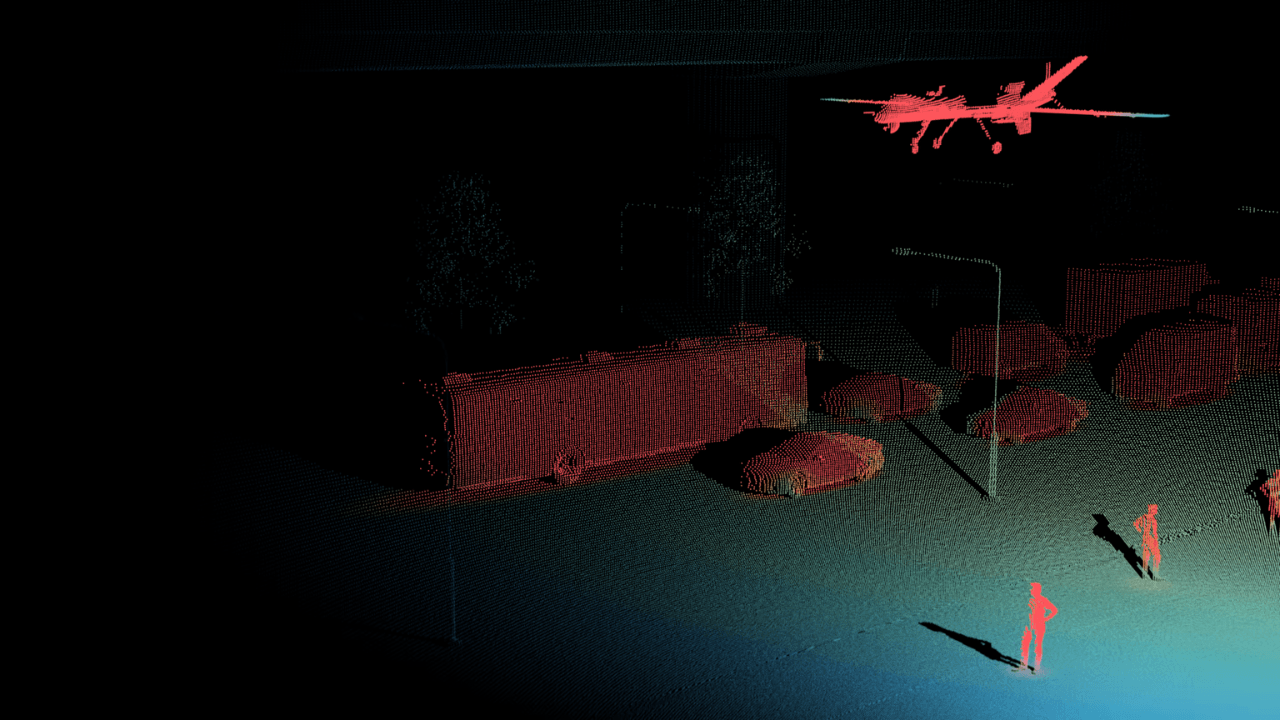
Today, Berlin startup Xavveo, a deeptech building perception technology based on a proprietary chip, is expanding to tap fast-growing drone-detection/C-UAV, infrastructure surveillance and perimeter security markets with its cutting-edge dual-use platform.
Xavveo’s move follows direct demand from high-profile customers in the defence sector. Cheap, readily-available drones are becoming a central element in modern warfare, and a major threat to Western defences. For example, Russia is launching 200+ drones per day into Ukraine - a record high.
Many drones can evade layered air defence systems, slipping through a near-field gap that conventional radar leaves wide open. Xavveo closes that gap.
I spoke to Xavveo CEO, Dr Sven Otte, to learn more.
Xavveo was founded in Berlin in 2023 by industry veterans and former founders of Sicoya, Dr Sven Otte (CEO) and Dr Stefan Meister (CTO), alongside Intel veteran Dr Ulrich Keil (VP Engineering). All brought extensive experience: Dr Otte previously held leadership roles at companies including Ametek, Amphenol, and MergeOptics, while Dr Meister previously served as head of silicon photonics at Technische Universität Berlin.
According to Otte, his background is rooted in optics and optical data communications.
“I’m an engineer by heart, with a PhD,” he explains, describing a career that began in chip design for optical data communication systems before progressing through engineering management, business development and executive leadership roles at companies including Ametek, Amphenol and MergeOptics, where he eventually ran an entire business unit for a large US corporation.
Building a new sensing architecture
The origins of Xavveo can be traced back to an earlier attempt to push silicon photonics — optical signal processing using CMOS silicon — into the market.
After being told the technology was “too early,” he co-founded Sicoya, where the team developed silicon photonic transceiver chips and modules for data centres. From there, Otte and his co-founders began exploring how silicon photonics and fibre optics could be applied beyond communications infrastructure.
Together with Meister — formerly head of silicon photonics at Technische Universität Berlin — and Keil, the team developed the idea for a new perception architecture for autonomous systems.
According to Otte, perception remains “one of the biggest problems in autonomous systems,” spanning robots, drones, unmanned vehicles and humanoid robotics, and the founders believed existing camera- and laser-scanner-based approaches could be fundamentally improved.
A new architecture for autonomous perception
Based on patented chip and system design, Xavveo offers a distinct perception architecture, rather than an incremental improvement to conventional radar. Built on proprietary photonic and fibre-based technology, it is not replicable from off-the-shelf components and delivers high-resolution, distributed sensing across any environment.
But how does it work?
Otte describes the company’s sensing architecture as resembling a tree structure. In this model, fibre optic cables act as the “trunk and branches,” while distributed sensing elements function as the “leaves” connected throughout the system. At the root sits the central compute and signal-processing unit, allowing the entire assembly to operate as “one large sensor” rather than as multiple disconnected systems.
The individual sensing components are simplified versions of traditional sensors. For example, instead of deploying full camera modules, the system uses only the underlying CMOS sensor chips.
Additional sensing modalities — including radar, infrared and acoustic sensors — can also be integrated into the same fibre-optic architecture.
“All signal processing happens centrally,” Otte explains, enabling the creation of “very large distributed sensing systems operating at very high frequencies.”
Why Xavveo pivoted toward defence
The company started initially focusing on autonomous driving. Otte explained:
“We brought fibre optics into the car and attached radar sensors around the vehicle — front, rear and sides — creating one 360-degree sensing system. The resulting sensor was really 10 to 20 times better than anything else in the market. We achieved resolutions below 0.1 degrees, which is normally something only cameras or LiDAR systems can achieve.”
This achievement is attributed to physics.
“Existing systems force you to choose between large distributed architectures operating at low frequencies or smaller systems operating at higher frequencies.
One limitation compensates for the other. What we do is combine large distributed sensing with very high frequencies. That combination creates a major performance boost.”
In terms of price comparison, conventional autonomous driving stacks typically rely on a combination of multiple LiDARs, radars, cameras, extensive cabling and separate compute systems. When compared against that full legacy sensing and compute architecture, the company’s fibre-optic system is cheaper overall.
However, the team realised it would take time to convince both the US and Chinese ecosystems to adopt an entirely new perception architecture while they’re all racing toward commercial autonomous driving deployment.
So they expanded into defence-related applications — particularly autonomous transport, logistics and perimeter protection, where the team’s team and its providence provide a competitive advantage.
As Otte shared, “Defence customers are very conscious about where technology is developed. They are much more hesitant to use US or Chinese technology.”
A distributed sensor network for modern air defence
Xavveo’s fibre-optic sensing architecture is designed to overcome limitations in traditional perimeter-security and air-defence systems, particularly for detecting small drones and low-altitude aerial threats.
Otte contends:
“We are not just building a radar company. This is a completely new perception architecture.
We’re integrating additional sensing modalities and working with platform companies across transport, drones and autonomous systems. Xavveo’s fibre-optic architecture can combine radar, infrared sensors, cameras, and acoustic sensing into a single distributed system for perimeter protection.
“Traditional radar systems were designed to detect aircraft or cruise missiles approaching from long distances. They operate at low frequencies and have poor resolution for drones. They also tend to have blind spots close to the radar because they were never designed for small drones appearing suddenly within one or two kilometres.”
Xavveo developed its PAIR-500 and PAIR-5000 systems to address this gap, enabling the detection of small aerial targets including Class 1 drones, FPV platforms and low-altitude surveillance aircraft within a 5–10km near-field range.
“Most radar systems refresh once per second or slower,” he says.
“Our systems update 20–30 times per second, allowing us to continuously track drones in real time. We can classify drones, identify drone types and distinguish drones from birds.
We can also operate effectively in urban environments where many radar systems struggle to separate drones from surrounding buildings or infrastructure.”
The platform’s distributed design allows it to scale across environments without introducing a single point of failure, while also reducing false alarm rates compared with conventional perimeter-security radar systems.
Crucially, the system is far less vulnerable to conventional radar jamming because it operates at uniquely high frequencies that are not currently used by other systems in these applications.
“Traditional radar technologies struggle at those frequencies because conventional printed circuit boards and copper interconnects cannot handle them effectively. Fibre optics can.”
The ability to operate without GPS or 5G
The system can continue to operate even in degraded communication environments. Otte explained:
“We are not dependent on GPS or 5G. If connectivity exists, that’s helpful because it allows multiple systems to share information and build a connected operational picture.
It also helps retrain our neural networks in the cloud. But if connectivity disappears, the systems continue operating autonomously. They only need power.”
Xavveo is currently in discussions with defence and aerospace organisations, including stakeholders seeking more effective means of detecting and classifying small unmanned aerial systems.
The company now employs ≃50 people and has raised funds from investors including Vsquared Ventures and imec.xpand.


Would you like to write the first comment?
Login to post comments