

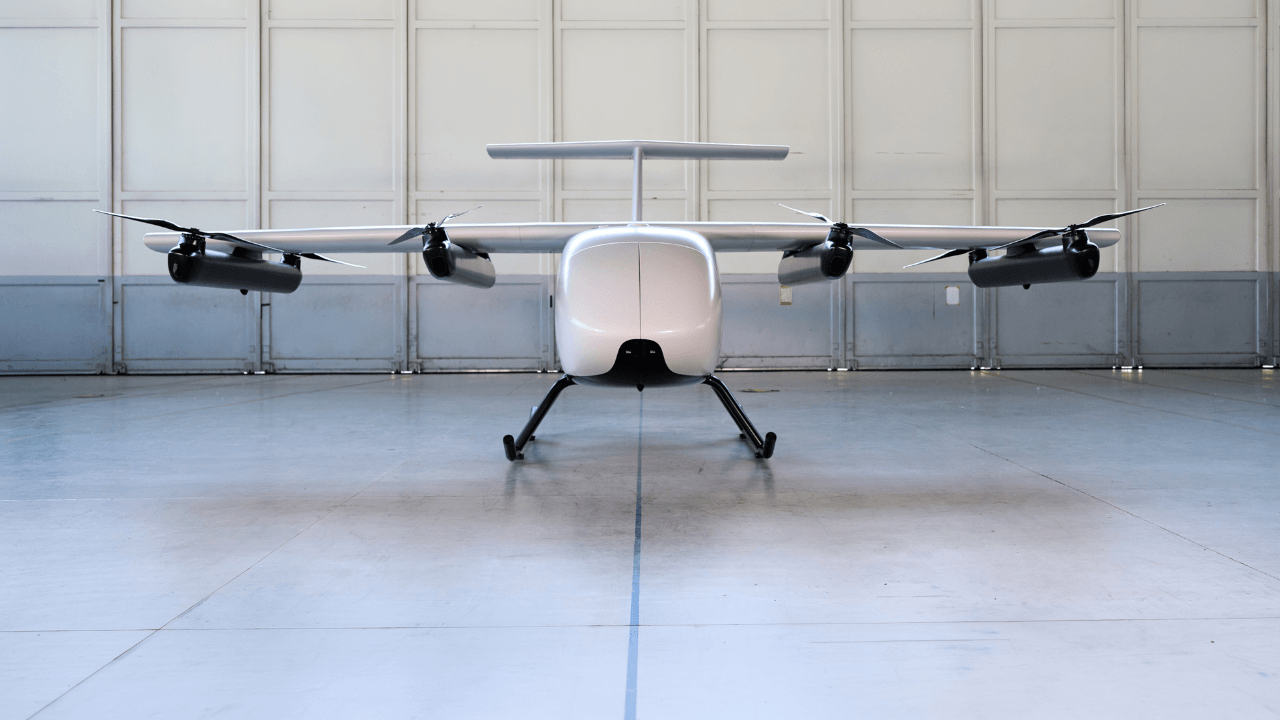
Munich EVTOL company ERC System today announces the launch of “Victor”, a dual-use heavy-lift cargo UAS (Uncrewed Aircraft System) designed for critical missions in fields such as defence, commercial logistics, and disaster response.
Presented publicly at ILA Berlin 2026, Victor aims to close a military capability gap through a scalable, deployable solution for infrastructure-independent, uncrewed aerial logistics capable of carrying payloads over 200 kg.
I spoke to Maximilian Oligschläger, ERC’s Chief Commercial Officer, to learn more.
From medical air mobility to military logistics
Founded in 2020, ERC System develops electrified aviation solutions for critical missions.
The company’s hybrid-electric aircraft take off vertically like helicopters, but fly forward wing-borne, like aeroplanes. They provide high speeds, long ranges, and cost-efficient operations for cargo, patient, and passenger transport as well as uncrewed utility applications.
Victor builds on ERC’s experience designing, building, and flying some of the European Union’s largest electrified aircraft, positioning the company for commercial entry in 2028.
ERC’s product portfolio includes Victor, an uncrewed hybrid-electric lift-and-cruise eVTOL aircraft designed for logistics missions, and Charlie, a crewed eVTOL developed for patient and passenger transport. Victor is scheduled to enter service in 2028, with Charlie expected to follow in 2030.
Check out our earlier interview with ERC System CEO Dr David Löbl.
Through its Charlie programme, ERC has already developed and tested multiple full-scale, full-mass prototypes.
Before Victor, there was the full-size, full-mass prototype Romeo, in which the company began flight testing its full-size Romeo prototype in November 2025.
Operated remotely in an uncrewed configuration, Romeo has a take-off weight of approximately 2.7 tonnes and is believed to be the heaviest uncrewed eVTOL currently flying in the EU, based on publicly available information.
It follows the earlier Echo demonstrator, which validated core capabilities such as controlled lift-off and stable hover while providing valuable system-level data for subsequent aircraft development.
According to Oligschläger:
“When we first came out of stealth, and people saw what we were building, we were approached by various defence stakeholders. They found the technology interesting because, just like in the civilian market, an eVTOL aircraft can operate at low cost."
He explained that for military users, low maintenance requirements and the ability to fit into containers are also very important.
“At the same time, with everything happening politically, we started asking ourselves how we could contribute using the technology we were already developing.
We realised we were in a strong position to build such an aircraft. Development costs are significantly lower than for a crewed aircraft, which meant Victor could reach the market around three years earlier.”
Targeting Europe's missing logistics capability
Victor is designed to address a critical gap in defence logistics recognised across Europe.
While small drones can carry payloads below 50 kg and crewed aircraft can transport larger loads, there is currently no widely available, cost-effective uncrewed platform capable of delivering payloads exceeding 200 kg over long distances at high speed. This leaves military operators with few options when ground transport is blocked, and crewed flights are considered too risky.
Designed for infrastructure-independent operations, Victor can transport up to 250 kg of payload over distances of up to 300 kilometres at a cruise speed of 250 km/h.
Its hybrid-electric lift-and-cruise architecture combines vertical take-off and landing with efficient wing-borne flight, enabling access to austere locations while delivering greater speed, range and cargo throughput than conventional multicopter systems.
The aircraft can carry up to two pallets and perform cargo-drop deliveries, eliminating the need to land in hostile or otherwise unsuitable environments.
Oligschläger explained that “Victor also benefits from everything we've already built. And so will Charlie as the next step. We use the same suppliers, the same production approach and, in many cases, the same customer relationships.”
Further, because Victor is fully uncrewed, its development costs are substantially lower than those of a crewed aircraft, enabling the company to bring the platform to market around three years earlier.
Victor’s operating costs are also approximately 70 per cent lower than those of a small helicopter, according to Oligschläger.
“When customers buy an aircraft, they look at lifetime operating costs rather than purchase price alone. We can’t disclose exact figures, but both acquisition and operating costs are significantly lower than those of comparable helicopters,” he said.
Dual-use logistics, civilian certification
ERC has set 2028 as the target for first deliveries, a challenging goal only few European companies would be able to achieve.
“We are confident about our timeline, given our 6-year experience building some of the heaviest electrified aircraft in the EU,” Oligschläger explained.
“Combined with strategic partnerships, particularly focused on industrialisation, we believe we have the capabilities to help close the gap quickly.”
With Victor, ERC System is pursuing a civil certification pathway that can also be recognised by military operators. The platform is initially focused on logistics missions, including transporting spare parts, equipment and supplies to remote or hard-to-access locations. In the longer term, it could also support casualty evacuation missions — without the cost and risk of a crewed aircraft.
Beyond defence logistics, ERC sees early demand across offshore and coastal logistics, critical infrastructure maintenance, remote industrial operations, and emergency response.
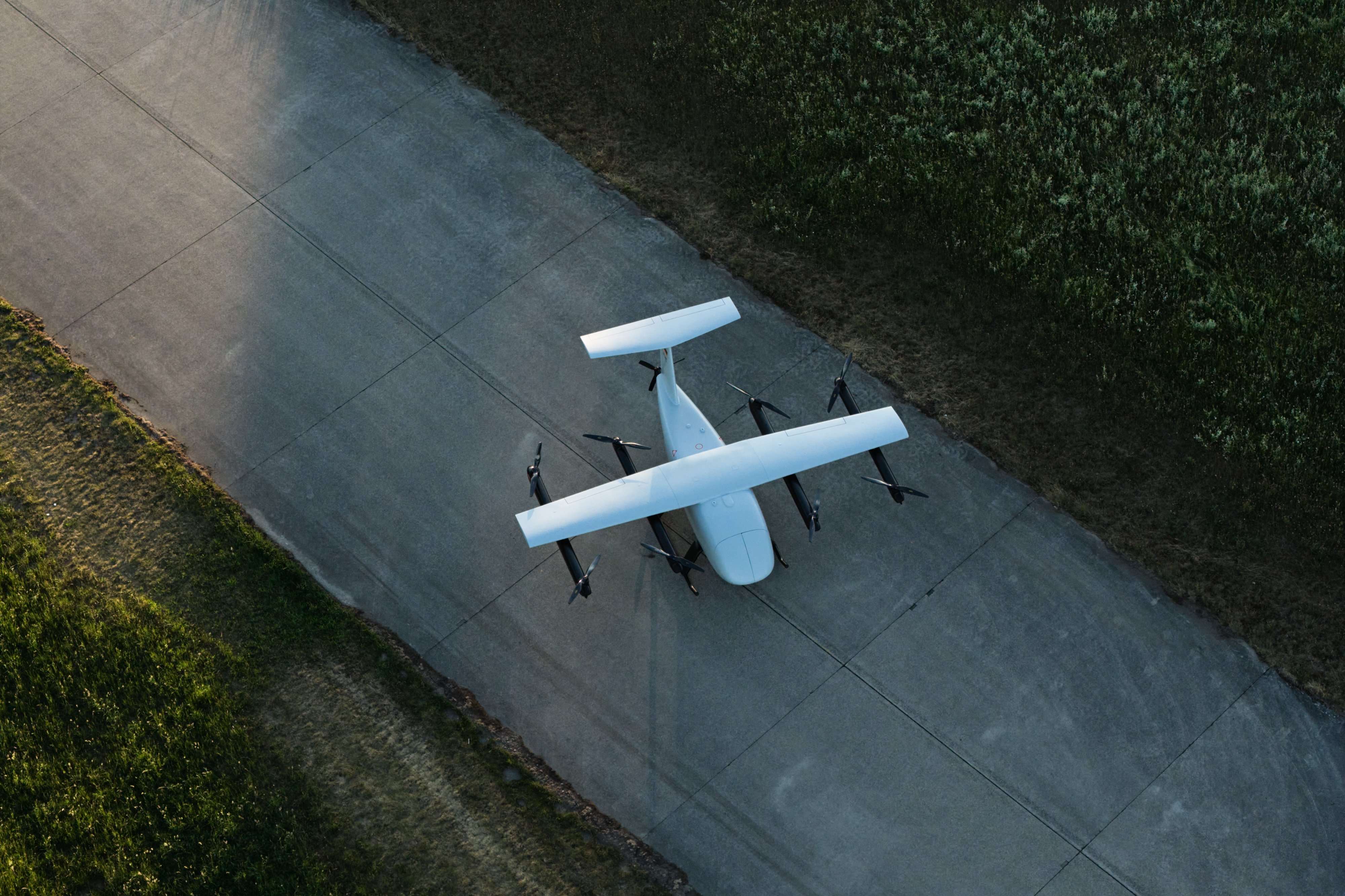
Many of the organisations already working with ERC System on its Charlie platform could also become Victor customers.
In terms of defence, most missions are expected to take place behind the front line rather than directly in combat zones, but operating in contested environments still raises challenges, particularly around GPS jamming, spoofing and other forms of electronic warfare that can disrupt navigation and communications.
The company has therefore had to consider how the aircraft can maintain reliable operations in environments where satellite navigation cannot be assumed.
According to Oligschläger, Victor already has some characteristics that help. It's capable of flying at around 250 kilometres per hour which allows it to reduce exposure to certain threats.
“At the same time, Victor needs to remain affordable. It's a logistics asset. We don't want it to be as expensive as a helicopter. In a worst-case scenario, operators must be willing to lose the aircraft without losing a massively expensive platform.”
“The European eVTOL industry is not dead”
The 2010s saw a wave of enthusiasm around eVTOLs, which were widely touted as the future of urban mobility, regional air travel, and cargo transport. However, the demise of German eVTOL pioneers like air-taxi companies Volocopter and Lilium highlighted just how difficult it is to develop, certify, manufacture and finance an entirely new class of aircraft.
Oligschläger argues, however, that the setbacks faced by some high-profile air taxi ventures should not be mistaken for a broader failure of the technology. Instead, he believes the market is maturing, with demand increasingly concentrated around practical, mission-driven applications.
“The most important thing is that the European eVTOL industry is not dead. Victor is the first product where I've genuinely felt strong product-market fit. Customers are approaching us asking when it will be available rather than needing to be convinced why they need it.
That changes the dynamic completely. It doesn't feel like we're pushing technology onto the market. Instead, we're responding to a capability gap that customers have already identified for themselves.”
Oligschläger attributes ERC Systems’ success to a number of factors:
“First, we started later. Companies such as Lilium and Volocopter had to prove the technology itself. Today, customers already understand the potential.
Second, we brought in strategic investors early. IABG contributes expertise as well as capital.
Third, we've focused on critical missions that already exist today, such as patient transport and military logistics. These are services that society already depends on.”
Further, Victor is a stepping stone towards Charlie. Rather than jumping immediately to a large crewed aircraft, its building experience, production capability and customer relationships gradually. Oligschläger acknowledges that the industry has learned some hard lessons.
“There have been a lot of lessons learned. We initially wanted to build a fully electric aircraft, but we shifted to a hybrid-electric approach because we realised range and speed still matter. An aircraft with limited endurance and lengthy charging times simply isn't practical for many of the use cases we're targeting,” he said.
“The uncrewed eVTOL sector is still a relatively new market that has only really emerged in the last few years. Before that, most companies were focused on crewed eVTOLs.”
Meanwhile, smaller uncrewed VTOL aircraft are demonstrating strong commercial and operational momentum in mission-critical applications. Companies such as Wingcopter, which specialises in medical and cargo deliveries, and Quantum Systems , whose aircraft are used for intelligence, surveillance and reconnaissance (ISR) missions, have shown that there is significant demand for VTOL platforms where they solve clear operational problems.
Building Europe's eVTOL ecosystem
More broadly, though, Europe has lacked the same level of government support that we've seen in the United States. Oligschläger asserts:
“Policymakers didn't fully appreciate the importance of building this industry early enough. I've spent a lot of time talking with both German and European politicians. I ask them a simple question: do we want this industry in Europe?
Because if we don't actively support it, we risk losing it to the United States and China.”
ERC Systems wants the government to help foster an ecosystem of innovation and successful commercialisation:
“This isn't just about funding companies. Building an industry means creating regulations, training pilots and operators, establishing maintenance networks and creating an ecosystem around the technology.
The US has been much more proactive in saying, "We want this industry, and we're prepared to support it."
The positive thing is that this is starting to change. Over the last few months, we've seen growing political recognition of the opportunity.
Competition is healthy. We need multiple successful companies if we're going to build a sustainable industry.”
From here, ERC System’s goal is to enter service by 2028. It’s currently focused on manufacturing, suppliers, and potential construction sites, and, together with its investor, IABG, is evaluating where and how it should build the aircraft.
“We're not vertically integrated. We won't manufacture every component ourselves. We source major systems and focus on assembly, which makes scaling more manageable,” shared Oligschläger.
Whether ERC System can deliver on its ambitious 2028 timeline remains to be seen. But as Europe looks to strengthen both its industrial base and defence capabilities, the market for autonomous heavy-lift aircraft appears far more tangible today than the air-taxi dreams that once dominated the conversation.


Would you like to write the first comment?
Login to post comments