

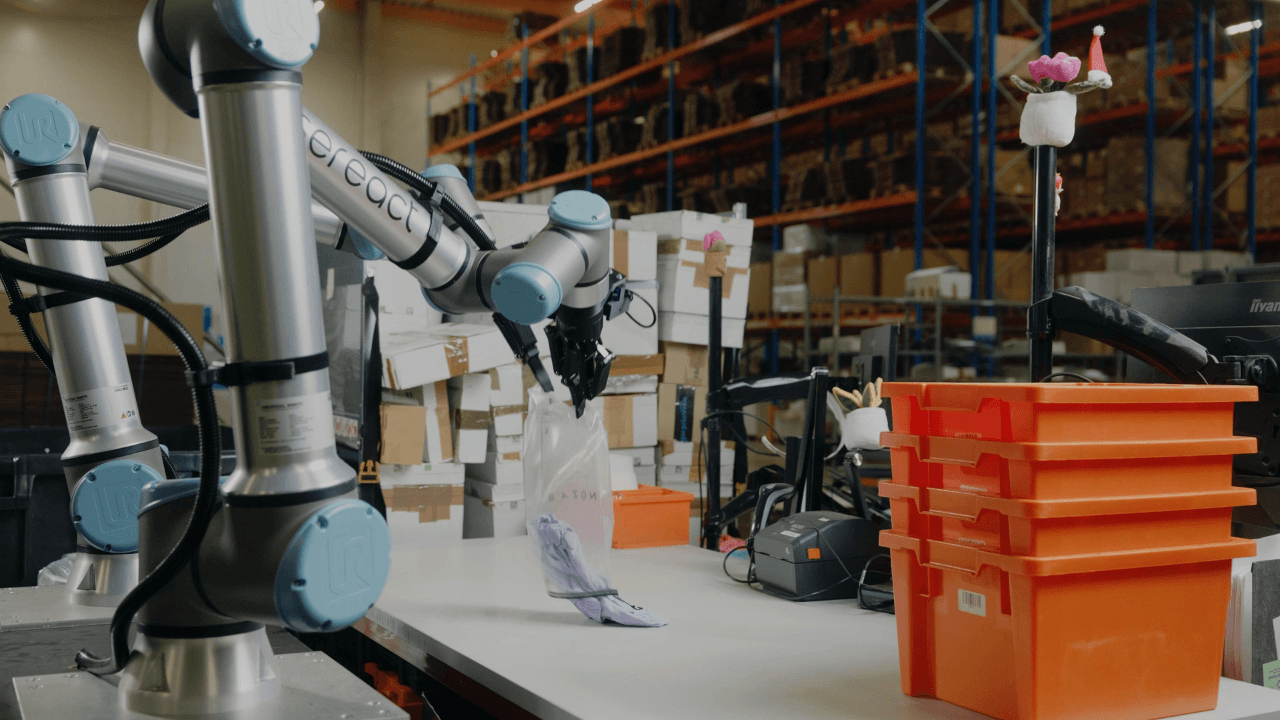
Sereact, a provider of physical AI for warehouse robotics, today announced that Zalando, Europe’s leading technology platform for fashion and lifestyle, has joined its ongoing Series B round as a strategic investor. The total Series B funding grows to $116 million.
The Series B financing round was originally led by Headline in April 2026, with participation from Bullhound Capital, Daphni, and Felix Capital, as well as returning investors Air Street Capital, Creandum, and Point Nine.
I spoke to CEO and co-founder Ralf Gulde to learn all about it.
Sereact builds physical AI for warehouses and manufacturing. Its Cortex brain spans single-arm picking cells, dual-arm return stations, humanoid robots, and Sereact Lens, a 3D perception system for inventory and quality control.
Founded in 2021, headquartered in Stuttgart. Customers include Daimler Truck, Mercedes-Benz, BMW, MS Direct, Ikea, Active Ants, DeltiLog, Rohlik Group, and Austrian Post.
Why Zalando invested
With Zalando's participation, Sereact has now raised over $145 million to date.
Founded in Berlin in 2008, e-commerce fashion and lifestyle platform, Zalando connected 62 million active customers with more than 7,000 brands across 29 markets, with operations built on a unique AI-powered data and infrastructure platform.
By joining as a strategic investor, Zalando recognises the potential of Sereact's Cortex technology and its role in the future of fulfilment automation.
According to Gulde, as often happens after a successful financing round, many investors reached out. Upon speaking with Zalando, they recognised a major strategic opportunity, particularly in packing and returns handling.
For an e-commerce company like Zalando, efficiently processing both outbound orders and returns is critical for customer satisfaction.
Germany, for example, has one of the highest rates of fashion over-shipping, with items eventually returned because customers often order multiple sizes or styles before deciding what to keep.
According to Zalando, around 50 per cent of items ordered are returned. Returns are a huge operational challenge in ecommerce because items coming back from customers have to be unpacked, inspected, folded and processed, and today that's still largely manual work.
Further, explained Gulde, “in Europe, retailers generally can't simply destroy returned goods, so everything has to be handled efficiently.“
Sereact has developed a dual-arm robotic system that can open boxes, remove items, fold garments and process returns automatically.
“We're currently the only company offering this level of automation,” explained Gulde.
That made the opportunity very compelling for Zalando. "
"We're delighted that Zalando is now a strategic investor. That's a strong signal to the market: companies that focus on operational excellence believe in our technologies.“
As a strategic investor, Zalando is committed to supporting Sereact's growth and development. Masood Choudhry, SVP Fulfilment, Zalando, shared:
“This strategic investment underscores Zalando’s commitment to supporting European technology companies, driving industry innovation, and shaping the standards of modern e-commerce.”
Why warehouse robotics is finally scaling
While robotics and automation have been instrumental to Industry 4.0 innovation over decades, many startups have languished with pilots – even successful ones – that failed to commercialise.
According to Gulde, the biggest difference now is that customers are now expanding deployments.
“Ultimately, robotics has to deliver measurable value through cost savings and operational improvements. The breakthrough came from better AI models.
After the transformer architecture emerged and ChatGPT demonstrated what was possible, we built what we called PickGPT in early 2023 — the first commercially available vision-language-action model.
These models dramatically improved the ability to translate what a robot sees and senses into physical actions. Since then we've continued improving the models, culminating in Cortex 2.5.
But as important as the models themselves is the data. Frontier research matters, but collecting real-world data matters even more.”
The data flywheel behind Cortex
Sereact’s technology is already demonstrating significant market impact, with over 200 systems currently live across Europe and more than one billion real production picks successfully completed on the Cortex platform.
Cortex acts as a universal AI operating system that can run across multiple hardware forms — from single-arm picking cells and dual-arm returns stations to humanoid robots. Sereact’s intelligence level has created a data flywheel by deploying robots with real customers, so every robot contributes valuable real-world data back into its central robotics brain, Cortex.
Gulde explained:
“Large language models had a huge advantage because they had the internet as a training dataset. Physical AI doesn't have that luxury.
We've now collected more than one billion picks. Every successful pick, every edge case and every new environment strengthens the model.”
While many robotics companies rely heavily on simulation or laboratory environments, he believes robots need to learn in the environments where they'll actually operate.
“That's why we deliberately started with a relatively simple task: single-arm warehouse picking. After deploying more than 200 robots and collecting hundreds of millions of picks, we expanded into increasingly complex use cases. Rather than trying to solve everything at once, we move from one use case to the next, allowing the model to generalise gradually.
Our long-term vision is a general robotics brain that can operate across many different tasks and many different robot form factors.”
Regarding the cost of robotics versus workers, Sereact offers customers a price guarantee based on the per-return cost.
In most regions, Sereact-embedded robotics is around 30 per cent more cost-effective than manual processing.
From reactive robots to robots that plan ahead
The enormous dataset Sereact has accumulated is also enabling the next generation of its robotics brain. As with the rest of the Series B, the additional capital will fund the scaling of Cortex 2.0, the next generation of Sereact's robotic brain, and further international expansion.
The upcoming Cortex 2.0 model shifts robotic automation from a "try-and-see" to a "plan-and-try" approach by using a learned world model to anticipate physical outcomes, score potential trajectories for risk and efficiency, and plan movements before the robot even acts.
Gulde explained:
“Imagine you're unpacking groceries. You have eggs, a bag of chips and a bottle of water. You instinctively know not to put the heavy bottle on top of the eggs because you understand how the physical world works. Humans constantly predict the consequences of their actions."
Sereact robots can now do something similar. Before acting, they simulate multiple possible futures internally. They evaluate different action sequences, predict the likely outcomes, rank those possibilities and then choose the sequence with the highest probability of success.
Why Sereact isn't betting on humanoid hype
During our interview, Gulde showed me an injured foot caused by a walking humanoid robot.
He remains more cautious about hyped aspects of robotics, such as legged humanoids, noting that they are expensive, technically fragile, and battery-constrained.
“Walking, manipulating objects, balancing and carrying loads simultaneously is technically very challenging.”
Further, industrial customers don't actually care what a robot looks like. They want something reliable that works every day for 10–15 years, delivers a strong return on investment and is safe.
In terms of household usecases, he admits,“I wouldn't want a 100–150 kilogram humanoid operating around my dog if the software failed and the robot tipped over. That's why our current systems combine dual robotic arms with mobile wheeled platforms. They're safer, proven, can't fall over, have larger batteries and are much more practical.”
Also, in Europe, you can't simply deploy legged humanoids commercially yet because they still need to meet the EU's CE marking and machinery safety requirements, and the regulatory framework for humanoid robots is still evolving.
Gulde asserts:
“If a serious accident happens anywhere in the industry, it could damage public confidence across the entire robotics sector.”
The road to a general robotics brain
Sereact opened its first US office in June in Boston. Over the next year, further North American expansion is a major priority for the company.
“It's a huge unified market, and we want to deploy many more robots there,” explained Gulde.
While Sereact’s overall ambition remains to build a general robotics brain, Gulde retains a sense of realism by following a milestone-based approach.
This year, the company launched a dual-arm returns-handling product and wheeled humanoid systems for retail replenishment and shelf management.
“Those products were only possible because of all the data we gathered from earlier deployments.
Once we've deployed those systems at scale, the next step is to move into much more contact-rich tasks, such as assembly. I don't think today's models are quite ready for that yet, but with more data they will be.”


Would you like to write the first comment?
Login to post comments